Kinetiq’s Elysium launched its mainnet on November 9, 2026, according to reporting published that day. The Layer 2’s central proposition is not simply faster execution: it aims to give applications more room to operate around Hyperliquid’s existing trading infrastructure, particularly its spot order book.
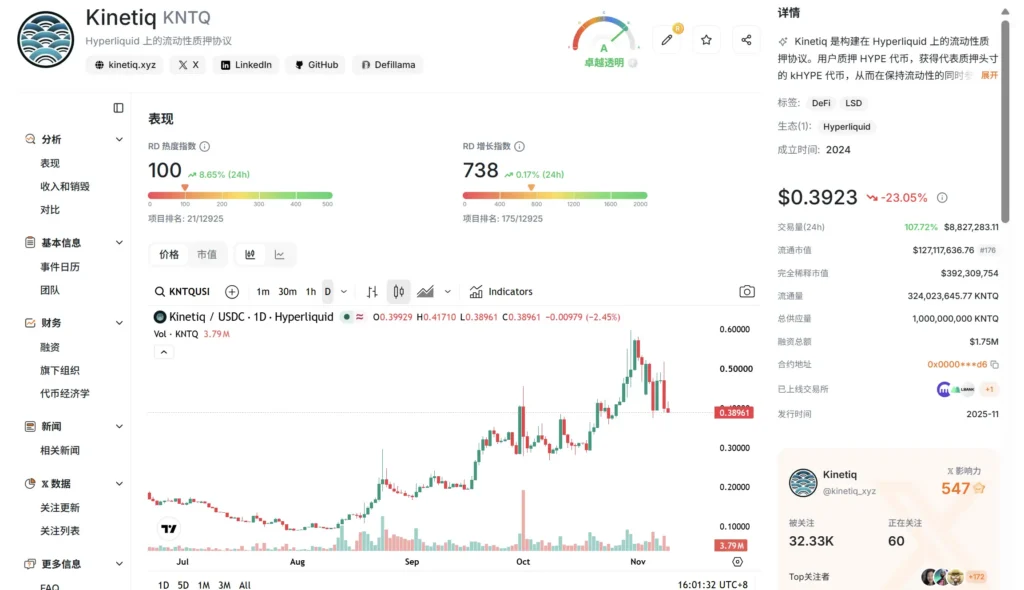
Kinetiq is already active in the Hyperliquid ecosystem as the issuer of the liquid-staking token kHYPE. At the time of the report, its total value locked exceeded $1.2 billion, and its products extended beyond staking to institutional staking, yield and trading services. That existing position helps explain Elysium’s focus, but does not establish that the new chain will attract sustained trading activity.
The proposed route from issuance to trading
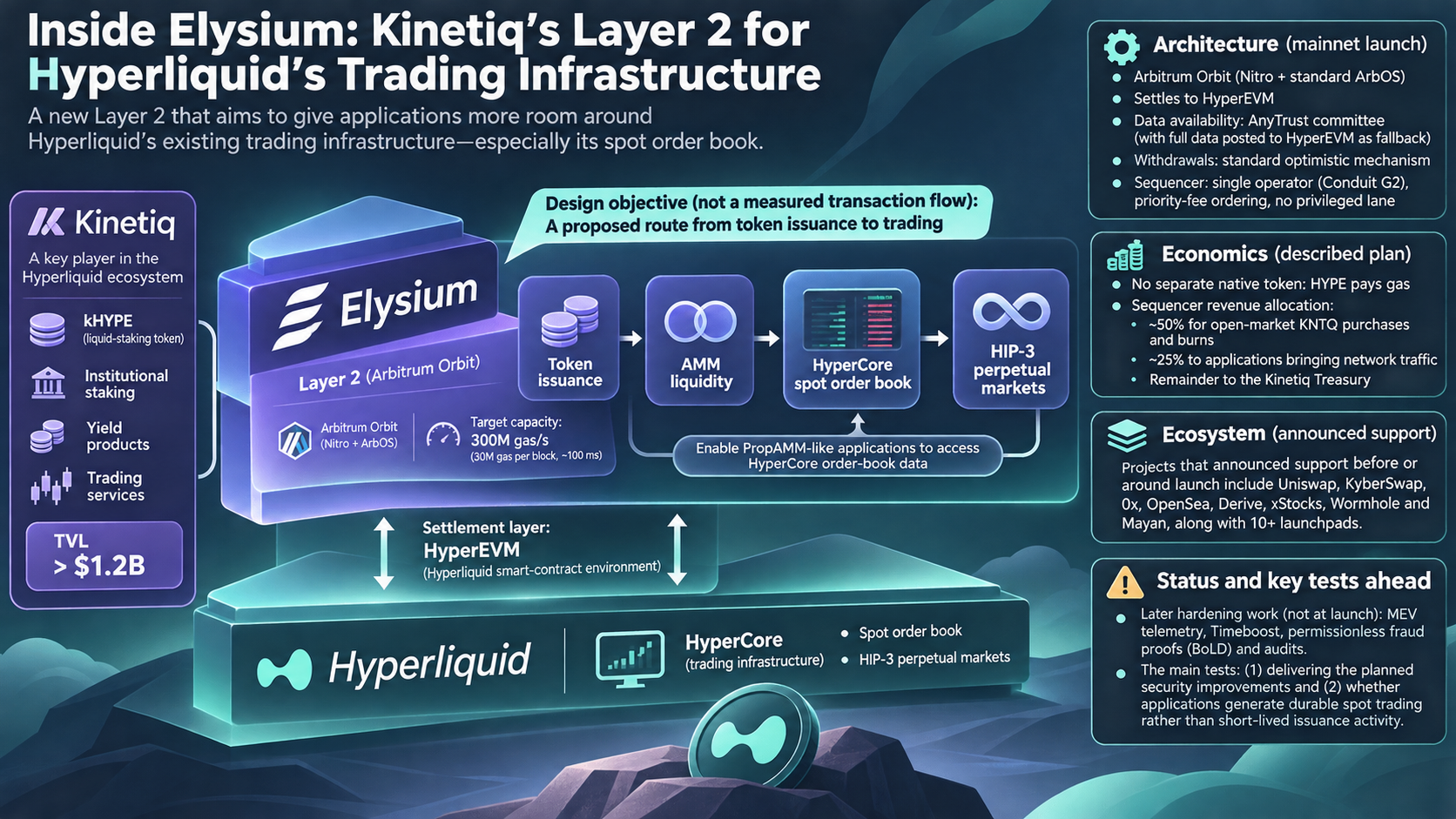
The reported design connects token issuance and automated-market-maker liquidity with HyperCore’s spot order book and, potentially, HIP-3 perpetual markets. It also aims to let applications resembling proactive automated market makers access HyperCore order-book data. The research question is whether that route can improve spot-market activity, rather than merely create another venue for token launches.
The original report described Hyperliquid spot activity as weak relative to its perpetuals business. Citing on-chain monitoring data without naming a dataset or measurement window, it said Hyperliquid spot volume relative to Binance had reached a 15-month low and HIP-2 activity its lowest level since the fourth quarter of 2024. It also reported that PropAMM-led spot volume on Solana was more than 30 times HyperCore spot volume, while Robinhood Chain reached roughly 10 times that volume. Those comparisons lack enough methodological detail in the supplied report to treat them as independently reproducible benchmarks.
What the architecture does—and does not yet prove
Elysium uses Arbitrum Orbit technology, including Nitro and standard ArbOS, with HyperEVM—the Hyperliquid smart-contract environment—as its settlement layer. The stated performance target is 300 million gas per second, with 30 million gas per block and an approximately 100-millisecond block interval. Elysium’s team compares that target with roughly 30 million gas per 60 seconds on HyperEVM and describes a 600-fold difference. This is a comparison of stated capacity figures, not evidence of observed application throughput.
The reported data-availability design uses an AnyTrust committee, with full data posted to HyperEVM as an automatic fallback; withdrawals follow a standard optimistic mechanism. At launch, Elysium has one sequencer, operated using Conduit’s G2 infrastructure, with priority-fee ordering and no privileged transaction lane. MEV telemetry, Timeboost, permissionless fraud proofs based on BoLD, and audits were listed as later hardening work—not protections already delivered at launch. The report says the underlying sequencer architecture meets SOC II Type 2 security standards; it does not establish that every component of Elysium has been independently certified or audited.
The economic test
Elysium has no separate native token or points program; HYPE pays gas fees. Under Kinetiq’s disclosed plan, approximately 50% of sequencer revenue would fund open-market KNTQ purchases and burns, about 25% would go to applications bringing network traffic, and the remainder would enter the Kinetiq Treasury. These are described allocations, not evidence of realized revenue or sustained buybacks. The report said KNTQ rose as much as 30% on the day the news was announced, without providing a trading dataset.
Projects announcing support before or around launch included Uniswap, KyberSwap, 0x, OpenSea, Derive, xStocks, Wormhole and Mayan. The report also counted more than ten launchpads announcing testnet participation and thousands of tokens created there. Announced integrations and token creation show interest, but neither measures lasting liquidity or users. The report estimated that launchpads and meme-token infrastructure made up much of an ecosystem of nearly 30 projects.
Elysium therefore has two distinct tests ahead: whether its technical roadmap delivers the planned security improvements, and whether applications generate durable spot trading rather than short-lived issuance activity. Kinetiq has also warned that purported Elysium tokens, presales and points claims are suspicious, given its stated no-token, no-points policy.