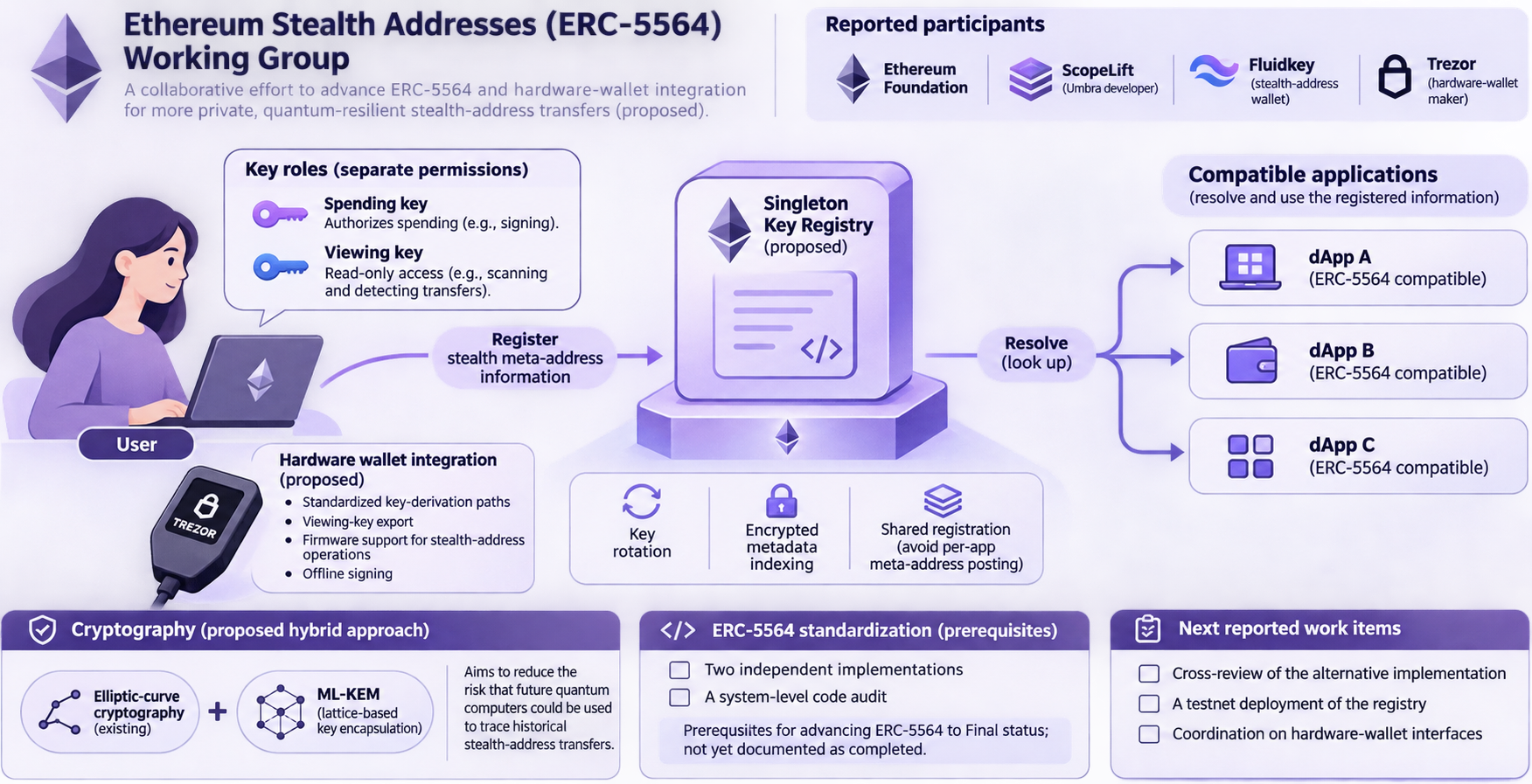
As reported on November 18, 2026, Ethereum Foundation privacy researcher Pierre announced a stealth address working group focused on ERC-5564 and hardware-wallet integration. The reported participants include the Ethereum Foundation, Umbra developer ScopeLift, stealth-address wallet Fluidkey and hardware-wallet maker Trezor. The group plans to meet every two weeks.
Standards and cryptography
The group proposes a hybrid approach combining existing elliptic-curve cryptography with ML-KEM, a lattice-based key-encapsulation mechanism. Its stated aim is to reduce the risk that future quantum computers could be used to trace historical stealth-address transfers. This is a proposed upgrade, not a deployed protection.
The group also intends to build an independent, production-grade reference implementation. The report describes two independent implementations and a system-level code audit as prerequisites for advancing ERC-5564 to Final status; it does not document their completion.
Shared registration and device support
A proposed mainnet Singleton Key Registry would give compatible applications a common way to register and resolve stealth meta-address information. The design calls for separate spending- and viewing-key permissions, key rotation and encrypted metadata indexing, rather than requiring users to publish a meta-address separately in each application.
With Trezor, the group plans to standardize hardware-wallet key-derivation paths and viewing-key export, alongside firmware support for stealth-address operations and offline signing. These are integration goals, not demonstrated device capabilities in the supplied report.
The next reported work items are cross-review of the alternative implementation, a testnet deployment of the registry, and coordination on hardware-wallet interfaces. No test results, audit findings or deployment date were provided.