A sufficiently capable quantum computer could, in theory, derive a private key from an exposed elliptic-curve public key. For Ethereum, the hard question is not only which cryptography could replace today’s signatures. It is how accounts, validators and applications could move to new security assumptions without losing control of existing assets.
In an assessment published on November 19, 2026, imToken described Ethereum’s post-quantum work as a long-term engineering effort. It reported that protocol priorities published in September 2026 set a December 2029 target for post-quantum resistance across Ethereum L1’s execution, consensus and data layers. That is a stated engineering goal, not a completed upgrade or a guarantee that every part of the ecosystem will be secure by that date.
Where the risks differ
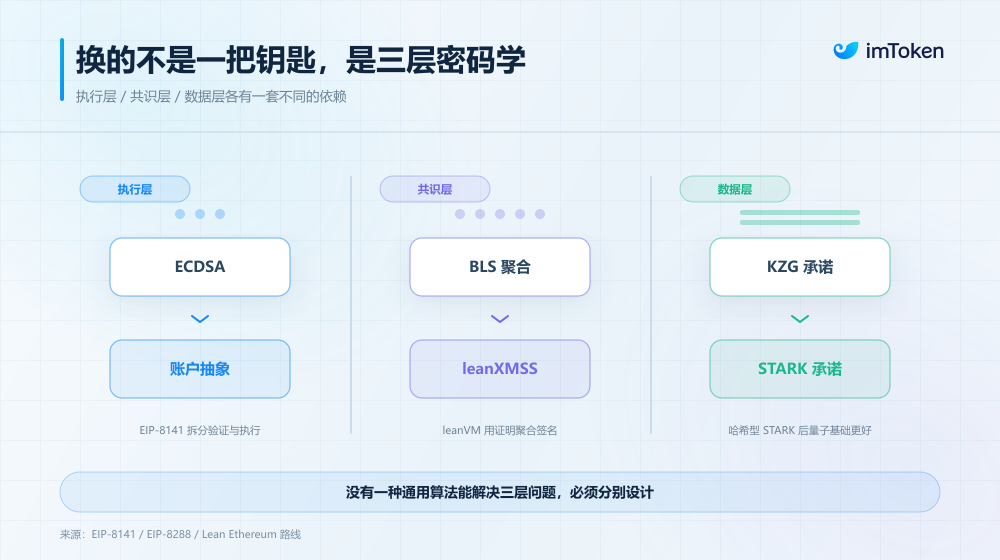
Ethereum uses cryptography for several distinct jobs. Ordinary externally owned accounts (EOAs) use ECDSA signatures; proof-of-stake validators use aggregatable BLS signatures. KZG polynomial commitments support blob-related data verification, while some rollup proof systems also rely on assumptions involving elliptic curves.
A fault-tolerant quantum computer running Shor’s algorithm could theoretically undermine the elliptic-curve assumptions behind ECDSA and BLS. If an attacker could derive a private key, they could forge a signature without obtaining a wallet’s seed phrase. Validator keys, multisignature controls and bridge keys would face related concerns. This is a prospective threat: the assessment says no quantum computer currently has the capability to break these cryptographic systems in practice.
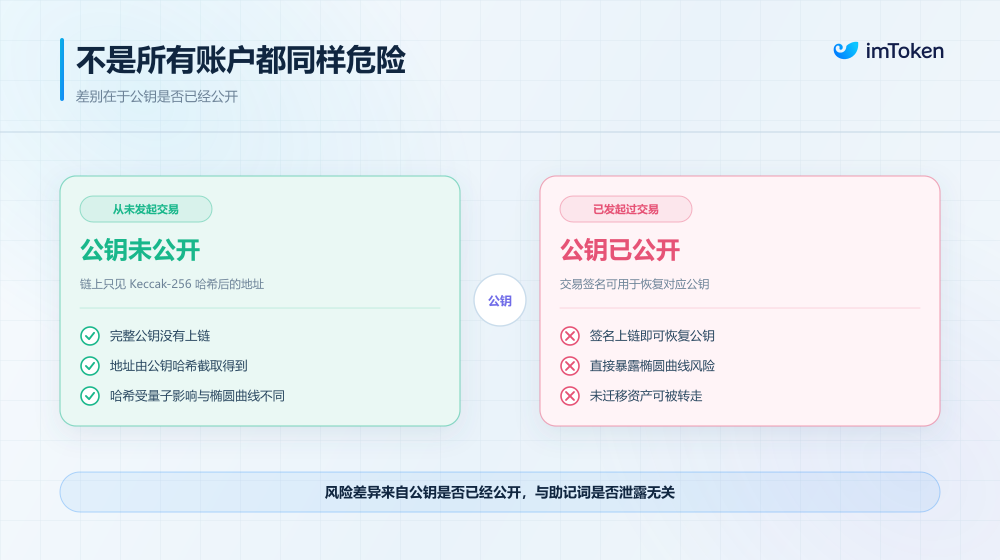
Exposure also differs between accounts. An Ethereum EOA address is derived from a hash of its public key. If an account has never sent a transaction and its public key has not otherwise been disclosed, its address alone does not reveal that key. A publicly recorded transaction signature, by contrast, allows the public key to be recovered. Hash functions such as Keccak-256 have different quantum-security properties: Grover’s algorithm offers a square-root speedup, rather than Shor’s attack on the elliptic-curve problem.
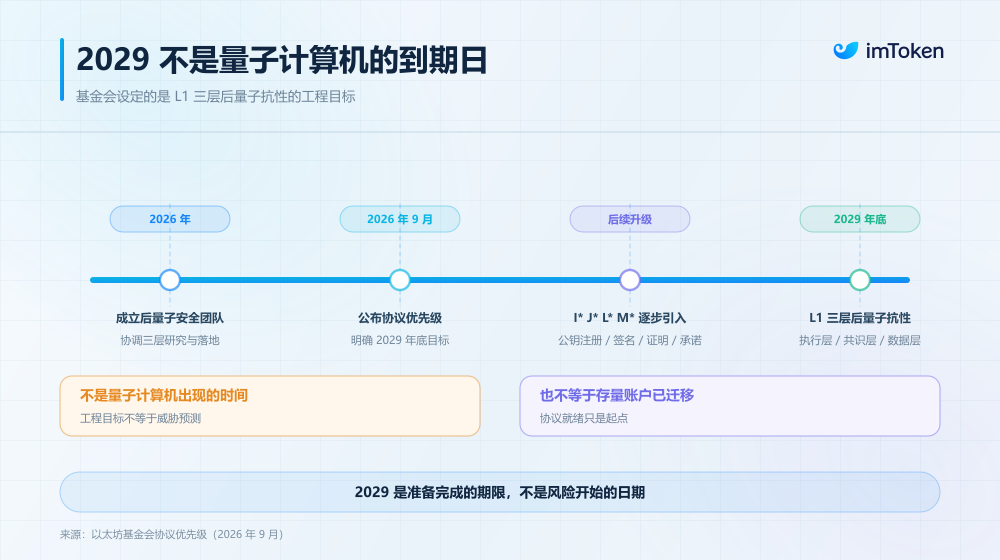
Three layers of proposed change
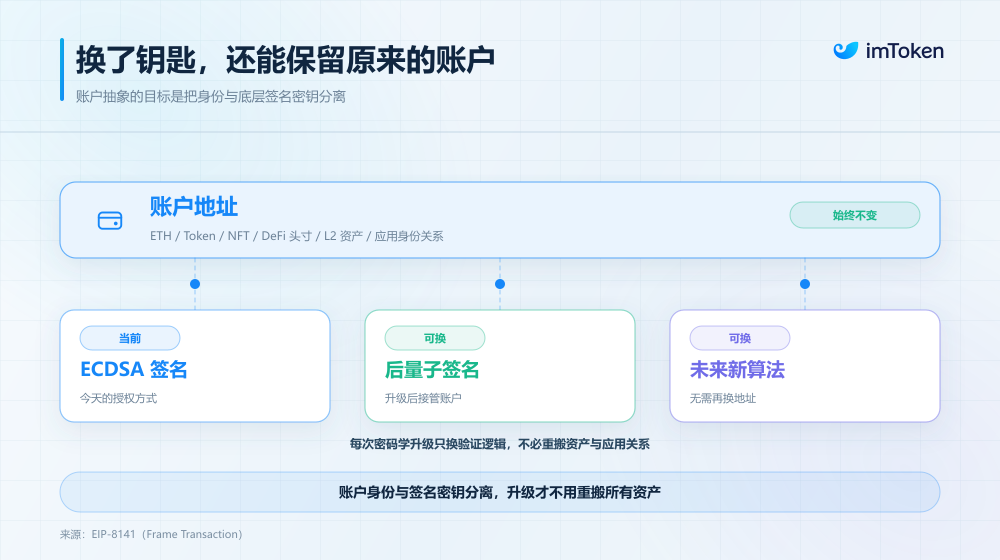
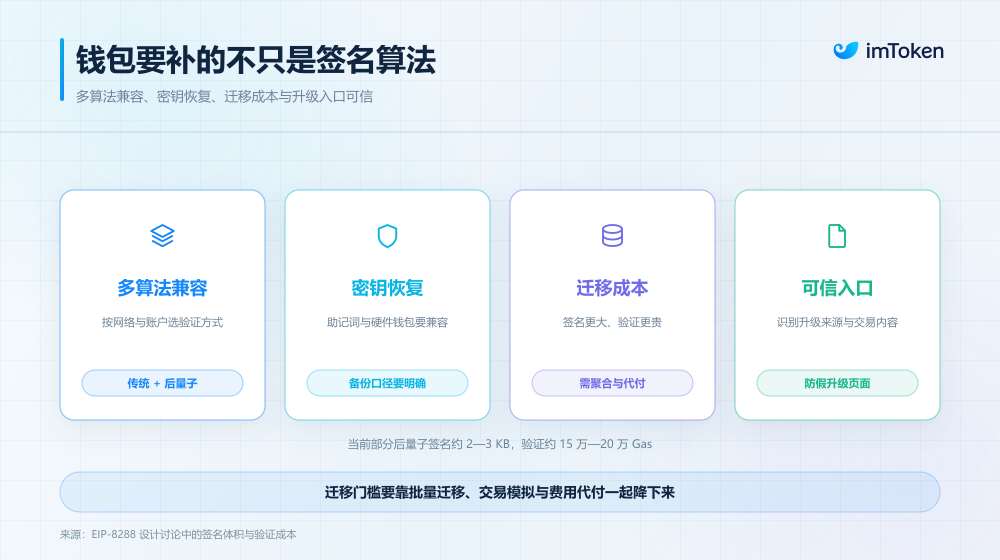
Execution and accounts. imToken points to native account abstraction, particularly EIP-8141, as a route toward separating transaction validation, execution and gas payment. Programmable validation could allow an account to change its authorization rules instead of remaining permanently tied to one ECDSA key. Post-quantum signature-verification precompiles are also under study. Because post-quantum signatures can be much larger than current signatures, the assessment identifies EIP-8288’s proposed use of recursive STARK aggregation as one possible way to reduce on-chain verification and data costs. These are design directions, not capabilities that all existing EOAs already possess.
Consensus. Replacing BLS is not a straightforward signature swap: its aggregation helps Ethereum handle validator votes efficiently. The Lean Ethereum directions described by imToken include leanXMSS, a hash-based signature approach proposed for validators, and leanVM, intended to aggregate post-quantum signature verification into compact proofs. Whether a replacement can preserve acceptable propagation, storage and verification costs remains an engineering question.
Data and proofs. KZG commitments depend on elliptic-curve pairing assumptions, so data-availability infrastructure also needs consideration. Some pairing-based SNARKs face related questions; hash-based STARKs avoid dependence on the elliptic-curve discrete-logarithm assumption. A credible migration would therefore extend beyond L1 accounts to the proof systems and applications that depend on them.
The account-continuity constraint
For a traditional EOA, adopting an unrelated post-quantum key may mean moving to a new address. That can be more complicated than transferring ETH: an address may also be associated with tokens, NFTs, DeFi positions, L2 assets and application-specific permissions or history. Programmable accounts could, in principle, retain an address while changing its validation logic, but that possibility should not be mistaken for a universal migration path for existing accounts.
Timing matters. While an old key remains secure, its owner could authorize a change to new validation rules. If the old signature scheme has already become forgeable, a valid-looking signature would no longer reliably distinguish the owner from an attacker. Dormant accounts, lost keys and owners who never upgrade raise a further unresolved question: whether assets should remain under the old rules or face measures such as a freeze. imToken presents that choice as contested, not settled policy.
The assessment’s practical conclusion is restrained. It does not call for users to move assets immediately because of quantum computing. The nearer design challenge is to build verifiable, safe migration paths—without making purported “quantum safety” upgrades themselves an opportunity for seed-phrase theft or malicious approvals.