A Chainalysis report published on November 11, 2026, examines a market for proxy services that resell access to overseas AI models. Its on-chain finding is narrower than its broader account of that market: wallet activity associated with China rose around major US model releases, but aggregate transactions cannot establish what customers did with the access they purchased.
What the survey and payment data show
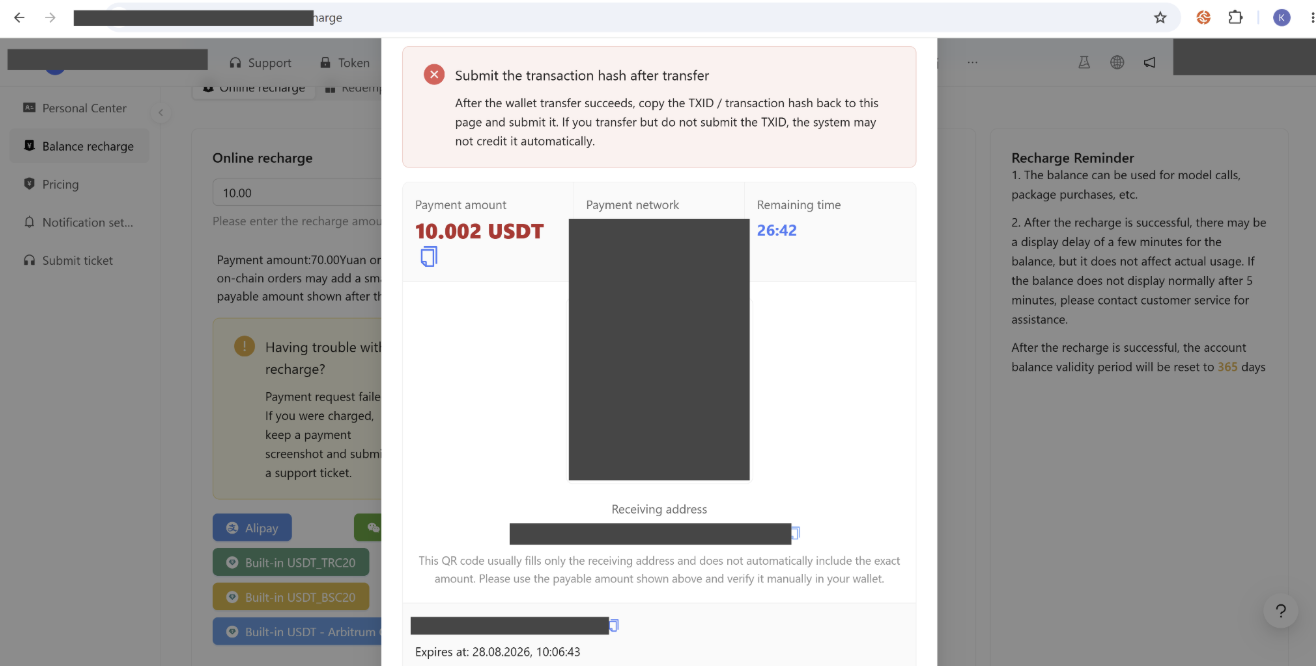
Chainalysis surveyed 100 AI proxy platforms and found that 40% accepted cryptocurrency payments, predominantly in stablecoins. A proxy routes a customer’s request to a model provider rather than having the customer connect directly. In an account-top-up interface captured in August 2026, one surveyed platform offered Alipay and WeChat payments alongside USDT deposits on TRC20, BSC and Arbitrum.
The report says proxy operators commonly use third-party custodial crypto payment processors instead of receiving customer deposits directly into their own wallets. That arrangement places another intermediary between the payer and the operator. Chainalysis also reports that wallets paying AI proxies were concentrated in mainland China, with activity in Japan, Hong Kong, Singapore and South Korea.
The model-release pattern—and its limit
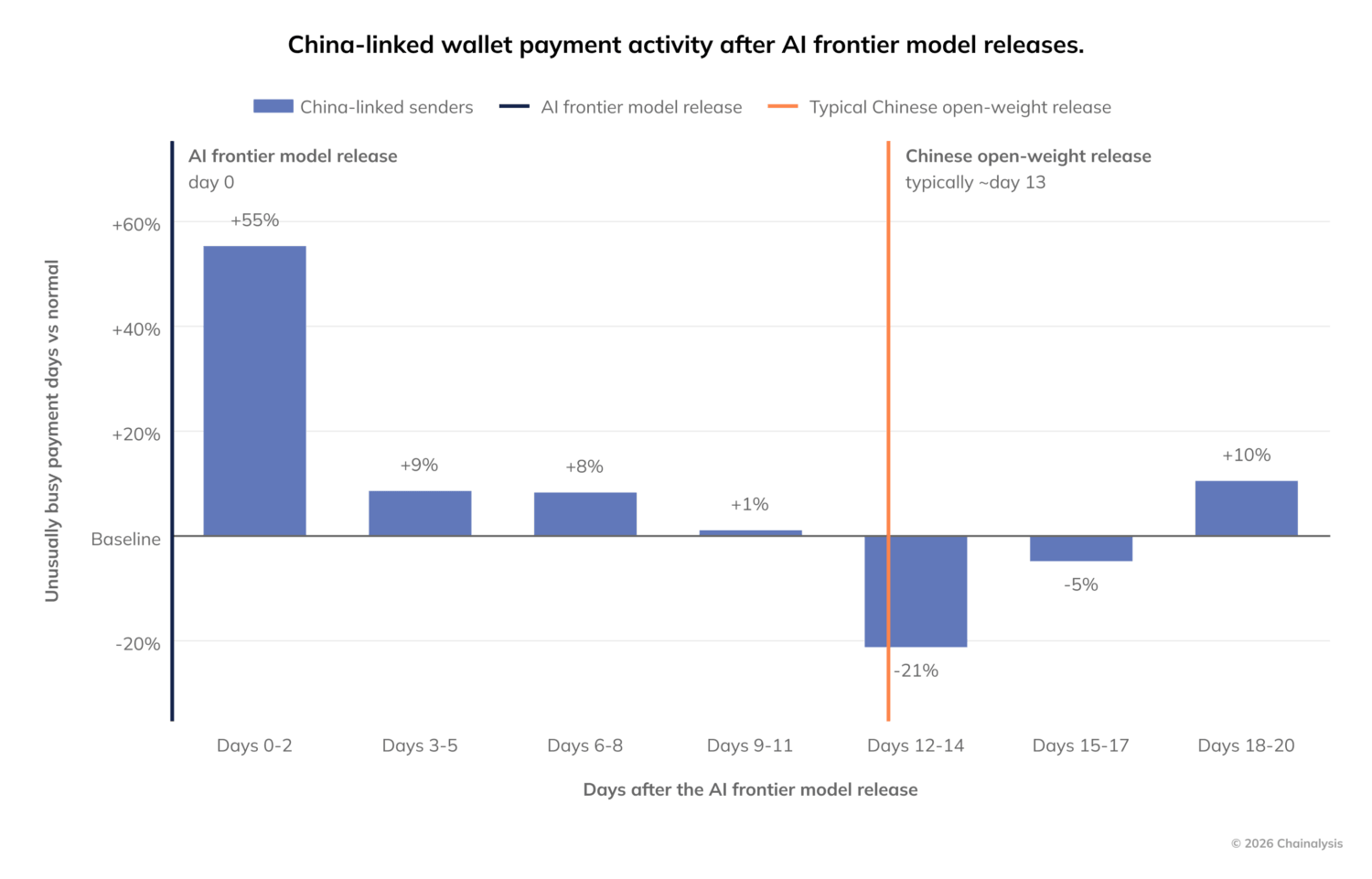
Chainalysis compared payments from wallets it identified as suspected China-linked wallets with a normal activity baseline around US frontier-model releases. During days 0–2 after a release, their payment activity was 55% above baseline. Around day 13, it was 21% below baseline. The report says the initial rise also exceeded the average for other wallets, but the supplied account does not provide the underlying transaction counts or wallet-attribution method.
The timing is consistent with increased demand for new-model access through proxies. It does not show which model a particular payment bought, whether the buyer used it for ordinary inference or training, or whether any specific payment supported model distillation—the use of one model’s outputs to train another. Chainalysis explicitly cautions that aggregate on-chain data cannot identify the conduct behind each transfer.
The report discusses the possibility that proxy access could be used for distillation. Separately, it cites Anthropic’s allegation that DeepSeek, Moonshot and MiniMax used proxy services and 24,000 false accounts to extract capabilities from Claude. That allegation should not be treated as a conclusion established by Chainalysis’s payment data.
For on-chain research, the distinction matters: the survey documents available payment methods, while the wallet analysis identifies a release-timed transaction pattern. Neither alone measures how much restricted-model access occurred or establishes the purpose of individual purchases.