Originally reported by Decrypt on November 13, 2026, at 04:36 UTC+8. The signature scheme and wallet settings discussed below were proposals or considerations at that time, not enacted Bitcoin rules.
A proposed route to post-quantum Bitcoin signatures would give wallets a choice between smaller signatures that demand careful bookkeeping and larger signatures that avoid that particular risk. For hardware-wallet makers, the question is not only which cryptography Bitcoin might adopt, but whether a device can use it safely.
The signing trade-off
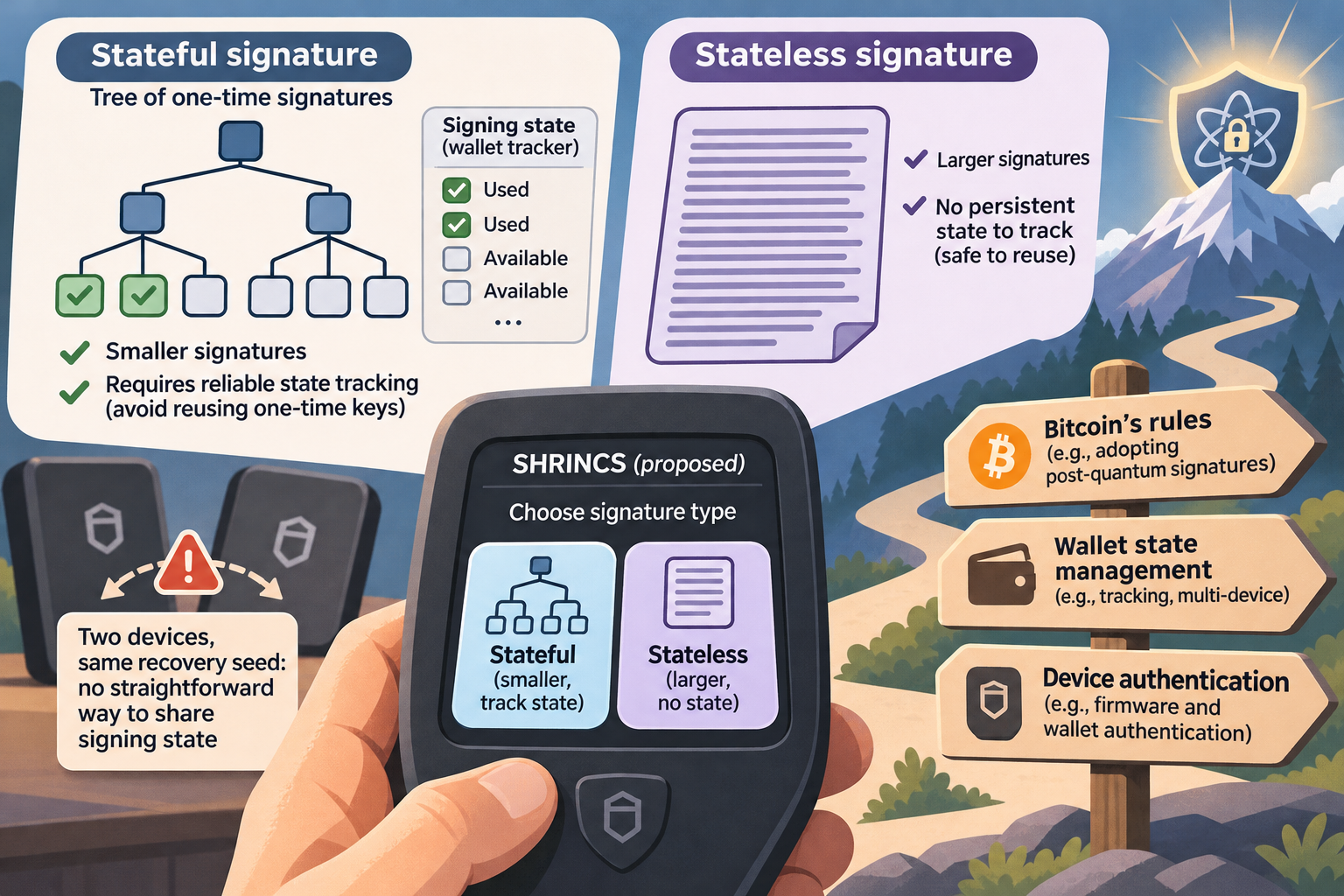
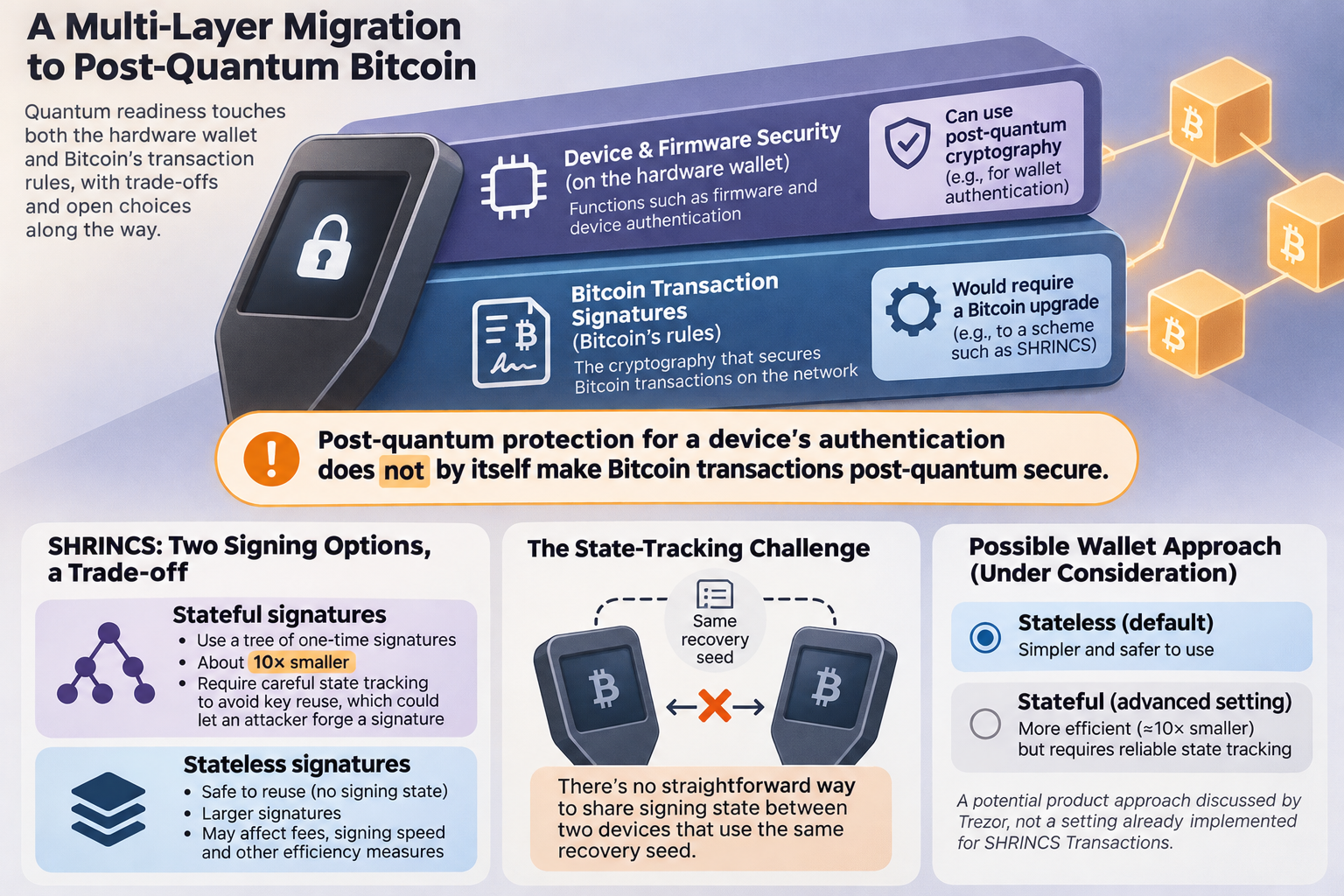
SHRINCS, proposed in 2025 by Blockstream Research Director Jonas Nick and cryptographer Mikhail Kudinov, combines stateful and stateless hash-based signing options. Its stateful component uses a tree of one-time signatures. According to Trezor CTO Tomáš Sušánka, reusing keys beyond their signing budget could reveal enough cryptographic information for someone else to forge a signature and steal funds. Preventing reuse requires a wallet to track its signing state reliably.
Stateless signatures do not carry that reuse constraint, but they are larger and may affect fees, signing speed and other efficiency measures. Sušánka said the stateful signatures are 10 times smaller. He described SHRINCS as a potentially conservative cryptographic choice because it relies on the same assumptions as SHA-256, while stressing that maintaining state is a burden.
That burden becomes concrete when two Trezor devices share a recovery seed: Sušánka said there is no straightforward way to share signing state between them. Trezor was considering making stateless signatures the default and placing the stateful option behind an advanced setting. This was a possible product approach, not a setting already implemented for SHRINCS transactions.
The device is part of the migration
Sušánka also distinguished transaction signatures from a device’s own security functions. Signing devices commonly use cryptography vulnerable to quantum attacks for functions such as firmware and device authentication. Decrypt reported that Trezor Safe 7 already supports post-quantum cryptography for wallet authentication, but transactions made with it would not become quantum-secure on that basis alone: Bitcoin itself would also need to adopt post-quantum transaction security.
The unresolved work therefore spans Bitcoin’s rules, wallet state management and hardware authentication. Sušánka argued against delaying migration options, saying that moving potentially millions of users would take time. Neither SHRINCS adoption nor a timetable for that migration was established in the report.