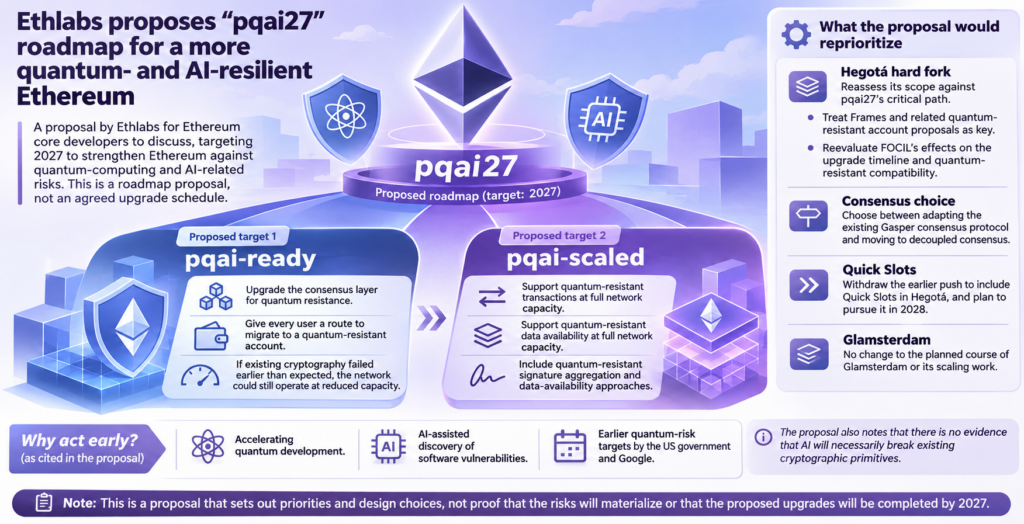
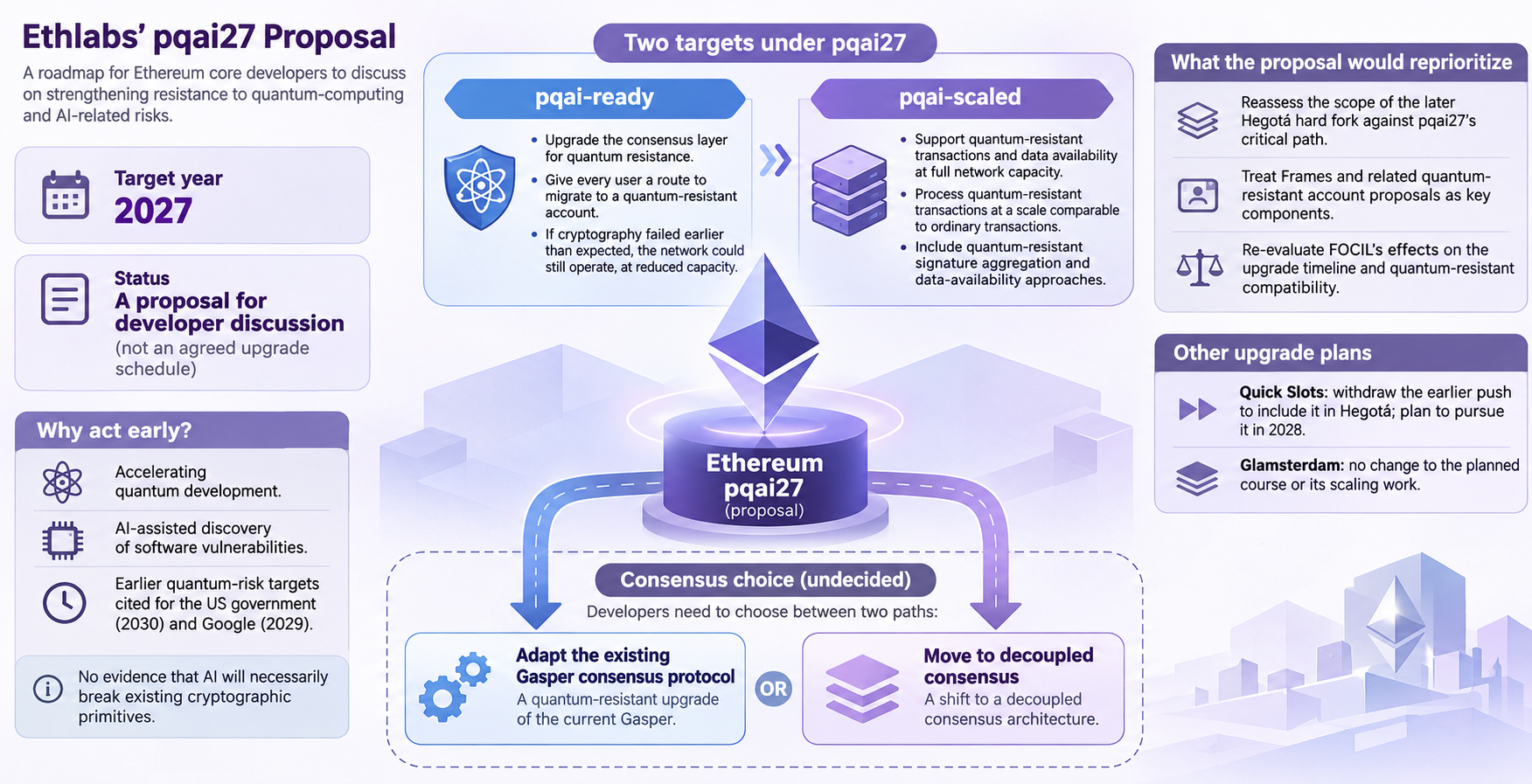
Ethlabs has proposed 2027 as a target year for making Ethereum more resistant to quantum-computing and AI-related risks. It calls the proposal “pqai27.” As reported by ChainCatcher on November 12, 2026, at 11:07 a.m. UTC+8, this is a roadmap for Ethereum core developers to discuss, not an agreed upgrade schedule.
Two different targets
Ethlabs divides the work into “pqai-ready” and “pqai-scaled.” Under its proposal, pqai-ready would mean upgrading the consensus layer for quantum resistance and giving every user a route to migrate to a quantum-resistant account. If existing cryptography failed earlier than expected, the network would still be able to operate, though at reduced processing capacity.
Pqai-scaled is the more demanding goal: supporting quantum-resistant transactions and data availability at full network capacity, with quantum-resistant transactions processed at a scale comparable to ordinary transactions. Ethlabs includes quantum-resistant signature aggregation and data-availability approaches in that work. The distinction matters: a network that can continue operating at reduced capacity has not necessarily solved the problem of scaling quantum-resistant activity.

What the proposal would reprioritize
Ethlabs recommends reassessing the scope of the later Hegotá hard fork against pqai27’s critical path. It treats Frames and related quantum-resistant account proposals as key components, while calling for another look at FOCIL’s effects on the upgrade timeline and quantum-resistant compatibility. Developers would also need to choose between adapting the existing Gasper consensus protocol and moving to decoupled consensus.
Ethlabs says it will withdraw its earlier push to include Quick Slots in Hegotá and plans to pursue that feature in 2028. It proposes no change to the planned course of Glamsterdam or its scaling work.
The case for acting early rests on uncertain risks. Ethlabs points to accelerating quantum development, AI-assisted software-vulnerability discovery, and earlier quantum-risk targets cited for the US government and Google. It also acknowledges that there is no evidence that AI will necessarily break existing cryptographic primitives. The proposal therefore sets out priorities and design choices, not proof that those risks will materialize or that the proposed upgrades will be completed by 2027.
Source: chaincatcher.com (originally published 2026-11-12 11:07 UTC+8)