Historical report: Deep Tide TechFlow published the original article on November 10, 2026, at 20:53 (UTC+8). The figures and plans below reflect that reporting, not a current implementation status.
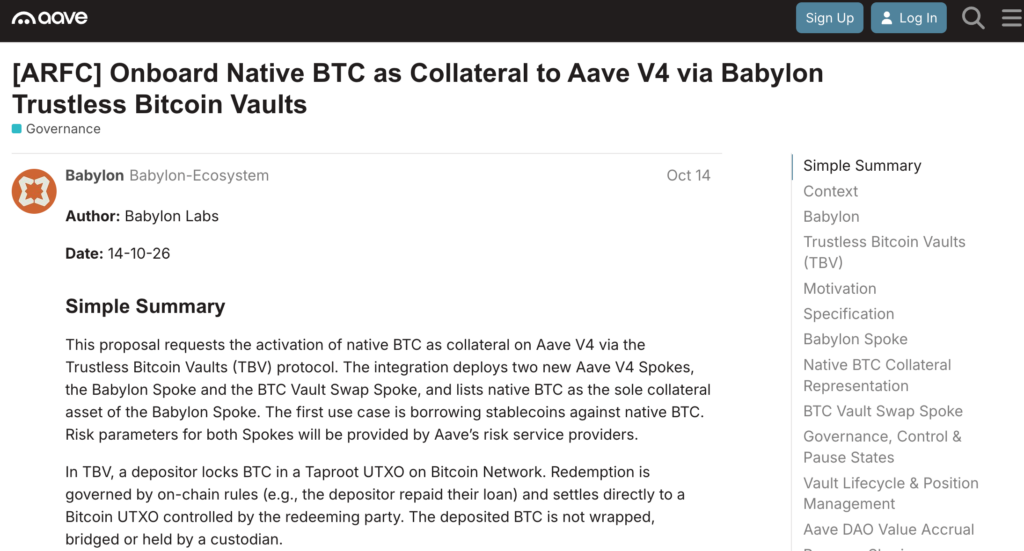
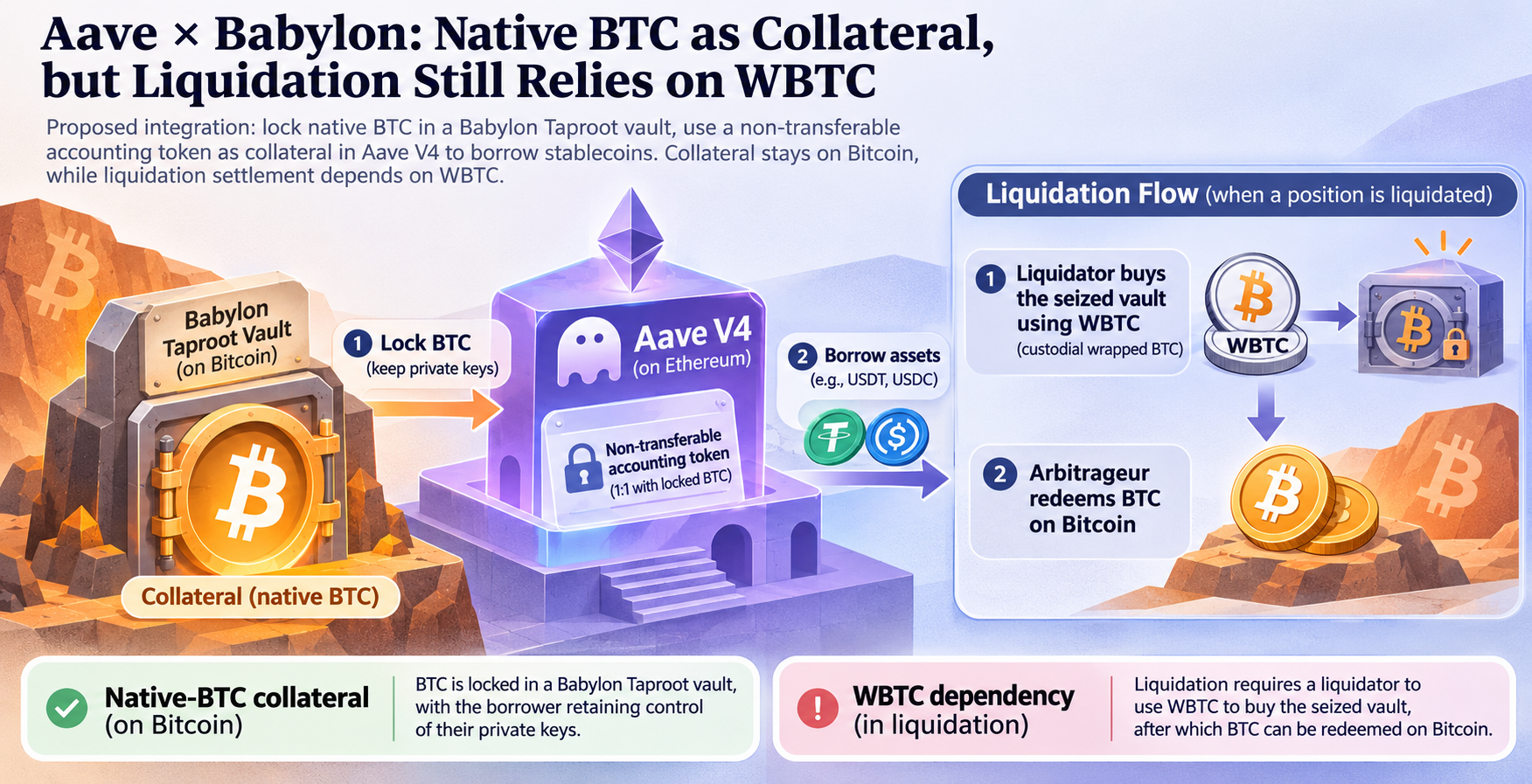
On November 9, 2026, Aave DAO’s ARFC-stage vote on a Babylon integration received 100% support, according to a Babylon announcement cited by TechFlow. The proposal would let borrowers lock native BTC through Babylon’s trustless Bitcoin vaults and use it as collateral in Aave V4 to borrow assets including USDT and USDC. The vote was not the final authorization: the proposal still had to proceed to an AIP, Aave’s on-chain execution vote. Its stated mainnet target was the end of 2026, with participation and capacity initially restricted.
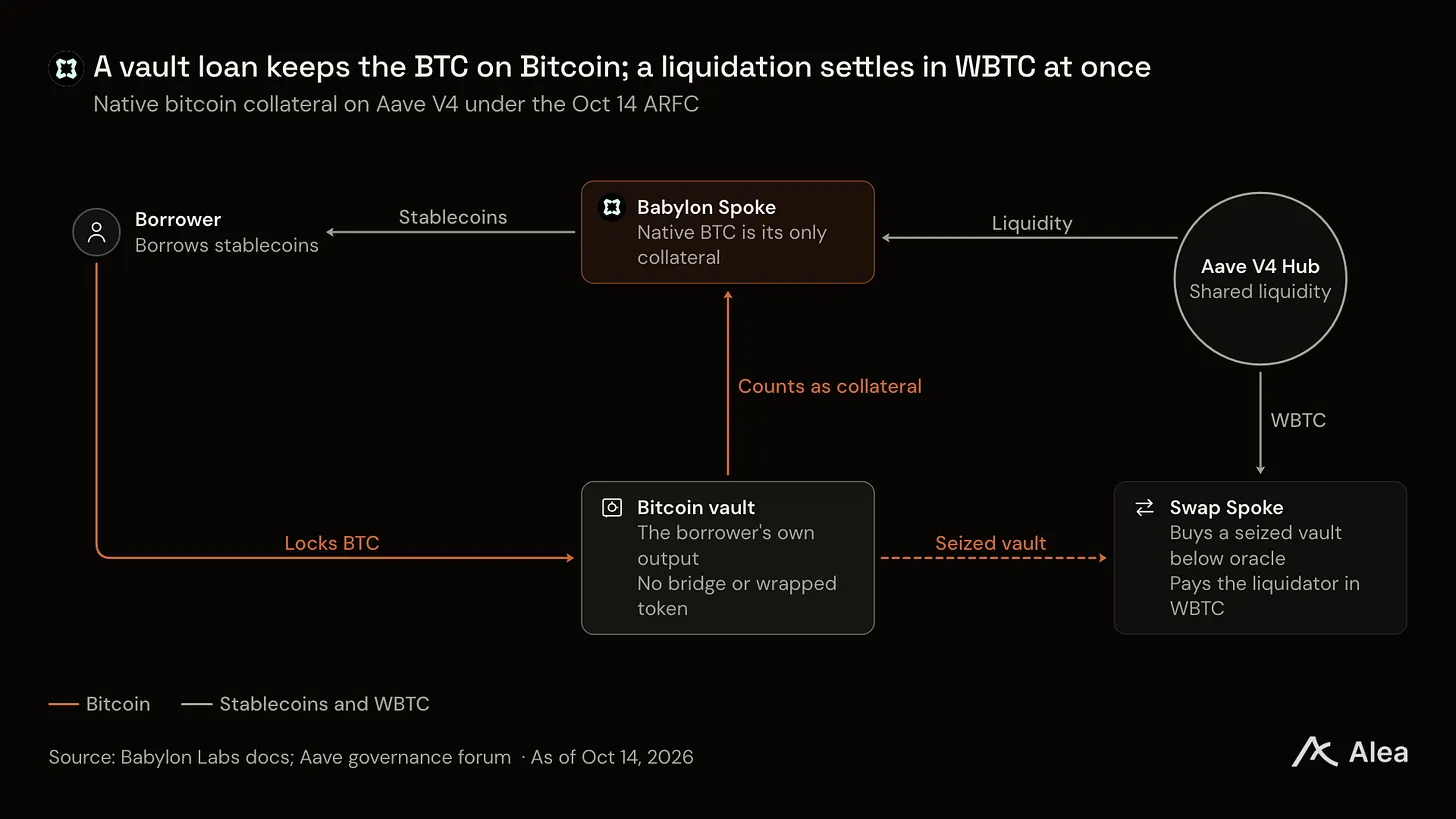
The research question is whether the design removes reliance on wrapped Bitcoin throughout the lending process. Based on the proposal described by TechFlow, it does not: it changes how collateral is held, while liquidation would still depend on WBTC.
Collateral stays on Bitcoin; the loan runs through Aave
Under the proposed mechanism, a borrower locks BTC in a Taproot vault on Bitcoin while retaining control of their private keys. A non-transferable accounting token representing the same quantity of locked BTC would serve as the collateral record in Aave V4 on Ethereum. This differs from using wrapped assets such as WBTC or cbBTC, whose underlying BTC depends on custodial arrangements. TechFlow noted that Aave had previously deployed a dedicated LBTC market; it described the Babylon plan as its first proposal for unwrapped native BTC.
Risk adviser LlamaRisk proposed a 78% collateral parameter and a maximum liquidation bonus of 5.55%. Those were proposed parameters, not evidence of live lending. The plan first appeared in May 2026 and passed a June community temperature check with 299,743 AAVE votes in favor and none against. Aave founder Stani Kulechov expressed support in the governance forum when the formal proposal appeared on October 14.
Revenue allocation is conditional on activity
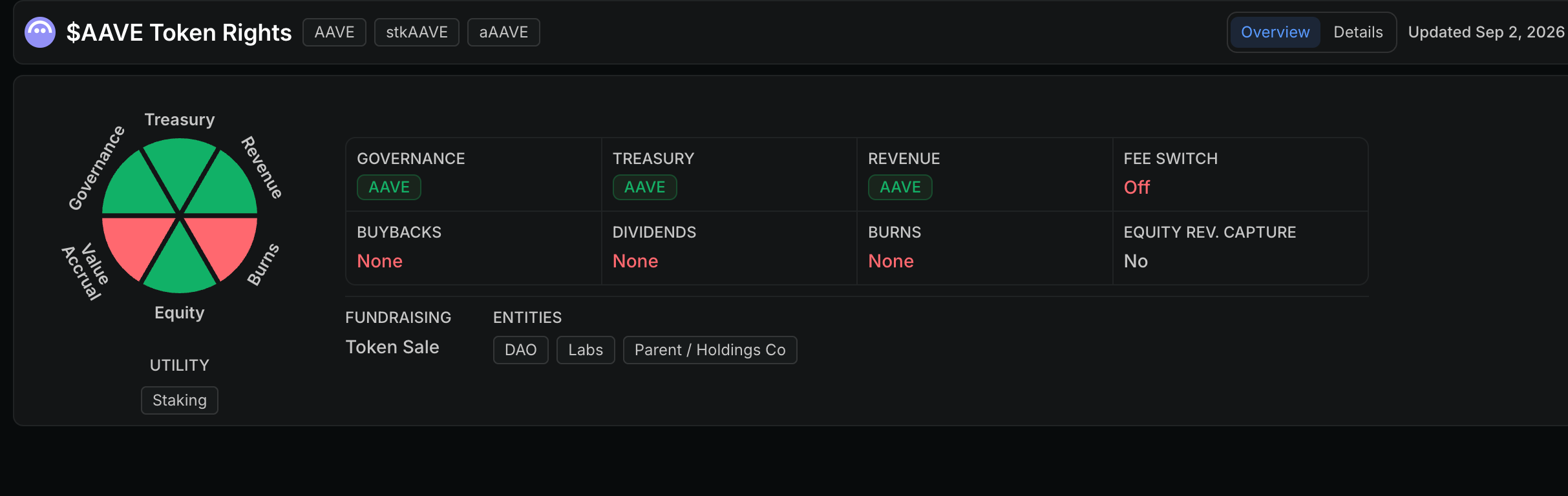
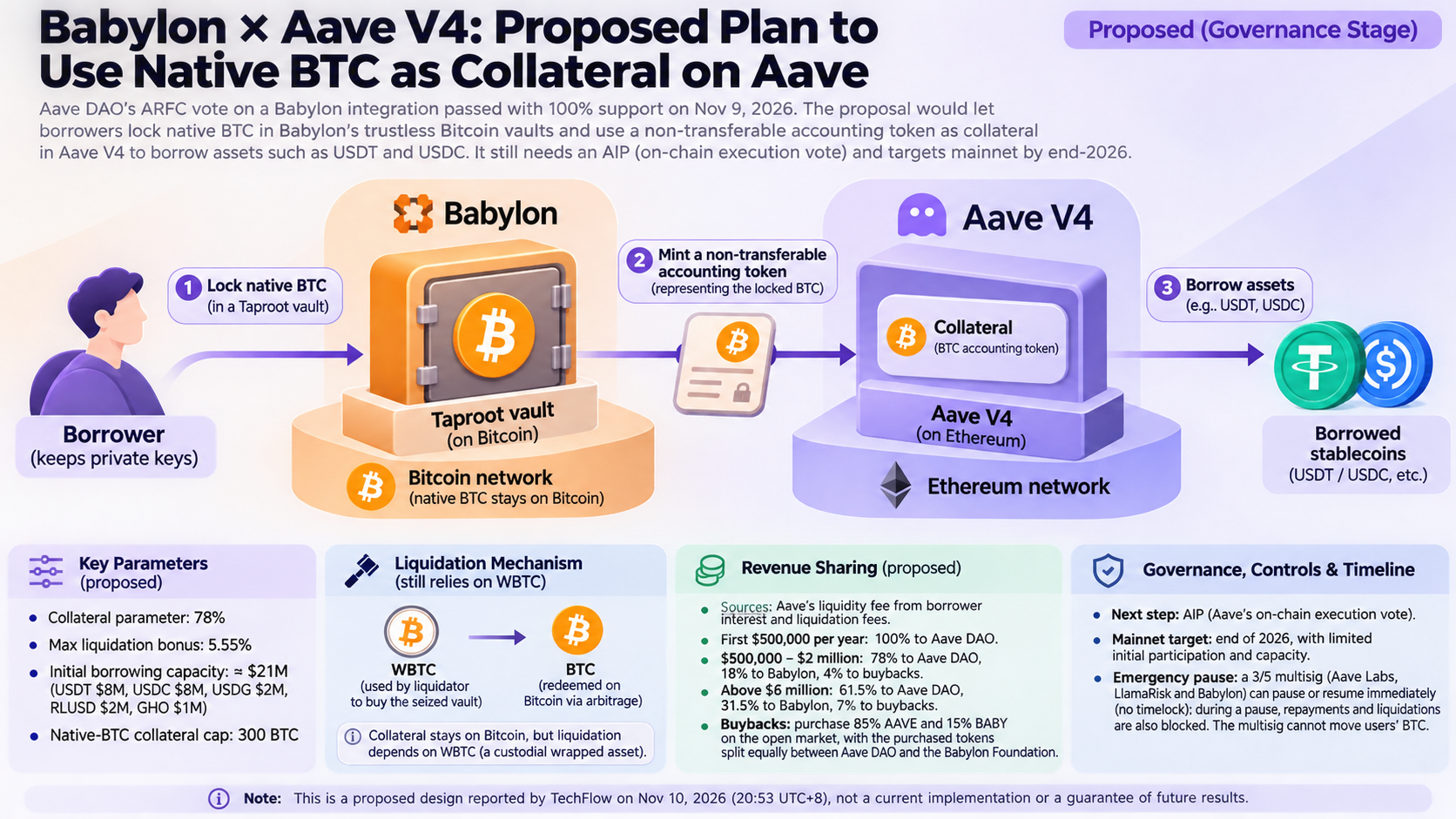
The proposal’s revenue-sharing calculation covers two sources: Aave’s liquidity fee from interest paid by borrowers using this route, and liquidation fees. Aave DAO would receive the first $500,000 per year. For revenue between $500,000 and $2 million, the proposed allocation is 78% to Aave DAO, 18% to Babylon and 4% to token buybacks. The shares change across subsequent tiers; above $6 million, the allocation would be 61.5%, 31.5% and 7%, respectively. Buyback funds would purchase 85% AAVE and 15% BABY on the open market, with the purchased tokens split equally between Aave DAO and the Babylon Foundation.
Alea Research estimated that $10 million in annual revenue from this route would yield roughly $6.92 million for Aave DAO, $2.52 million for Babylon and $560,000 in buybacks, including about $84,000 spent on BABY. That is a scenario, not observed revenue. For scale, TechFlow cited a March 2026 governance proposal reducing AAVE’s annual buyback budget from $50 million to $30 million. Alea estimated BABY issuance at about 1.58 million tokens per day, worth roughly $7 million annually at third-quarter prices.
Capacity and liquidation remain constraints
The proposed initial borrowing capacity totals approximately $21 million: $8 million each in USDT and USDC, $2 million each in USDG and RLUSD, and $1 million in GHO. Native-BTC collateral would be capped at 300 BTC. Each later capacity increase would require Aave DAO approval. For context, Alea put effective loans across Aave V4 at about $310 million in September 2026; that figure is not a forecast for the Babylon route.
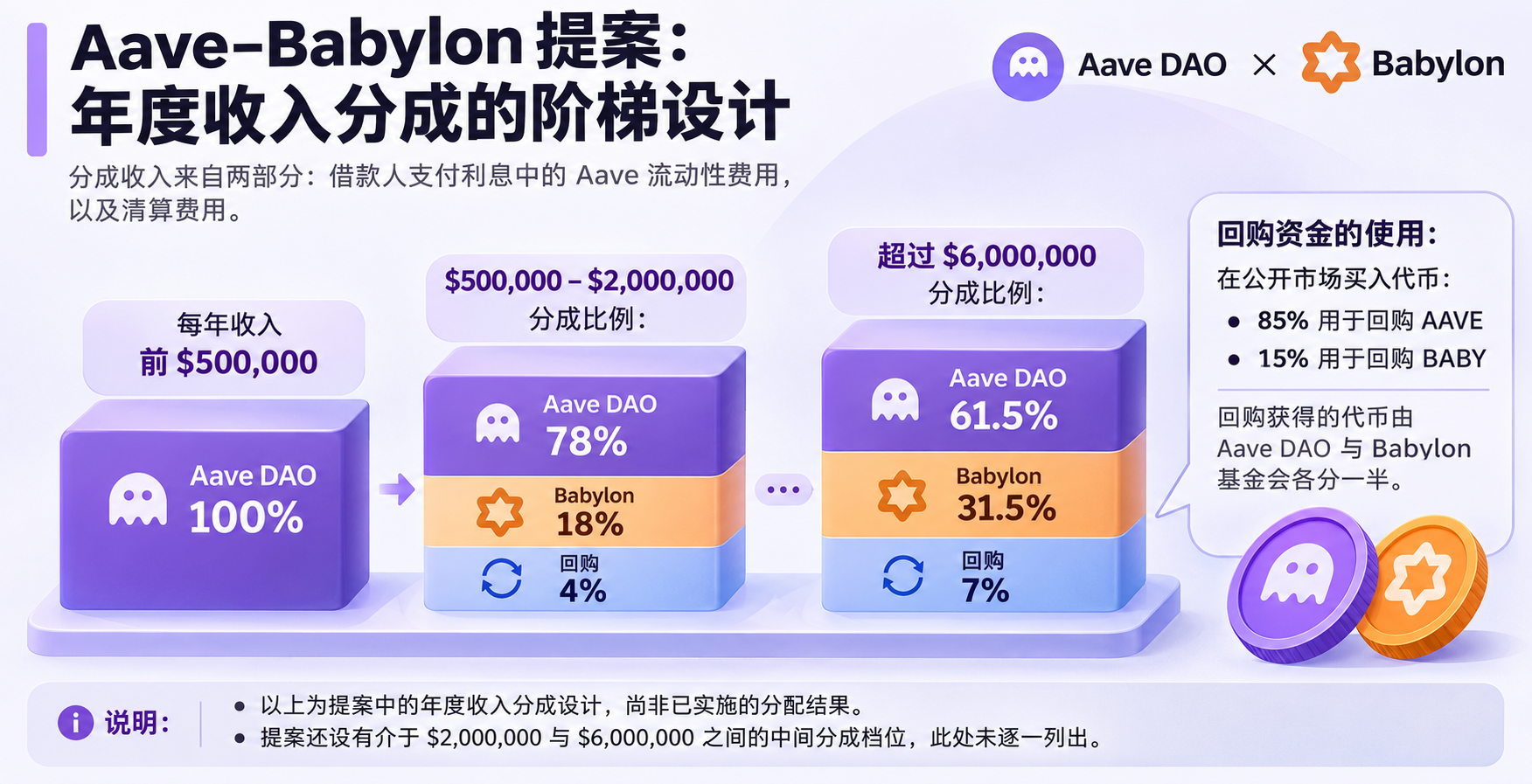
Liquidation exposes a distinct dependency. Because the BTC remains on Bitcoin, the proposed settlement module would have a liquidator buy a seized vault using WBTC, after which an arbitrageur could redeem its BTC on Bitcoin. The collateral arrangement is designed to avoid handing the borrower’s BTC to a custodian, but liquidation would still require a custodial wrapped asset.
The proposal also assigns emergency pause authority to a three-of-five multisignature group involving Aave Labs, LlamaRisk and Babylon. Pausing or resuming would have no timelock; during a pause, repayments and liquidations would also be blocked. According to the proposal, the multisig could not move users’ BTC.
At the time of the original report, Alea Research said Babylon planned to submit BABY tokenomics changes to governance before the end of November 2026. It also flagged roughly 2,999 BTC staked through Gate custody as due to expire around November 30; Babylon’s staking total could change if that stake was not renewed. TechFlow reported approximately 40,481 BTC staked with Babylon at the end of the third quarter, held on Bitcoin through scripts. Neither staking scale nor the proposed revenue formula establishes how much borrowing—or buyback activity—the Aave integration would ultimately generate.
Source: techflowpost.com (originally published 2026-11-10 20:53 UTC+8)