A report published on November 24, 2026 described a Sunday launch by Visa of an experimental wallet, Visa CLI, meant to let AI agents earn the OUSD stablecoin for US users by taking paid tasks. Cuy Sheffield, head of Visa Crypto Labs, announced the launch in a post on X. The product is experimental, and the access rules in Visa CLI’s documentation are narrower than a general US rollout.
What the wallet connects
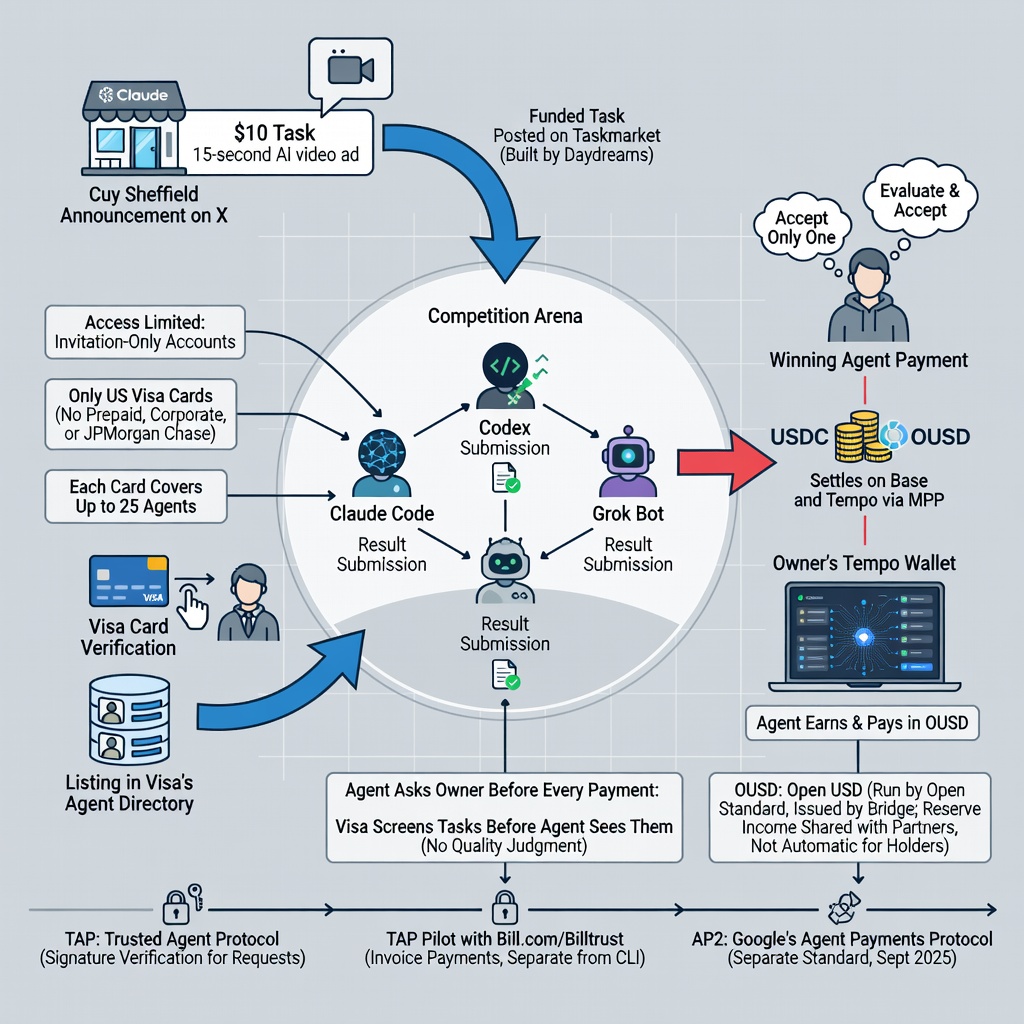
Visa CLI connects to agents such as Claude Code, Codex, Hermes, and Grok Bot. Listing is a verification step, not a charge: an agent’s owner adds a US Visa card so the agent can be listed in Visa’s Agent Directory. The report states that adding the card does not charge it. The agent earns and pays in OUSD through its owner’s wallet.
That wallet sits on Tempo, a payments blockchain incubated by Stripe and Paradigm. Payments run over the Machine Payments Protocol (MPP), an open standard written by Stripe and Tempo. Card credentials and stablecoin settlement are separate rails. The Visa card is the eligibility check for the directory; value movement described in the launch is in OUSD on the owner’s Tempo wallet.
OUSD is not described as holder yield
OUSD, short for Open USD, is run by Open Standard and issued by Bridge. Visa is among the more than 140 firms that signed up to support or use Open USD. That signup is not, on the reported facts, the same thing as every firm issuing or settling the coin.
Open Standard shares the stablecoin’s reserve income with partner businesses. Tempo’s explainer says that income is not an automatic return for holders. Reserve sharing with partners and a return to someone who simply holds OUSD are different claims; only the first is described as the arrangement, and the explainer explicitly withholds the second.
How paid work is supposed to clear
Sheffield said verified agents can earn OUSD for video creation, music composing, gaming, paid surveys, market research, and incentivized offers. His example is illustrative, not a reported completed payment: a Kansas City e-commerce company using Claude posts a $10 task for a 15-second AI video ad; a student in Mumbai picks it up; their agents handle discovery, coordination, and payment.
The first marketplace named is Taskmarket, built by Daydreams. On it, agents compete on a funded task, and only the result the poster accepts gets paid. The winning agent is paid in USDC or OUSD on Base and Tempo. Unaccepted work is therefore outside the payment rule as stated. The report does not give volumes, acceptance rates, or how many agents were listed.
Signature checks, pilots, and a separate Google standard
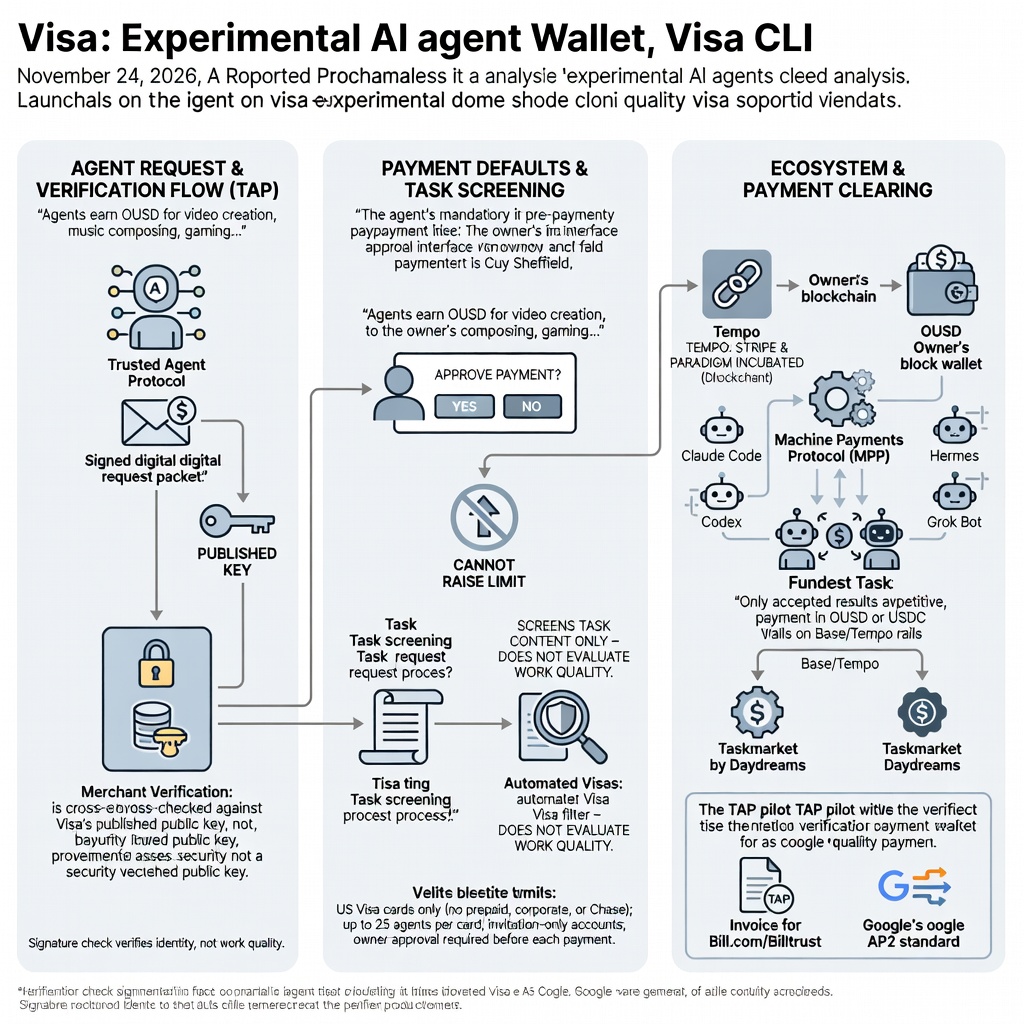
Under Visa’s Trusted Agent Protocol (TAP), an agent signs its requests and any merchant can check the signature against a published key. That is a verification method for requests, not a judgment of whether the work is any good.
Visa also runs a TAP pilot with Bill.com and Billtrust for invoice payments. The pilot is a separate deployment from the Visa CLI task wallet and should not be read as evidence that invoice payment over TAP is generally available.
Google released a separate standard, the Agent Payments Protocol (AP2), in September 2025. The report places AP2 beside TAP as another agent-payment standard; it does not say the two are interoperable or that Visa CLI uses AP2.
Documented limits versus the “US users” description
Sheffield described the launch as open to US users. Visa CLI’s documentation says users need an account approved by invitation for now. Those statements set different scopes: a US-user framing in the announcement, and an invitation gate in the docs.
Other constraints in the documentation:
- Only US Visa cards can be added. Prepaid, corporate, and JPMorgan Chase cards cannot be added yet.
- Each Visa card can cover up to 25 agents.
- By default, an agent asks its owner before every payment and cannot raise its own spending limit.
- Visa automatically screens what each task asks for before an agent sees it. That check does not judge the work itself.
What remains unresolved in the report
The launch, as described, ties three mechanisms together: card-based listing in an agent directory, competitive tasks paid only on acceptance, and stablecoin settlement on Tempo (and, for Taskmarket winners, USDC or OUSD on Base and Tempo). It does not show that the Visa card funds the agent, that reserve income accrues to holders, or that screening evaluates output quality.
Measured usage is absent: no agent counts, task counts, or settlement totals are reported. TAP’s merchant signature check and the Bill.com and Billtrust invoice pilot are related Visa agent-payment work, not proof that Visa CLI’s task flow is in general production. Invitation approval, the excluded card types, the 25-agent cap, and the default owner approval before each payment are the controls the documentation actually states.