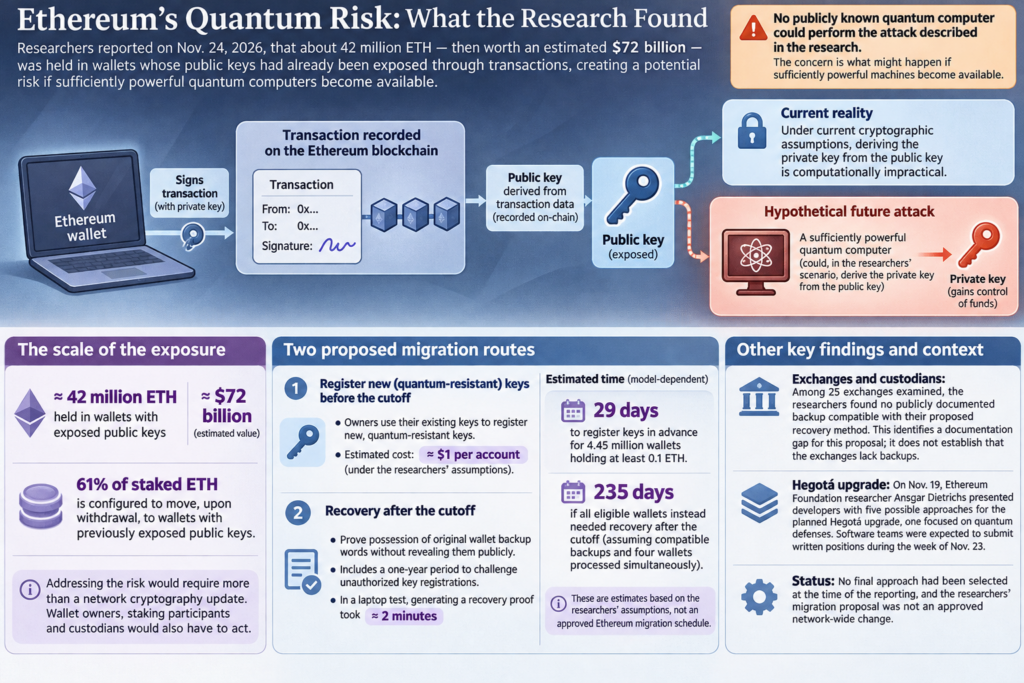
Reporting published on November 24, 2026, described a conditional security risk identified by researchers at the University of Pittsburgh and security firm SeQure: approximately 42 million ETH, then valued at an estimated $72 billion, was held in wallets whose public keys had already been exposed through transactions. No publicly known quantum computer could perform the attack described in the research. The concern is what might happen if sufficiently powerful machines become available.
Why prior transactions matter
Ethereum transactions use signatures that allow the associated public key to be derived from data recorded on-chain. Under current cryptographic assumptions, deriving the private key from that public key is impractical. The researchers’ risk scenario assumes a future quantum computer capable of doing so, potentially allowing an attacker to control funds in an affected wallet.
The migration problem extends beyond ETH currently held in those wallets. The researchers found that 61% of staked ether was configured to move, upon withdrawal, to wallets with previously exposed public keys. Changing network cryptography alone would therefore not move those funds to safer arrangements; wallet owners, staking participants and custodians would also have to act.
Two proposed routes, different constraints
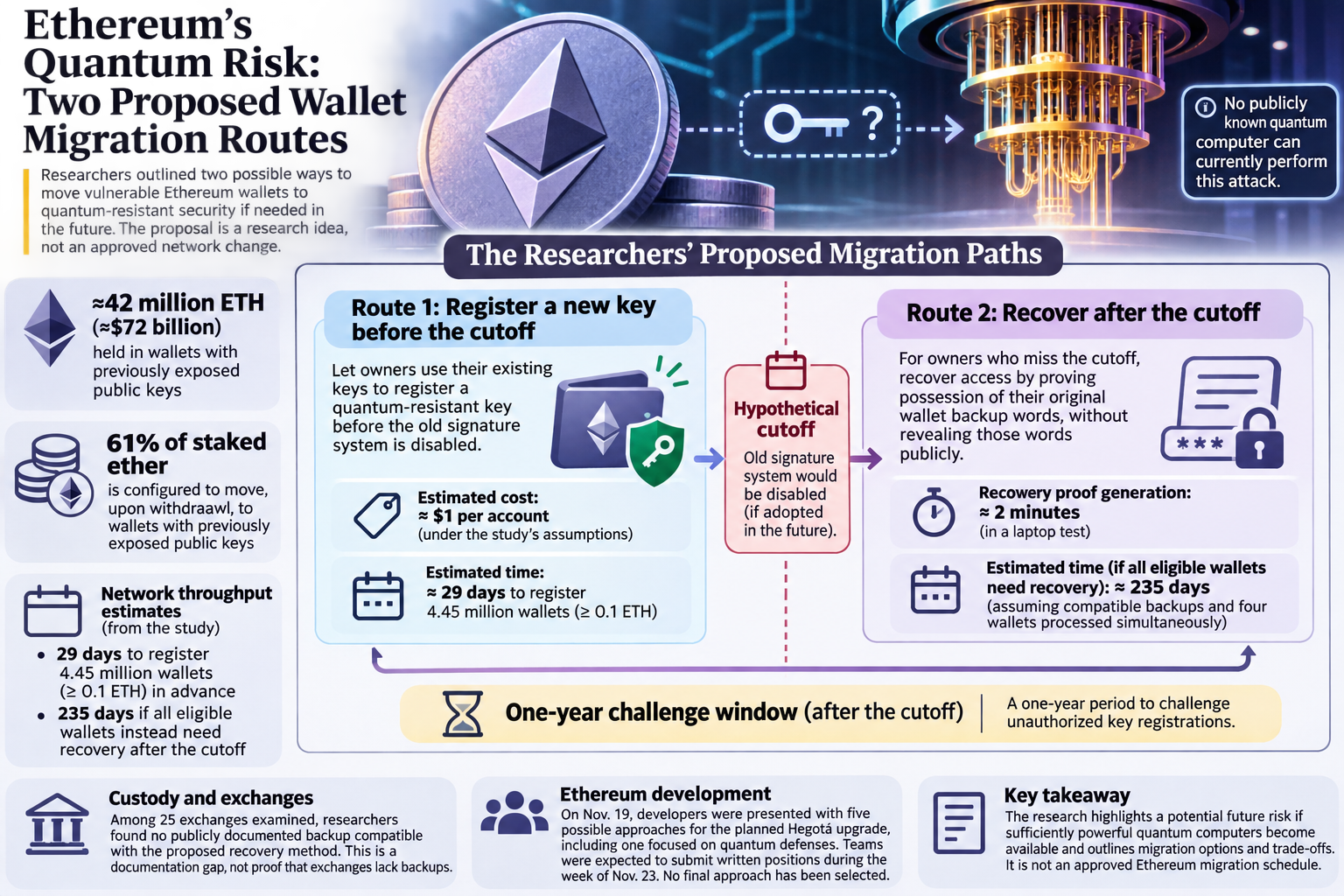
The researchers proposed letting owners register quantum-resistant keys using their existing keys before the old signature system is disabled. They estimated a cost of approximately $1 per account under their assumptions. For owners who missed that cutoff, they proposed a recovery process that would prove possession of original wallet backup words without revealing them publicly. It includes a one-year period to challenge unauthorized key registrations. In a laptop test, generating a recovery proof took approximately two minutes.
Network throughput poses a separate constraint. The researchers estimated 29 days for 4.45 million wallets holding at least 0.1 ETH to register keys in advance. If all eligible wallets instead needed recovery after the cutoff, they estimated 235 days, assuming compatible backups and four wallets processed simultaneously. Those are model-dependent estimates, not an approved Ethereum migration schedule.
Custody may be harder to coordinate: among 25 exchanges examined, the researchers found no publicly documented backup compatible with their proposed recovery method. That finding does not establish that the exchanges lack backups; it identifies a documentation gap relevant to this particular proposal.
On November 19, Ethereum Foundation researcher Ansgar Dietrichs presented developers with five possible approaches for the planned Hegotá upgrade, one focused on quantum defenses. Software-maintaining teams were expected to submit written positions during the week of November 23. At the time of the reporting, no final approach had been selected, and the researchers’ migration proposal was not an approved network-wide change.