Historical report: originally published November 10, 2026, at 10:59 a.m. UTC+8. The milestones and schedules below reflect what was reported at that time, not subsequent developments.
At Devcon 8 in Mumbai, Ethereum Foundation researcher Justin Drake set out an ambition to complete Ethereum’s post-quantum and “post-AI” transition by December 2028. That was a research target, not the Foundation’s formal deadline. An EF priorities article published that September set December 2029 for protection across three layers and said the date would remain unchanged until a review with external experts in January 2027.
The distinction matters because the proposed cryptography must reach users through successive hard forks. The article’s assessment was that shipping those forks without breaking existing applications could be harder than selecting the cryptographic tools.
What the proposed sequence requires
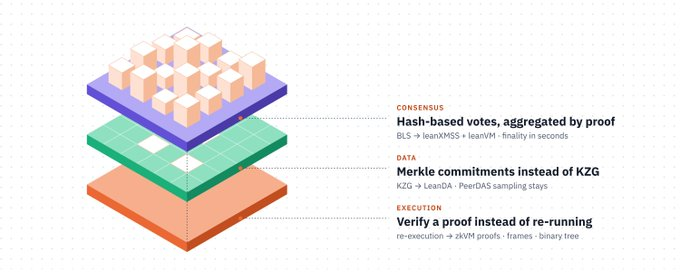
In the roadmap draft described by the source, Hegotá, planned for 2027, would introduce frame transactions that let accounts choose their authorization scheme. It was not itself described as the post-quantum fork. A later fork, provisionally called I*, would add the leanVM proof virtual machine and post-quantum “lean” transactions. J* would add hash-based validator signatures and post-quantum data sampling—the EF’s stated “minimum viable post-quantum” milestone. K* and L* would carry mandatory proofs and the remaining Lean architecture changes.
Drake’s December 2028 ambition implied three hard forks within 24 months after Glamsterdam: roughly one every eight months. The source compared that with recent Ethereum fork intervals of 11, 14 and seven months. It also reported the EF’s calculation that reaching L* by December 2029 would require an average interval of 7.2 months. These are delivery assumptions, not committed release dates.
The motivation is concrete, but the cited results are not demonstrations of an attack on Ethereum. A paper published in March 2026 by researchers affiliated with Google Quantum AI, UC Berkeley, the EF and Stanford estimated that breaking Ethereum’s elliptic-curve signatures would require fewer than 1,200 logical qubits and 500,000 physical qubits, with a runtime measured in minutes. In July, Anthropic reported that one of its models found an attack reducing the estimated key-recovery work for the lattice-signature scheme HAWK-256 from approximately 2^64 to 2^38 operations. The source presents these as reasons to prepare for quantum and AI-assisted cryptanalytic risks, not evidence that either capability had compromised Ethereum.
Glamsterdam shows the compatibility constraint
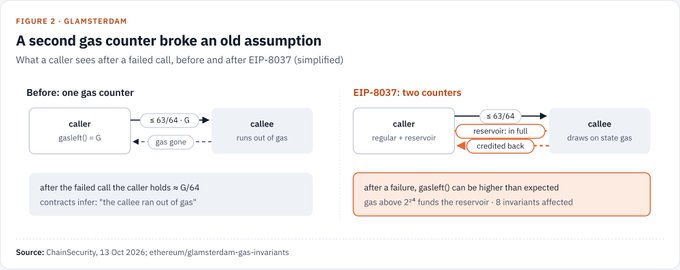
The reported schedule was already under pressure. Glamsterdam had been running on Sepolia since October 6, 2026, but was withdrawn from a second testnet on October 22. According to the EF’s explanation at Devcon, a proposed gas repricing broke assumptions relied on by deployed contracts.
Under EIP-8037, writing a new storage slot would rise from 22,100 to 110,020 gas, while deploying a 24 kB contract would cost about eight times as much. The proposal’s separate state-gas reserve would also change how gas reaches a called contract and is returned when a call reverts. ChainSecurity warned that error handlers previously stopped by gas exhaustion could then complete, potentially bypassing checks against malicious interference. The EF identified eight broken invariants, and an AllCoreDevs summary counted 13 affected DeFi projects. Hoodi testing was delayed without a new testnet or mainnet date; All Core Devs coordinator Nixo wrote that Glamsterdam’s mainnet release would “very likely” move into 2027.
That is relevant to the post-quantum path because the source says Hegotá’s frame-transaction proposal, EIP-8141, lists EIP-8037 as a requirement. A compatibility problem in one proposed fork can therefore hold up work intended for a later one.
Moving signatures and proofs off the block
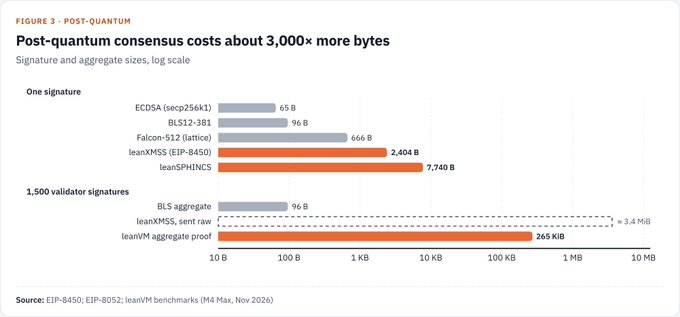
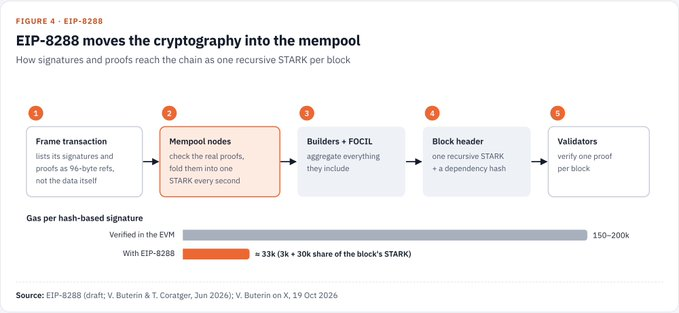
The proposed transition also has a size problem. The source reports a 2,404-byte leanXMSS validator signature, compared with 96 bytes for BLS. Unlike BLS signatures, hash-based signatures cannot simply be combined by adding them. The proposed alternative is for an aggregator to prove that it checked the signatures. The source cites a leanVM result of approximately 965 signatures aggregated per second on a laptop, with 1,500 signatures represented by a 265 KiB proof verified in 7.4 milliseconds. Those reported measurements do not establish production readiness.
For user transactions, draft EIP-8288 proposes mempool aggregation: nodes would check signatures and proofs as transactions arrive, while a block would carry a recursive proof covering its dependencies rather than every large signature or proof. The source estimates roughly 33,000 gas per aggregated leanSPHINCS signature, versus 150,000–200,000 gas for direct verification. These are proposal estimates, not observed mainnet costs.
EIP-8288 remained a draft as of the reporting date. Its STARK dependencies were reserved but not enabled, some identifiers were still unspecified, and its authors acknowledged a potential increase in mempool denial-of-service risk. The source also says the soundness of recursive proofs remained unproven. Separately, although Drake announced end-to-end formal verification for leanVM, the source distinguishes work proving instruction semantics and constraint soundness in Lean 4 from a Rust implementation tested differentially; it says the code was not yet production-ready.
The research question left by Devcon 8 was therefore not just whether Ethereum could specify post-quantum mechanisms. It was whether it could validate their security assumptions, preserve existing contract behavior and deliver the dependent forks at the pace the more ambitious date would require.
Source: panewslab.com (originally published 2026-11-10 10:59 UTC+8)