Historical report: the source was published on November 12, 2026, at 17:31 (UTC+8). Figures and company plans below reflect the reporting available then, not current conditions.
A megawatt of power at a mining site may now be worth more to an AI tenant than to a Bitcoin miner—but only where the site can support the conversion. In its review of nine listed miners’ third-quarter results, Blockhead estimated that AI hosting could produce roughly twice the revenue of mining from the same power capacity at the hashprice used in its comparison. Three of the nine companies already earned more than half their revenue outside mining, while others were selling Bitcoin held on their balance sheets to fund a shift toward AI infrastructure.
The megawatt comparison
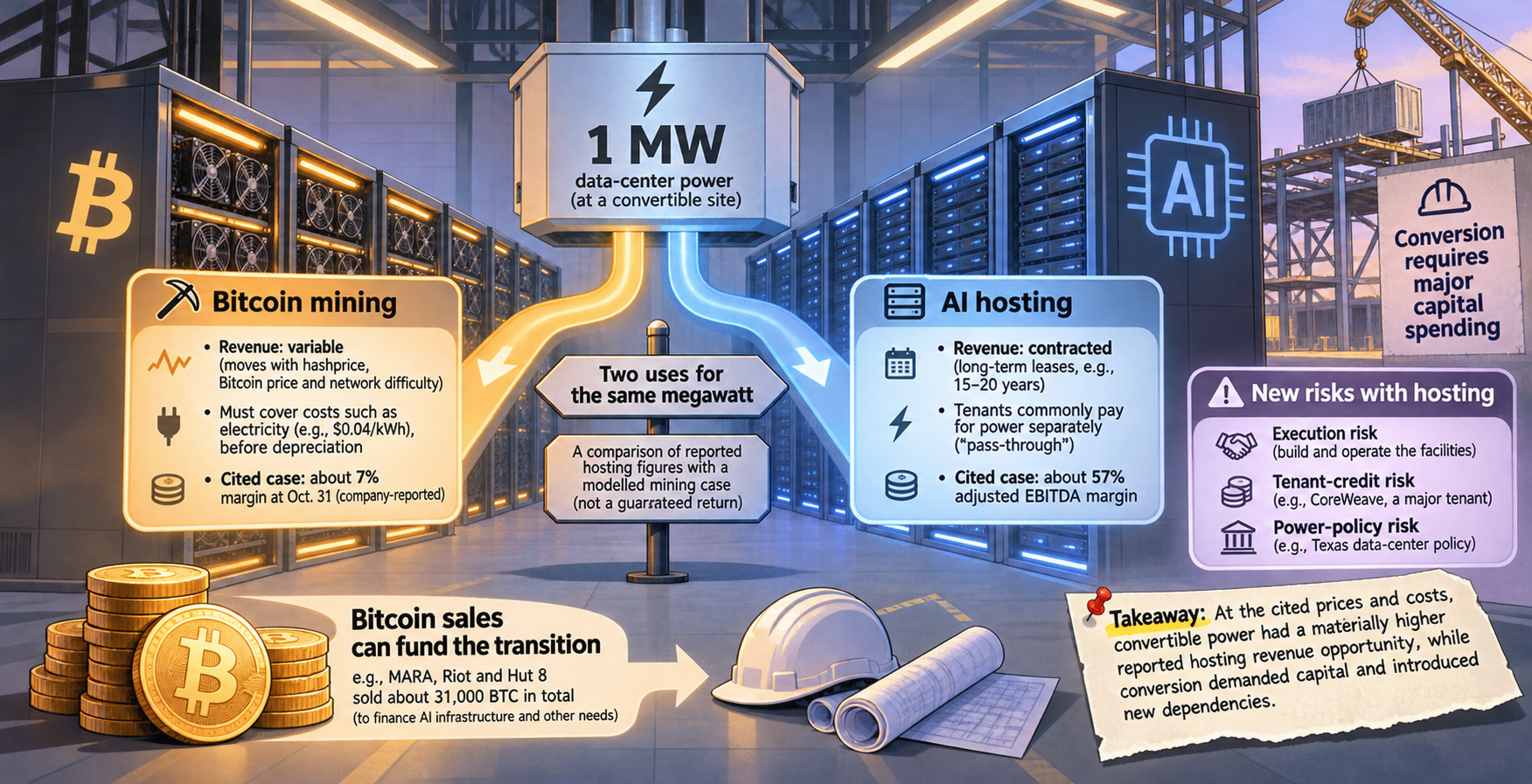
MillionMiner data cited by Blockhead put hashprice—daily mining revenue per petahash per second (PH/s) of computing capacity—at $33.18 on October 31, down 17.5% from $40.24 on October 1. MARA reported a cost of $30.80 per PH/s per day. On that company-reported basis, Blockhead calculated a margin of about 7% at October’s end.
Using mining equipment rated at 15–20 joules per terahash, Blockhead estimated that one megawatt could support 50–67 PH/s and generate $600,000–$800,000 a year at a $33 hashprice. Electricity at $0.04 per kilowatt-hour would cost roughly $350,000 a year, before depreciation. By comparison, Core Scientific disclosed 485 MW of billable power capacity associated with more than $700 million in annualized hosting revenue—about $1.44 million per MW per year—and a 57% adjusted EBITDA margin.
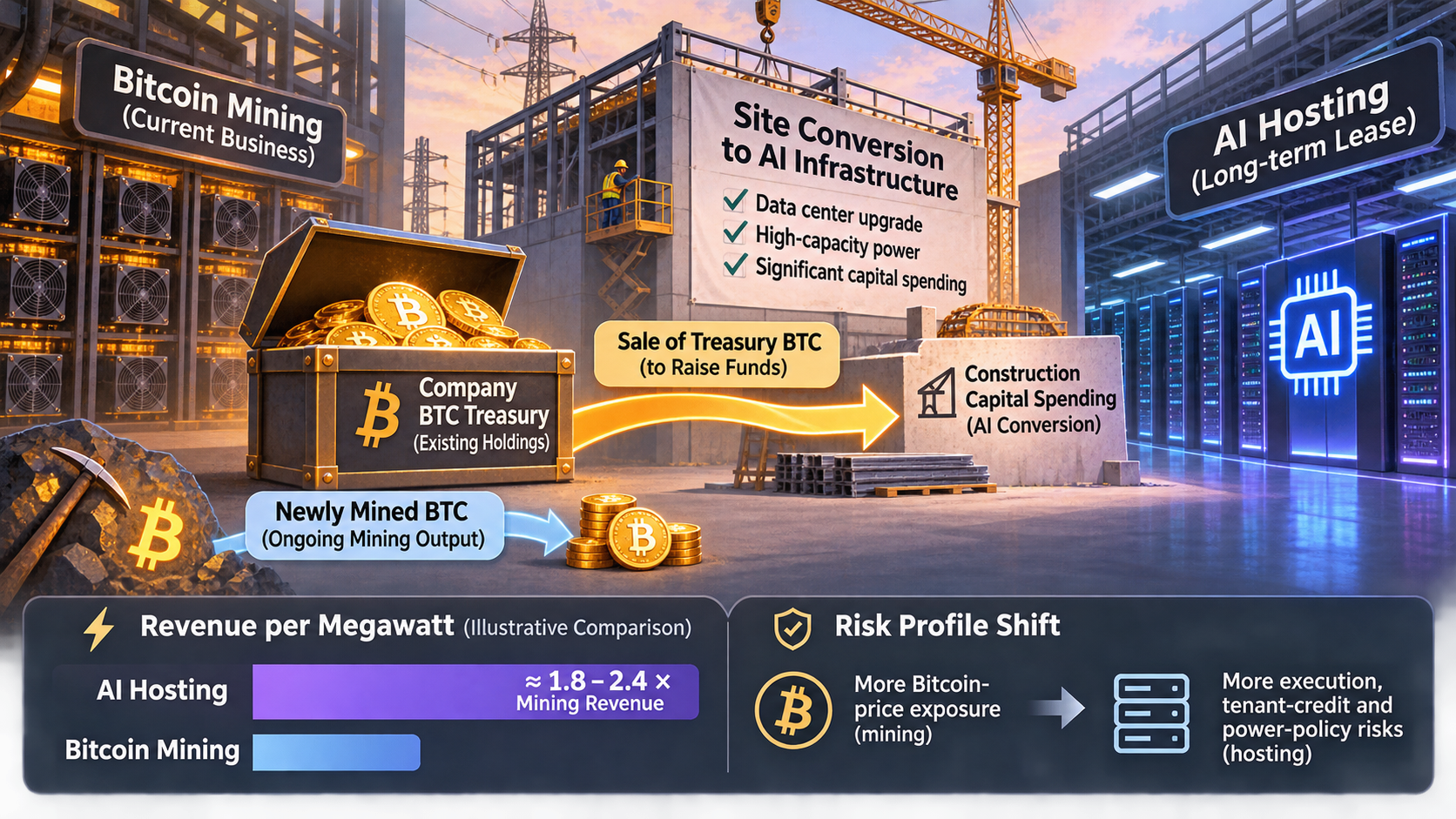
That puts the cited AI hosting revenue at 1.8–2.4 times the estimated mining revenue per megawatt. It is a comparison of reported hosting figures with a modelled mining case, not a guaranteed return from converting any particular mine. Blockhead also noted that AI data-center contracts commonly charge tenants separately for power; site conversion, however, requires substantial capital spending. Core Scientific reported $954.2 million in capital expenditure for the first half of the year, while its filings showed CoreWeave contributed $180.9 million toward that spending.
Bitcoin sales fund a different business
Long-term AI leases change the revenue exposure, but the transition needs financing. Core Scientific disclosed more than $24 billion in contracted revenue in an investor presentation, while Cipher disclosed $16.6 billion. The source also cited roughly $19 billion for a TeraWulf campus lease and $26.6 billion for Hut 8; it cautioned that the figures use differing measures. Contract value is not cash already received.
According to a shareholder letter cited by Blockhead, MARA sold 17,488 BTC during the quarter—7.8 times the 2,247 BTC it mined—and planned further sales to finance AI infrastructure and meet note obligations. Riot sold 10,599 BTC in the third quarter; Hut 8 sold about 3,100 BTC across the third quarter and October. Together, those sales were approximately 31,000 BTC, or $2.4 billion by the source’s estimate. The reporting windows differ, and the sales included Bitcoin from existing holdings: they should not be read as newly mined supply alone.
Bitcoin issuance remained approximately 450 BTC a day under the protocol rules described in the source. The relevant change is therefore not issuance, but which companies hold and sell coins—and whether capital needs add to their reasons to sell.
Capacity leaves mining; other risks remain
Blockhead calculated from disclosed figures that combined mining revenue at Core Scientific, TeraWulf and IREN fell about 84% year over year, from $334 million to roughly $54 million. Core Scientific expected to exit Bitcoin mining in the fourth quarter and become solely a hosting provider in 2027; IREN expected to have “substantially completed” its mining transition by the end of 2026. These were company expectations at the reporting date, not completed outcomes. Meanwhile, MARA reported 18% growth in energized hashrate and an increase in its share of block rewards from 5.0% to 5.4%.
The mechanism is an opportunity cost: a convertible site can compare prospective mining proceeds with what a tenant would pay for its power and facilities. If operators leave mining, network difficulty adjusts to the remaining hashrate. That does not establish a fixed floor under hashprice, and a site without a viable AI conversion has a different set of choices.
Hosting also replaces some Bitcoin-price exposure with execution, tenant-credit and power-policy risks. The source identified CoreWeave as Core Scientific’s major tenant and cited a 590 MW hosting agreement whose construction CoreWeave would fund. It also reported concerns about CoreWeave’s credit spreads and Texas data-center policy, attributing the latter reporting to Averin and analyst commentary. Those risks matter precisely because a large contracted revenue figure depends on facilities being built, financed and operated over time.
The evidence supports a narrower conclusion than a universal mining-to-AI switch: at the cited prices and costs, convertible power had a materially higher reported hosting revenue opportunity, while conversion demanded capital and introduced new dependencies. The next tests identified by Blockhead were hashprice against efficient miners’ costs, further miner Bitcoin sales, the pace of signed leases, and tenant financing and power policy.
Source: techflowpost.com (originally published 2026-11-12 17:31 UTC+8)