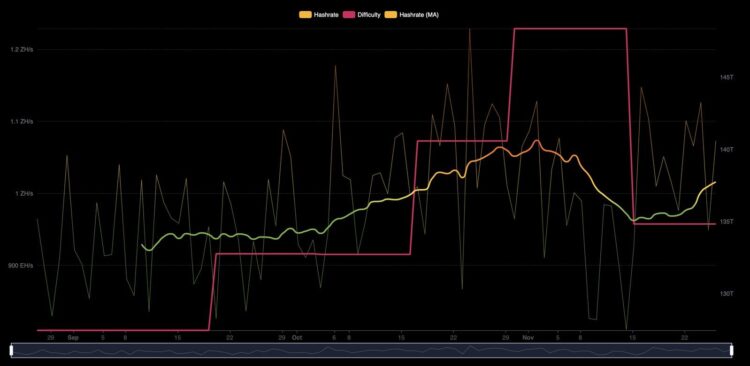
As of November 26, 2026, network estimates put Bitcoin’s next mining difficulty adjustment at roughly 9% higher, taking difficulty from 134.82 trillion toward 147 trillion. The adjustment was expected at block 977,760 on November 27. If the estimate held, it would reverse much of the 9.13% cut on November 14.
Bitcoin adjusts difficulty every 2,016 blocks to keep the average interval between blocks near ten minutes. Blocks had been arriving faster than that during the current period, pointing to an upward adjustment. For a miner running the same machines for the same number of hours, higher difficulty means less expected BTC output for the same electricity bill.
Why a 9% rise would mean about 8.3% less BTC
Expected output at a fixed hashrate—the number of hashes a miner computes per second—varies inversely with difficulty. With other conditions unchanged, a fleet that could expect to earn 1 BTC over a given period would instead expect to earn 1 divided by 1.09, or about 0.917 BTC. That is an 8.3% reduction, not 9%.
The dollar impact depends on hashprice, the expected daily revenue per unit of hashrate. It reflects Bitcoin’s price and transaction fees as well as difficulty. Mining industry trackers put daily hashprice around $28 per petahash per second of capacity as of the November 26 report.
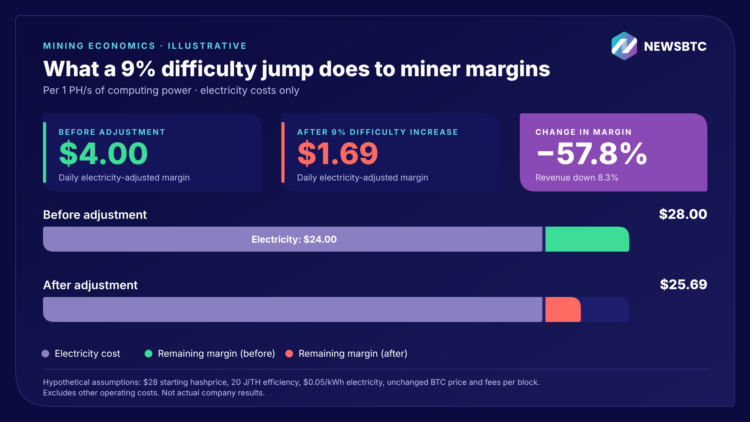
Consider a hypothetical fleet operating continuously at one petahash per second. At an efficiency of 20 joules per terahash and an electricity rate of $0.05 per kilowatt-hour, it would spend about $24 a day on power. If difficulty rose 9% while Bitcoin’s price and average fees per block stayed unchanged, the comparison would be:
| Per day | At the reported hashprice | After a hypothetical 9% difficulty rise |
|---|---|---|
| Gross revenue | $28.00 | $25.69 |
| Electricity cost | $24.00 | $24.00 |
| Revenue after electricity | $4.00 | $1.69 |
The last row is not net profit: it excludes hosting, maintenance, cooling, financing and other costs. Efficient machines on cheap power may remain economical, while an operator with older equipment may be better off shutting down part of its fleet. Some established miners are already redirecting infrastructure toward AI and high-performance computing, an option their power capacity and data centers afford them but smaller operators may lack.
Difficulty does not measure miner selling
Tighter margins can give miners a reason to sell BTC to meet operating costs or debt payments. They do not establish that miners have sold more. Some operators routinely sell their production; others hold treasury reserves, cut costs or seek financing.
The first question was whether the projected increase would materialize at block 977,760. After the adjustment, hashprice would show how expected revenue had changed, and network hashrate could indicate whether computing power was going offline. The separate question of BTC sales calls for different evidence: miner balances, transfers to exchanges and company treasury disclosures.