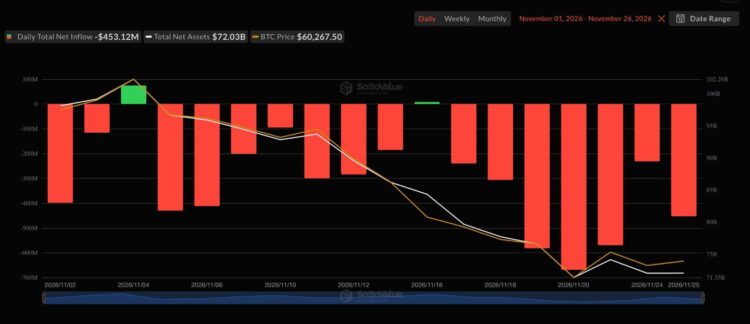
Bitcoin was back above $60,000 on November 26, 2026, but US spot Bitcoin exchange-traded funds had recorded roughly $2.05 billion in net outflows over the four trading sessions through November 24, according to Farside Investors. The figures document withdrawals from the funds, not a retreat by Bitcoin buyers across the market. The open question is whether demand elsewhere can sustain the rebound if redemptions continue.
Where the withdrawals were concentrated
BlackRock’s iShares Bitcoin Trust (IBIT) accounted for about $1.77 billion of the four-session total. Across all US spot Bitcoin ETFs, net outflows reached $582.3 million on November 19 and $669.2 million on November 20. Withdrawals continued on November 23 and 24. Preliminary figures for November 25 pointed to further net outflows but were not yet final.
ETF shareholders include individual traders as well as advisers and asset managers. The flow data do not distinguish investors cutting risk from those closing short-term positions. Nor do they capture direct purchases or demand on overseas exchanges. A rebound that holds while US funds continue to see redemptions would be stronger evidence that other buyers are absorbing sales than a move above $60,000 alone.
What realized losses say about the rebound
In its November 24 report, The Canary in the Coal Mine, Glassnode put Bitcoin’s November 21 low at approximately $55,300, below its summer lows. An earlier recovery above $64,000 had also failed to hold. Investors who bought near $60,000 during a prior decline may use a return to that price to sell near their purchase cost. The rebound gives them that opportunity; it does not establish how many will take it.
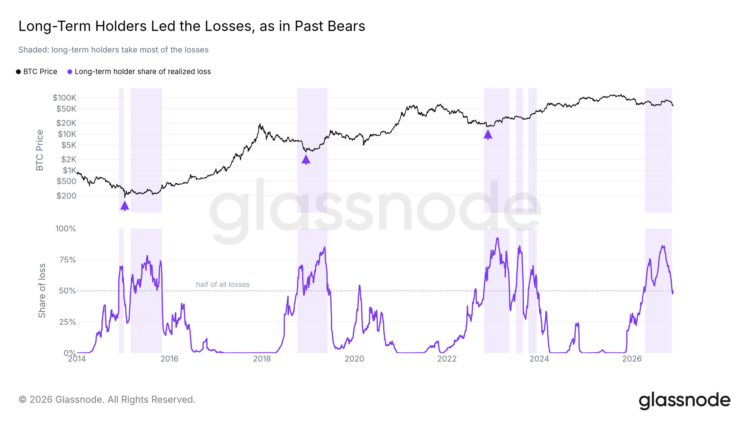
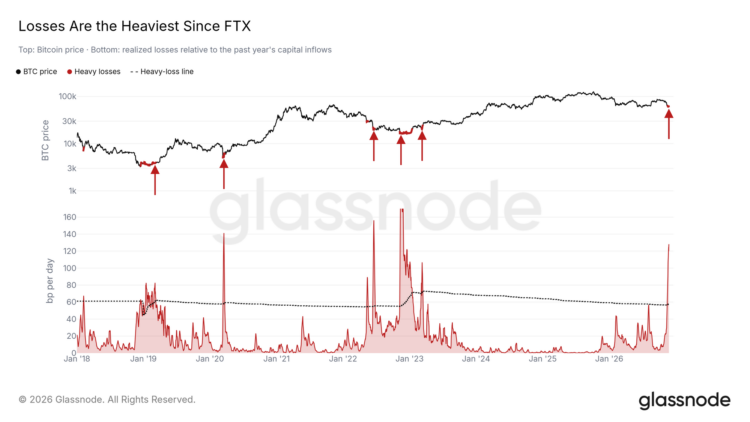
Glassnode’s data showed that long-term holders accounted for more than 75% of Bitcoin’s realized losses before their share fell back toward 50%. That measure identifies which holders accounted for losses when they sold. A separate measure compares the scale of realized losses with capital inflows over the preceding year. On that basis, loss intensity reached its highest level since the FTX collapse in 2022. Heavy realized losses have occurred near past market bottoms, but the comparison does not establish that $55,300 marked one this time.
US equity markets were closed for Thanksgiving on November 26 while Bitcoin exchanges continued trading. The holiday therefore left a gap in ETF flow data, not evidence that withdrawals had eased. The shortened November 27 session and the subsequent return to normal hours would offer a clearer test: whether redemptions slow, and whether Bitcoin retains its gains even if they do not.