
Aave Horizon held roughly $6 million in tokenized high-yield bond fund shares at 18:14 UTC on November 24, 2026. Aavescan snapshots showed deposits rising from 0.152 HINC on November 23 to about 6,200 HINC the following day. That figure measures collateral supplied, not money borrowed: Horizon reports stablecoin loans across the market, but its public data does not show whether HINC backs any of them.
HINC represents shares in the Neuberger Securitize High Income Tokenized Fund, advised by Securitize Capital and sub-advised by Neuberger Berman Investment Advisers. The fund focuses on high-yield corporate bonds and can also invest in tranches of collateralized loan obligations, bank loans and other fixed-income assets. Aave said on November 24 that eligible holders could borrow USDC, GHO or RLUSD against their shares without redeeming them.
When a HINC position becomes eligible for liquidation
Aave’s reserve overview listed a deposit cap of 10,000 HINC. It showed different borrowing limits for standard positions and for E-Mode, a setting in which holders borrow only GHO:
| HINC setting | Maximum initial loan-to-value ratio | Liquidation threshold | Liquidation penalty |
|---|---|---|---|
| Standard | 55% | 67% | 8% |
| GHO-only E-Mode | 57% | 69% | 8% |
The first two percentages compare debt with the value of the pledged shares. The initial limit determines how much a holder can borrow; the higher threshold marks when the position becomes eligible for liquidation. If the shares lose value, the ratio rises even if the holder borrows nothing more.
Who funds the wait for redemption?
The token’s transfer restrictions still apply during liquidation. According to the listing proposal, only wallets that have passed the fund’s identity and compliance checks can receive HINC. Under Securitize’s design, a preapproved liquidator repays the debt in the borrowed stablecoin and receives HINC in an eligible wallet. Securitize’s transfer agent then records the liquidator as the new shareholder.
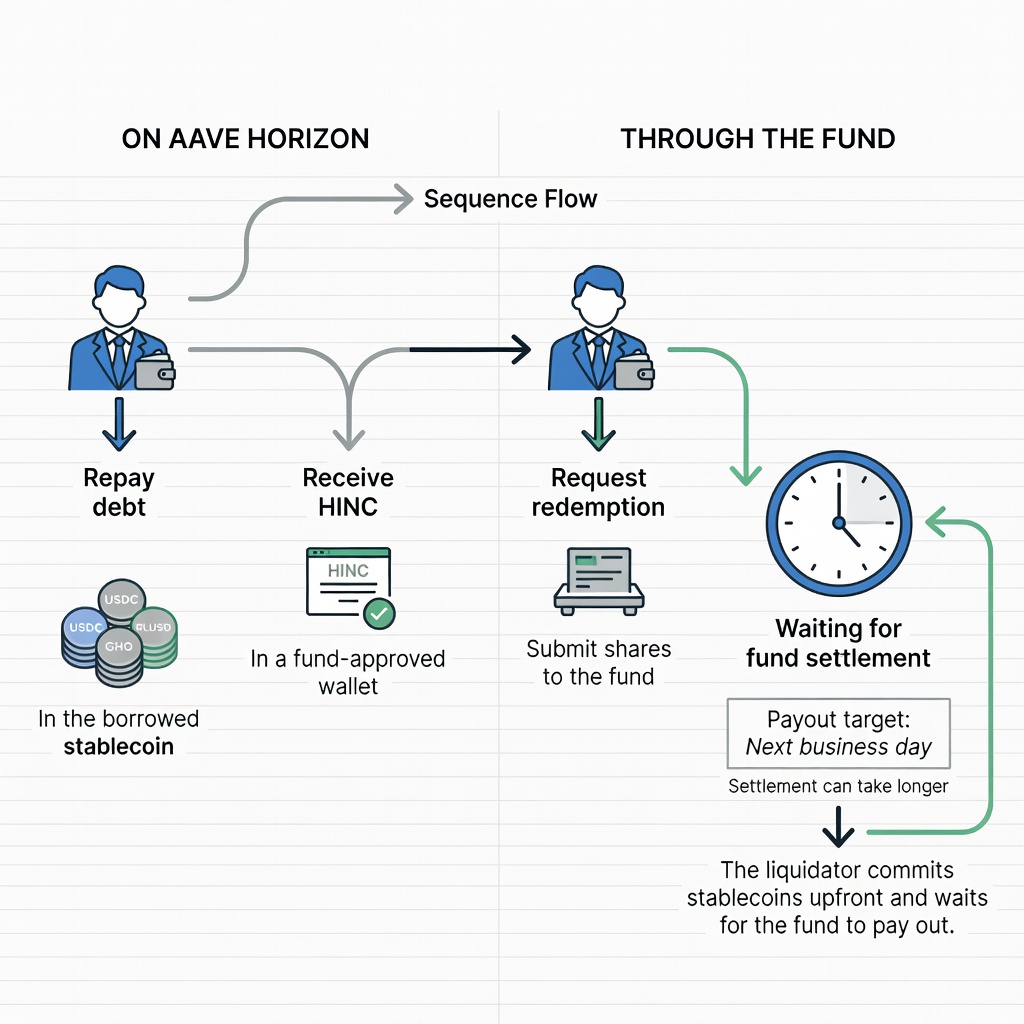
At that point the liquidator holds fund shares, not cash. Securitize says HINC has no secondary market. A liquidator using ordinary fund redemption must therefore commit stablecoins upfront and carry the shares until the fund pays. Securitize targets a next-business-day payout, but settlement can take longer depending on the liquidity of the fund’s investments. In its review, LlamaRisk cited Securitize’s plan to launch without an instant redemption pool.
If several positions reached liquidation before the first redemption paid out, approved liquidators would need enough stablecoins to cover the additional repayments. The $6 million deposit figure shows how much collateral holders supplied. It does not establish how much of that collateral approved liquidators could finance while waiting for settlement.