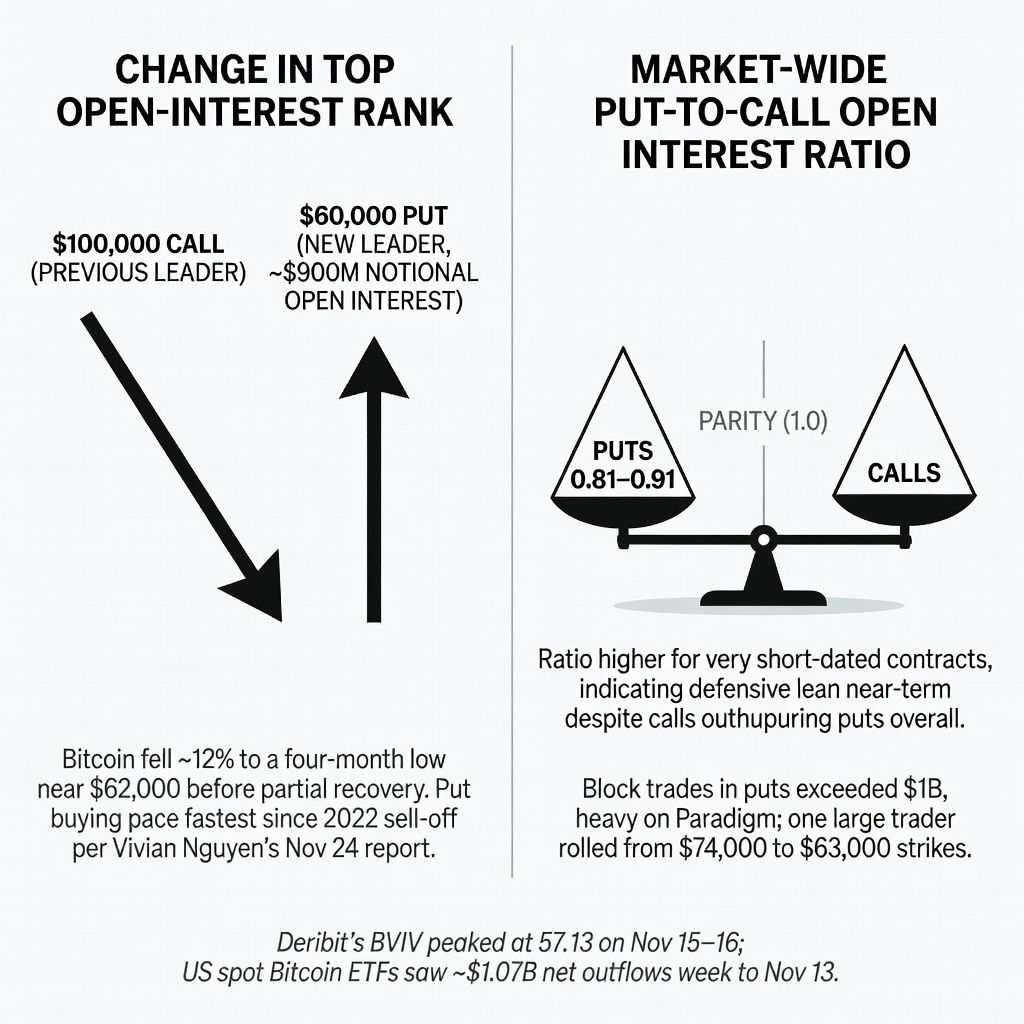
Deribit’s $60,000 Bitcoin put became the exchange’s largest options position by strike in mid-to-late November 2026, displacing the $100,000 call. The put accounted for approximately $900 million in notional open interest, a measure of outstanding contracts rather than the premiums buyers paid. Across all strikes, however, calls still outnumbered puts.
One leading strike, two possible motives
Bitcoin fell approximately 12% heading into mid-November, reaching a four-month low near $62,000 before recovering some of the decline. In her November 24 report at 14:56 EST, Vivian Nguyen described the pace of put buying as the fastest since the 2022 sell-off.
A put gives its holder the right to sell at the strike price. A Bitcoin holder could use the $60,000 put to protect against a further decline, while a trader without that exposure could buy the same contract to bet on one. The open interest ranking does not distinguish between those motives.
Negotiated block trades in puts exceeded $1 billion, with particularly heavy activity on Paradigm. As Bitcoin fell, one large trader repeatedly rolled puts to lower strikes, closing existing contracts and opening replacements. The trader’s strikes moved from $74,000 in late October to $63,000.
Positioning across the market
Deribit’s put-to-call open interest ratio ranged from 0.81 to 0.91 in late November, or 81 to 91 outstanding puts for every 100 calls. The ratio was higher for very short-dated contracts. Puts thus had a larger presence relative to calls at the shortest maturities than in the market overall.
Deribit’s Bitcoin implied volatility index, BVIV, peaked at 57.13 on November 15–16 before easing. Separately, US spot Bitcoin ETFs recorded approximately $1.07 billion in net outflows in the week leading up to November 13. The ETF figure measures net fund flows; it does not establish whether the traders buying puts were protecting existing holdings or betting on further losses.