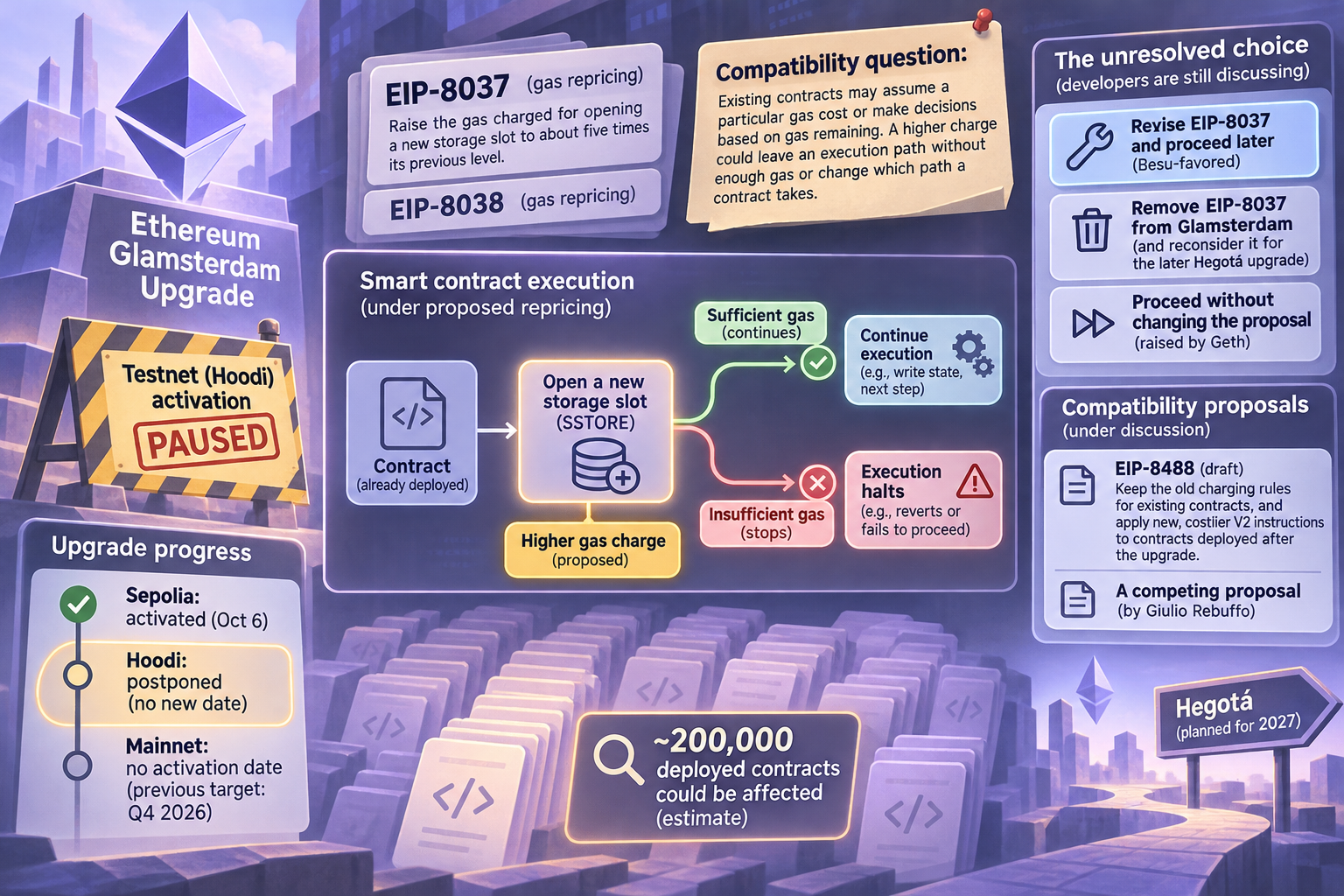
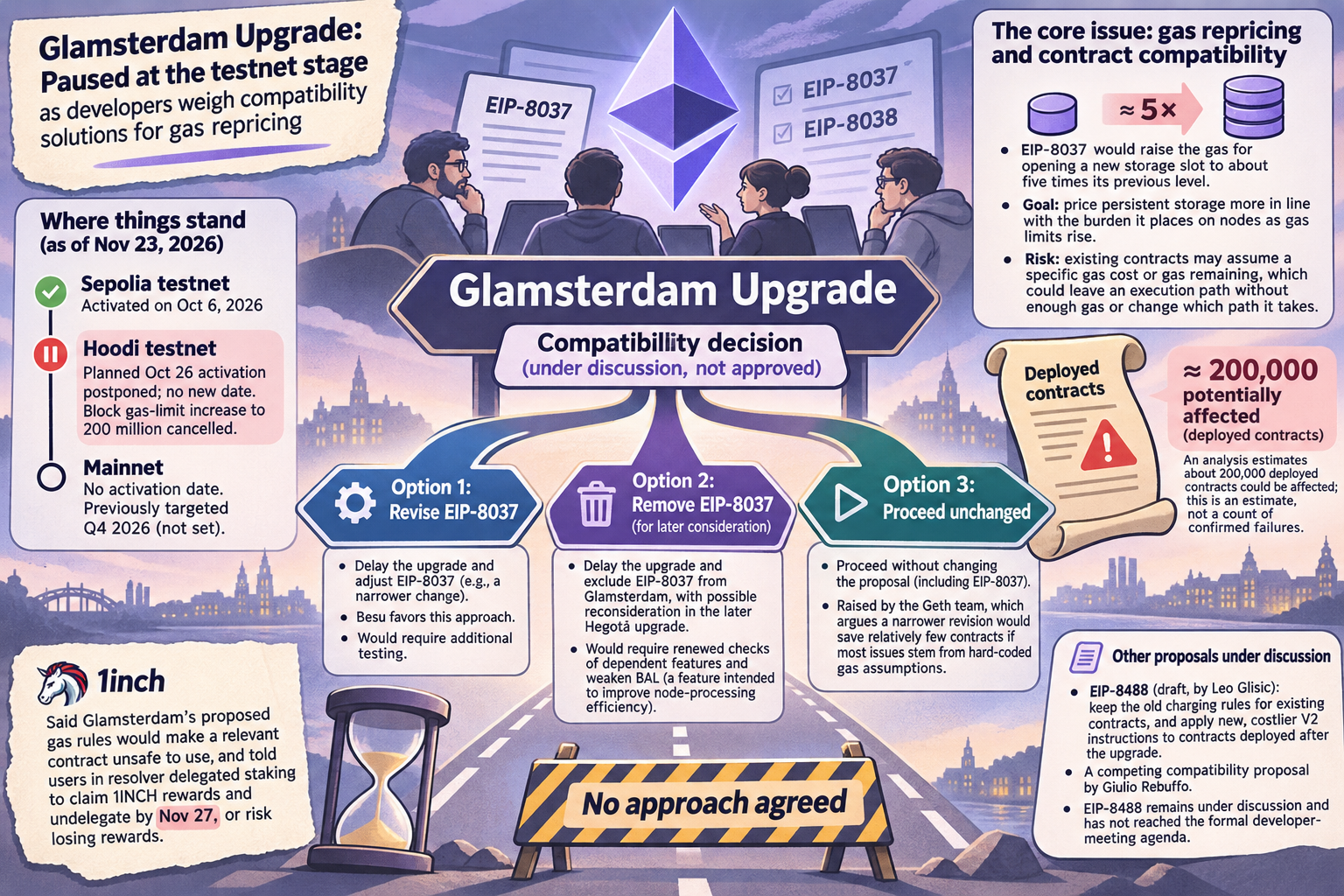
As of November 23, 2026, Ethereum’s Glamsterdam upgrade had no activation date for either the Hoodi testnet or mainnet. The immediate obstacle was a compatibility review of two proposed gas-repricing changes, EIP-8037 and EIP-8038. An analysis cited in the reporting estimated that roughly 200,000 deployed contracts could be affected; that figure is an estimate, not a count of confirmed failures.
What has—and has not—been delayed
Glamsterdam activated on Sepolia on October 6. At the October 22 All Core Developers Execution meeting, developers postponed its planned October 26 activation on Hoodi. The Ethereum Foundation said it needed to investigate EIP-8037’s interactions with mainnet contracts. A concurrent plan to raise Hoodi’s block gas limit to 200 million was also cancelled. On November 6, the foundation said it would not fork Hoodi until the issues were resolved.
The pause concerns the remaining testnet activation, not an upgrade already deployed to mainnet. Glamsterdam had previously targeted a fourth-quarter 2026 mainnet release, but no mainnet date had been set by the reporting date.
Why repricing creates a compatibility question
EIP-8037 would raise the gas charged for opening a new storage slot to about five times its previous level. Its aim is to price persistent storage more closely to the burden it places on nodes as block gas limits rise. The risk is that existing contracts may assume a particular gas cost or make decisions based on gas remaining. A higher charge could leave an execution path without enough gas or change which path a contract takes.
In an August 24 preliminary assessment, the Ethereum Foundation replayed historical mainnet transactions and found relatively few affected contracts, many of which could be addressed by increasing gas limits. The foundation later reviewed the issue with ChainSecurity and Dedaub; the subsequent analysis cited in the report put the number of potentially affected deployed contracts at about 200,000. The report does not establish that every contract in that estimate would fail in production.
The unresolved choice
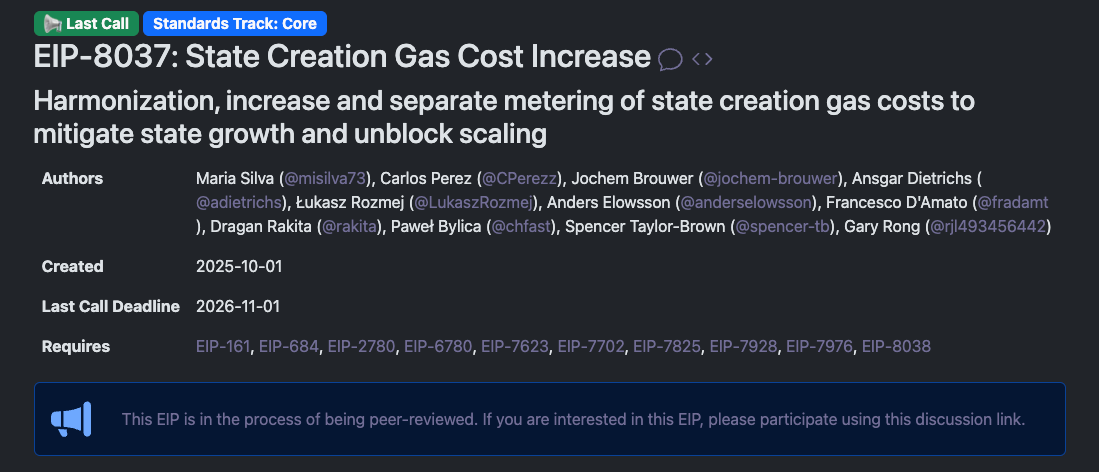
Ahead of the November 19 developer meeting, the Besu team described two paths, both involving a delay: revise EIP-8037 before proceeding, or remove it from Glamsterdam and reconsider it for the later Hegotá upgrade. Besu favored revision and warned that removal would require renewed checks of dependent features and weaken BAL, a feature intended to improve node-processing efficiency.
The Geth team disputed Besu’s framing. It said proceeding without changing the proposal remained a third option, and argued that a narrower revision would save relatively few contracts if most problems stemmed from hard-coded gas assumptions. Besu said it could accept losses arising from those assumptions, but not changes that broke contracts’ try/catch fallback behavior or created new problems through a higher gas limit. No approach had been agreed.
Developer Leo Glisic’s draft EIP-8488 offered another possible approach: retain the old charging rules for existing contracts while applying new, costlier V2 instructions to contracts deployed after the upgrade. Giulio Rebuffo submitted a competing compatibility proposal. EIP-8488 remained under discussion and had not reached the formal developer-meeting agenda.
The uncertainty was already affecting application planning. 1inch said Glamsterdam’s proposed gas rules would make a relevant contract unsafe to use, and told users participating in resolver delegated staking to claim 1INCH rewards and undelegate by November 27 or risk losing rewards. The foundation, ChainSecurity and Dedaub had contacted at least 50 affected companies in total; three projects were classified as high-impact, with fixes either completed or expected by mid-December.
Outside reports offered possible 2027 mainnet timelines depending on the decision, but these were projections, not an agreed schedule. Developers said work on Hegotá, planned for 2027, was continuing despite Glamsterdam’s delay.