
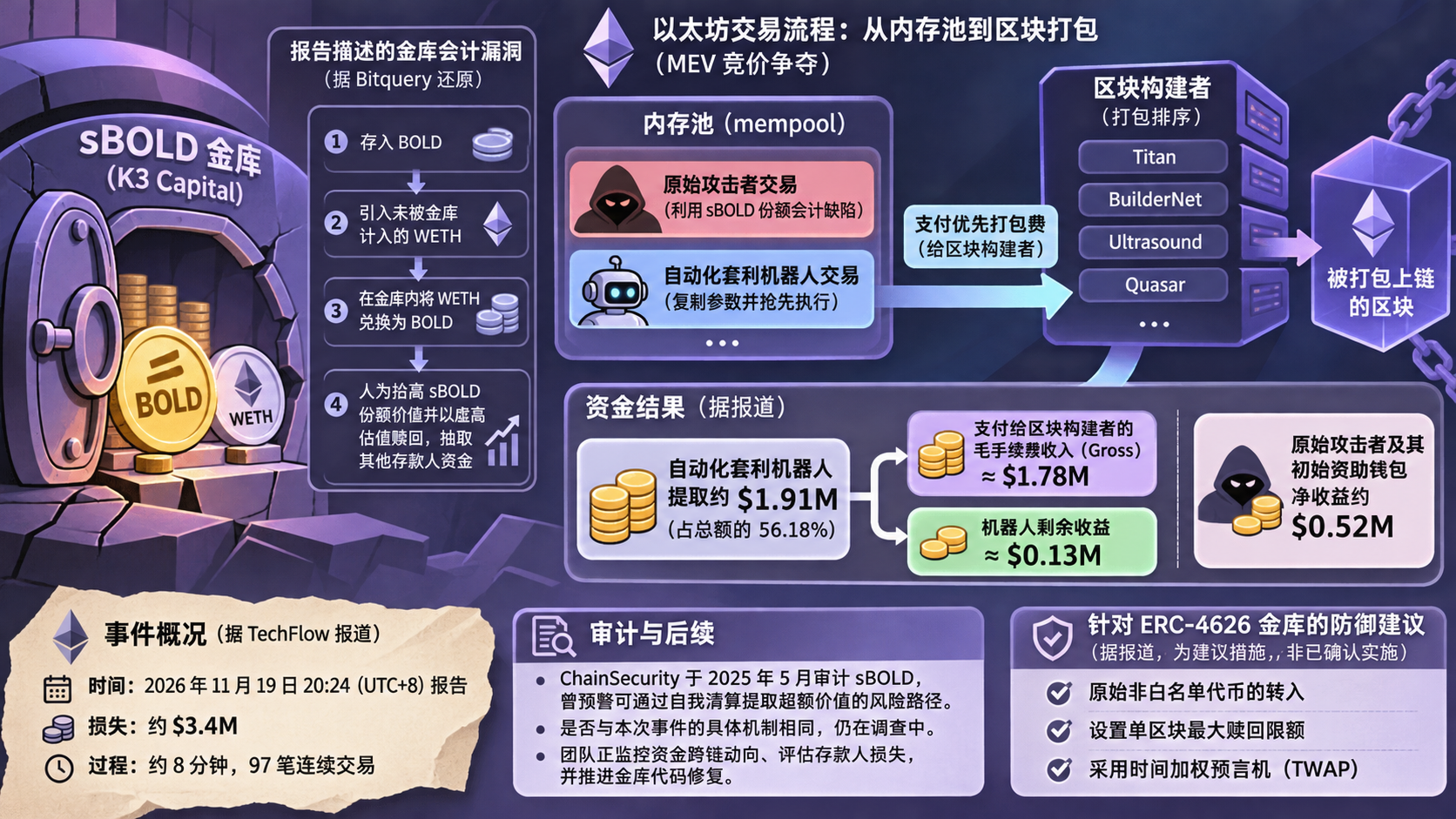
In a report published on November 19, 2026, at 20:24 UTC+8, TechFlow said K3 Capital’s Ethereum sBOLD savings vault had lost approximately $3.4 million in an attack lasting about eight minutes. Citing transaction analysis by Bitquery, it reported 97 consecutive transactions. The account describes both a vault-accounting exploit and an unusually costly contest over who could execute the profitable transactions first; it does not establish that the two mechanisms were the same vulnerability.
The reported accounting failure
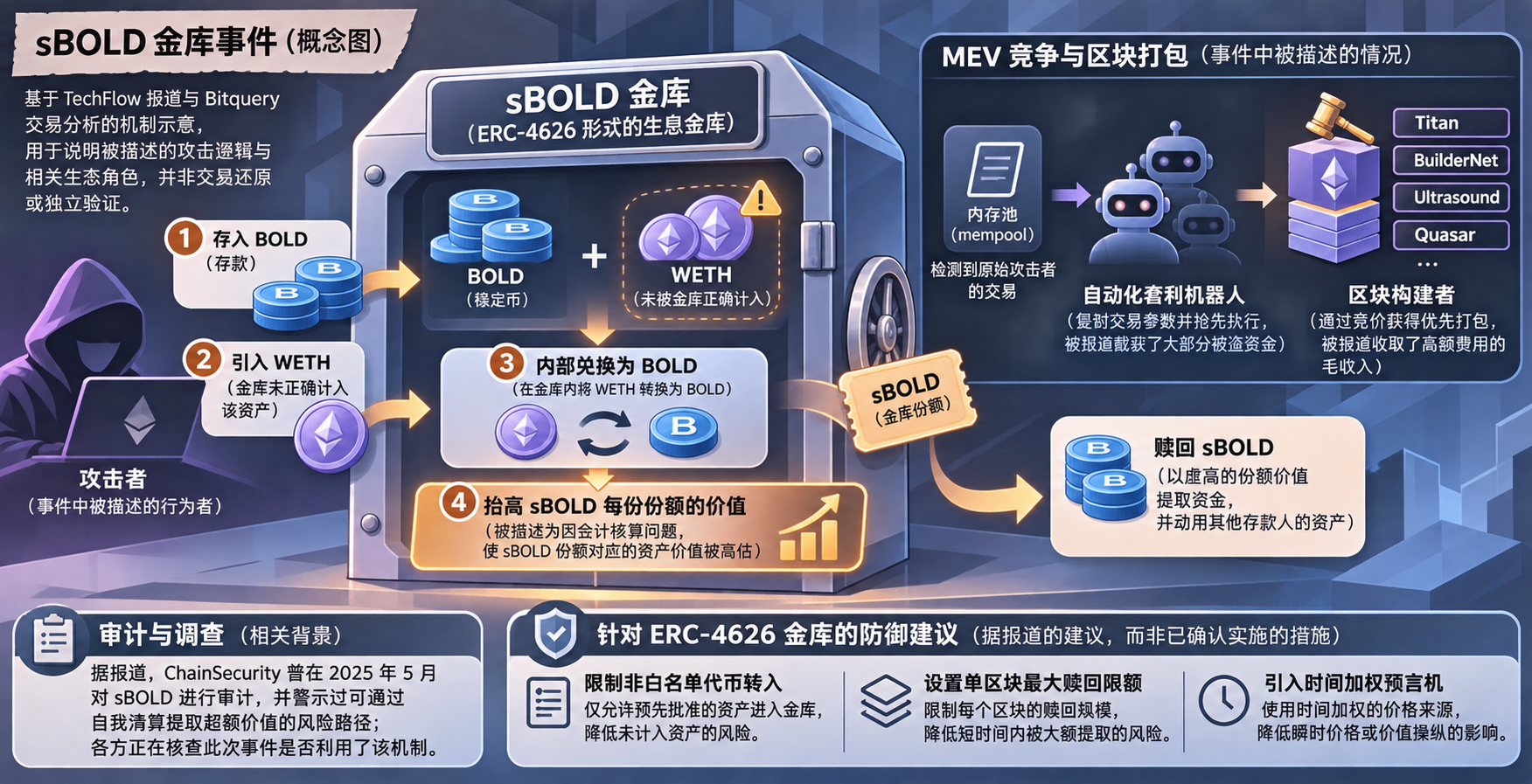
sBOLD is a yield-bearing vault built around BOLD, the stablecoin of the Liquity protocol. According to the Bitquery reconstruction described by TechFlow, the attacker repeatedly deposited BOLD, introduced wrapped ether (WETH) that the vault had not accounted for, and converted it internally to BOLD. That sequence allegedly inflated the value assigned to each sBOLD share, allowing redemptions at an overstated value and drawing on other depositors’ funds. The supplied report does not provide the transactions or accounting calculations needed to independently verify that reconstruction.
Where the extracted funds went
TechFlow reported that automated bots detected the original attacker’s transaction in the mempool, copied its parameters and executed ahead of it. The bots reportedly extracted about $1.91 million, or 56.18% of the roughly $3.4 million total. They paid approximately $1.78 million in fees to block builders for priority inclusion, leaving about $130,000 after those payments, according to the report.
TechFlow named Titan, BuilderNet, Ultrasound and Quasar among the builders involved. It cautioned that the $1.78 million was gross builder revenue, not builder profit: builders also bid for block inclusion through MEV-Boost. The report put the original attacker’s and initial funding wallet’s combined net proceeds at approximately $520,000.
Audit question and response
TechFlow said ChainSecurity had audited sBOLD in May 2025 and warned of a route to extract excess value through self-liquidation. Whether that warning described the mechanism used in this incident was still under investigation. The report also said the team was monitoring cross-chain fund movements, assessing depositor losses and working on vault-code repairs. Its suggested defenses for ERC-4626 vaults—including restricting transfers of non-allowlisted tokens, limiting redemptions per block and using a time-weighted oracle—were recommendations, not measures confirmed to have been implemented.