As reported on November 19, 2026, Pearl’s FP8 upgrade had gone live on testnet the previous day. The Bitcoin code fork aims to let AI inference providers earn PEARL block rewards by submitting proofs of computation they already perform for customers. The testnet change broadens the work that can qualify for mining, but it does not establish that rewarded blocks correspond to real customer requests.
What FP8 changes
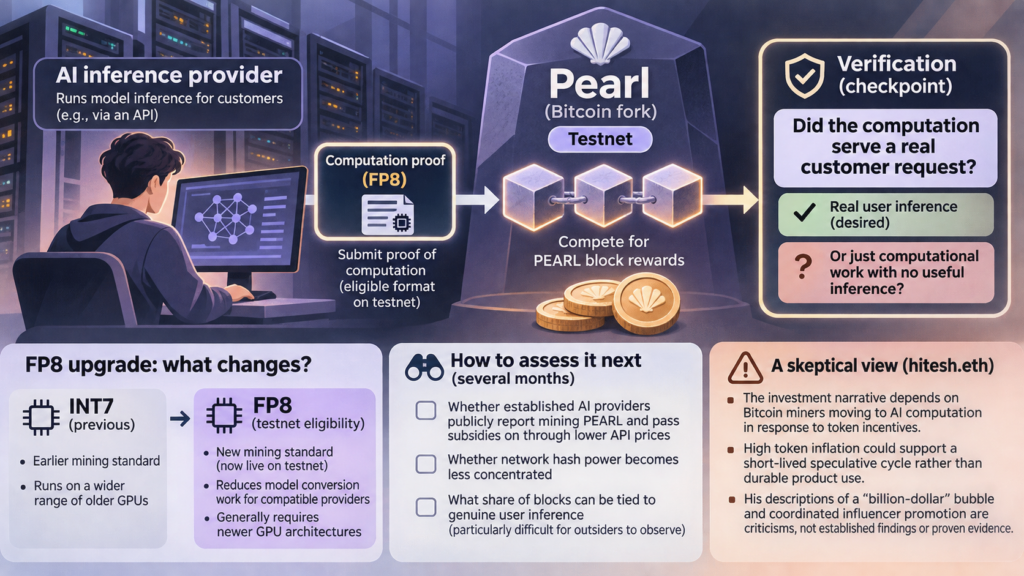
Bankless analyst David Christopher describes Pearl’s proposed mechanism as “Duplex Work”: an inference provider would use computation associated with serving a model to compete for block rewards. Under the earlier mechanism, eligible work was limited to INT7. Providers using other precisions would have had to convert their models to participate. The testnet upgrade moves the mining standard to FP8.
The November 19 account says more than 80% of model-inference traffic on platforms such as OpenRouter runs in FP8. That figure is presented in the source without a named dataset or measurement date, so it should not be treated as an independently verified adoption metric. FP8 could reduce conversion work for compatible providers, while also raising the hardware bar: the account says INT7 runs on a wider range of older GPUs, whereas FP8 generally requires newer architectures.
The proof Pearl still needs
Pearl does not currently require miners to perform real AI inference to receive rewards, according to the account. It says miners can instead produce computational work with no useful inference behind it. FP8 compatibility does not close that gap; distinguishing customer-serving computation from such work would require stronger verification.
The account proposes three ways to assess the mechanism over the following months: whether established AI providers publicly report mining PEARL and pass subsidies on through lower API prices; whether network hash power becomes less concentrated; and what share of blocks can be tied to genuine user inference. It notes that the last measure is particularly difficult for outsiders to observe. No results for those tests are provided.
Crypto researcher hitesh.eth offers a separate, skeptical interpretation. He argues that the investment narrative depends on Bitcoin miners moving toward AI computation in response to token incentives, and warns that high token inflation could support a short-lived speculative cycle rather than durable product use. His descriptions of a “billion-dollar” bubble and coordinated influencer promotion are criticisms, not established valuation findings or proven evidence of coordination.
The central distinction is therefore between accepting FP8 work on a testnet and demonstrating useful, verifiable inference at scale. The reported upgrade addresses compatibility; the supplied account does not show that Pearl has solved the latter problem.