As reported on November 6, 2026, Kinetiq planned to launch Elysium on November 9. The proposed Hyperliquid-connected chain is intended to give token issuance, trading and DeFi applications more execution capacity than they can obtain on HyperEVM alone. Its launchpad designs also raise a more specific question: can trading fees support projects after their initial launch?
The execution-capacity argument
HyperCore handles Hyperliquid’s order books and trade matching, while HyperEVM runs smart-contract applications. They share underlying state, and HyperEVM’s execution capacity must accommodate HyperCore’s operation. Kinetiq’s case for Elysium is that a separate execution environment could better serve crowded, fast-changing applications without placing the same demands on HyperEVM.
In an interview cited in the November 6 report, Kinetiq co-founder Omnia said Elysium uses the Arbitrum technology stack and Conduit’s G2 sequencer, targets 100-millisecond block times, charges gas in HYPE and settles to HyperEVM. The block time is a target, not a measured production result.
The reported application plans included support from Fomo and Pumpfun trading apps, with GMGN announcing it would join on the first day. Omnia also named Uniswap, 0x, KyberSwap, Li.Fi, Wormhole, MetaMask and Rabby among the intended ecosystem integrations. Nest planned to build trading pools on Uniswap v4. These plans describe a potential route from token creation to trading and longer-term liquidity; they do not establish how much activity Elysium would sustain.

Ascend: directing fees toward existing assets
Ascend’s launchpad design aims to make some creator fees conditional on a project’s progress. Part of an early token’s creator fees would be held and released when specified conditions are met. At higher market-cap ranges, creators would receive more of the base trading fee while the protocol’s share would fall. Creators could allocate their share to holder rewards, token buybacks or a combination.
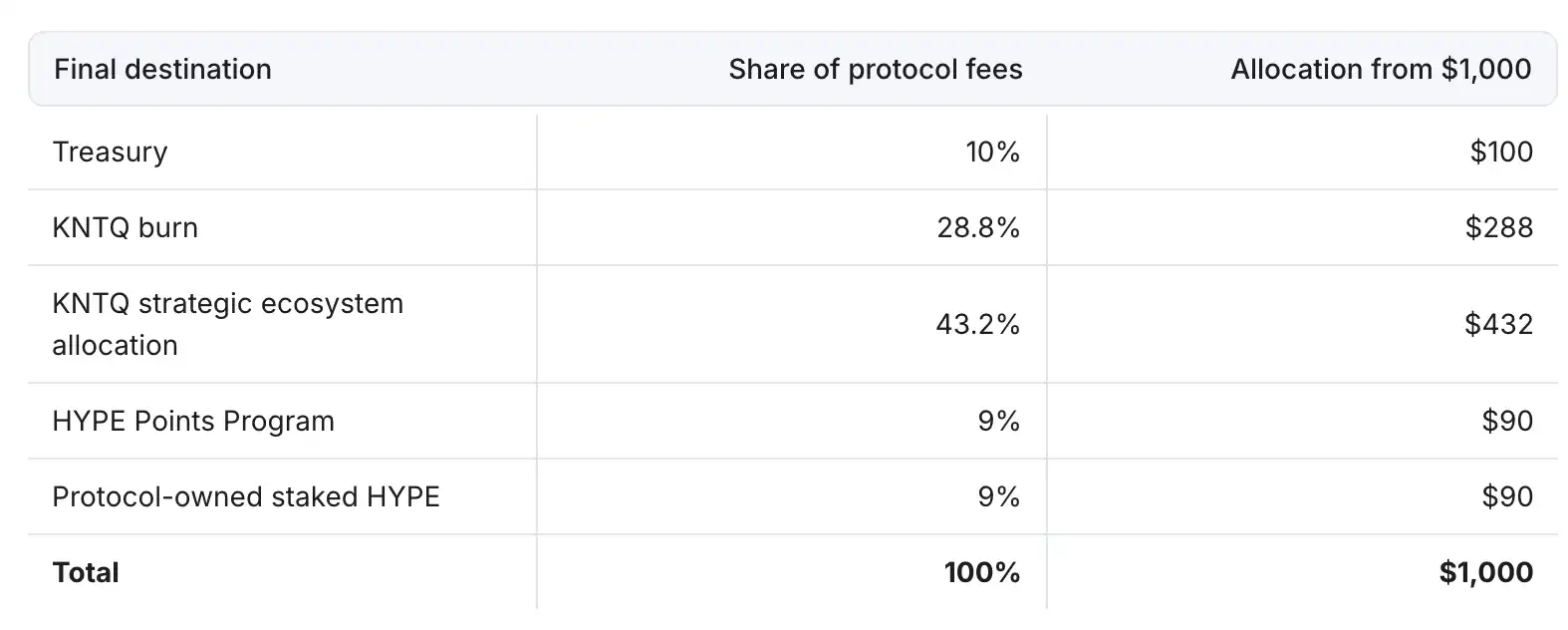
Ascend does not plan a separate platform token; it uses KNTQ as its protocol token. Under its official allocation model, each $100 in protocol fees would send $10 to a treasury, $72 toward KNTQ purchases and $18 toward HYPE purchases. Of the KNTQ purchased, 40% would be burned; the remaining 60% would support ecosystem-token buybacks, an Ascend points program and protocol-owned liquidity. Purchased HYPE would be used for participant rewards and staking.
Omnia said Elysium would use 50% of sequencer revenue to buy back KNTQ. Ascend, in turn, planned to use its share of Elysium sequencer revenue for builder support, including grants and preparation for HyperCore spot listings. Ascend also designed a vault in which deposited kHYPE would generate staking yield to purchase eligible ecosystem tokens for distribution to depositors. These are proposed flows of value, not evidence that the resulting projects will succeed.
Ascend reported approximately $5.97 million in trading volume, 47,254 trades, 873 tokens deployed and $34,808 in protocol fees in its first-day test figures. The report did not provide a measurement methodology or establish that those test figures predict activity after launch.
Montra’s alternative distribution model
Montra takes a different approach: it retains a separate MONTRA token and bases its standard token-launch process on Uniswap v4. Creators can direct their fee income to a team wallet, multiple recipients or token holders. Under Montra’s stated buyback design, 70% of its protocol share would buy and burn MONTRA, while 30% would go to its treasury.
Montra allocated 25% of MONTRA’s total supply to an airdrop across five categories, each representing 5% of supply: existing active HYPE, KNTQ and Elysium users; early Montra creators and traders; participants who discover, trade and hold a top-ten Montra token at the snapshot; liquidity providers; and verified creators, builder referrals and social-content contributors, with verification through its official Discord. As of the November 6 report, Montra had opened pre-trading and had two tokens valued above $1 million in market capitalization. The source did not specify the valuation method or measurement time for those market caps.
What remains unproven
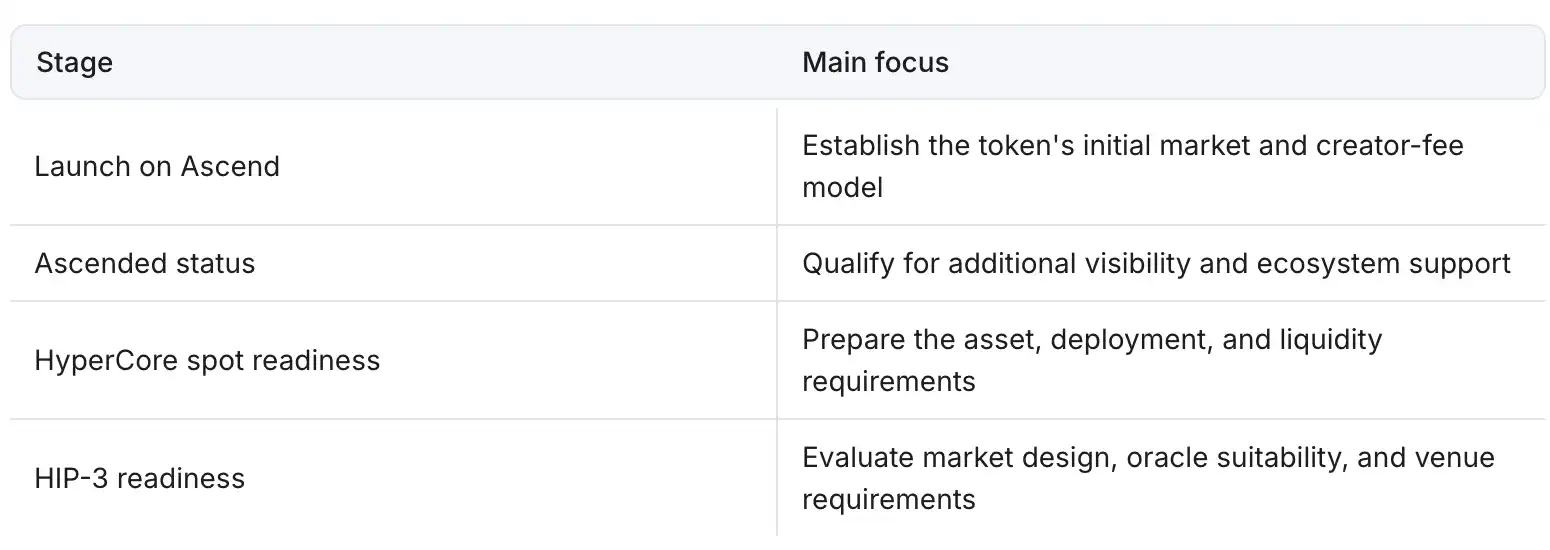
Omnia described a possible progression from Elysium activity to a HyperCore spot listing and, potentially, a perpetual market opened by a HIP-3 deployer. Ascend’s proposed “Ascended” status would prepare eligible projects for that path. Elysium also intends to expose HyperCore pricing and order-book depth so market makers could quote spot trades on Elysium and hedge on HyperCore. These are intended workflows, not assured listings, liquidity or hedging outcomes.
The distinction between the launchpads is clear on paper: Ascend routes fees toward KNTQ, HYPE and ecosystem support, while Montra uses its own token for distribution and buybacks. As of the original November 6 reporting, the open question was whether those mechanisms would fund durable liquidity and projects beyond an initial burst of issuance and trading.