Chainalysis data reported on November 18, 2026 (UTC+8) shows a divergence in Eastern Europe’s crypto activity during July 2025–June 2026: total activity fell, while the value of smaller transfers to crypto services rose. The distinction matters because the dollar value of flows does not, on its own, measure how many people used crypto or why they made transfers.
A regional decline led by larger transfers
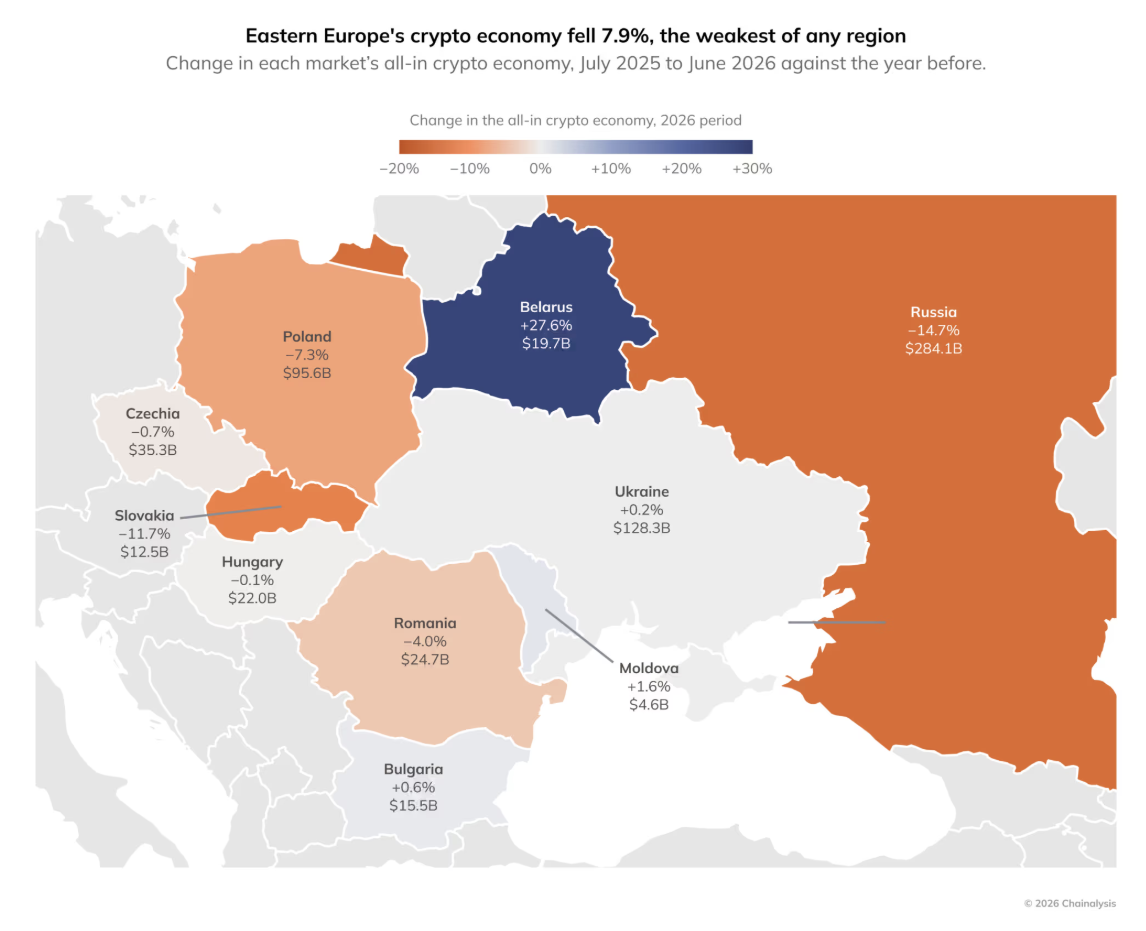
Chainalysis estimated Eastern Europe’s crypto economy at $642.1 billion, down 7.9% from $697.1 billion a year earlier. That was the steepest decline among the regions it tracked, compared with a 1.6% decline globally. Russia accounted for roughly 44% of the regional total; its activity fell 14.7% to $284.1 billion. Belarus recorded 27.6% growth, while Bulgaria, Moldova and Ukraine saw smaller increases.
The value of transfers of $10,000 or more to crypto services fell 17.4%, from $591.5 billion to $488.6 billion. Transfers below $10,000 to those services rose 8.3%. The smaller transfers represented 13.1% of the value sent to crypto services in Eastern Europe—the highest share of any region studied, against a global average of 10.1%.
What the figures measure
Chainalysis defines the crypto economy using inflows to crypto services, domestic transfers between personal wallets, and cross-border inflows to personal wallets. Its figures are denominated in dollars, so changes in cryptocurrency prices can affect the totals. A decline in measured dollar value therefore should not be read as an equivalent decline in transaction counts or participation.
The report also found that Eastern European crypto ATM transaction volume rose from $17.3 million to $33.9 million. In Poland, ATM transactions increased 120% despite a 5% decline in centralized exchange activity; stablecoins accounted for roughly 90% of its ATM transactions. These figures describe different channels and do not establish why their activity diverged.
Stablecoin flows to Ukraine
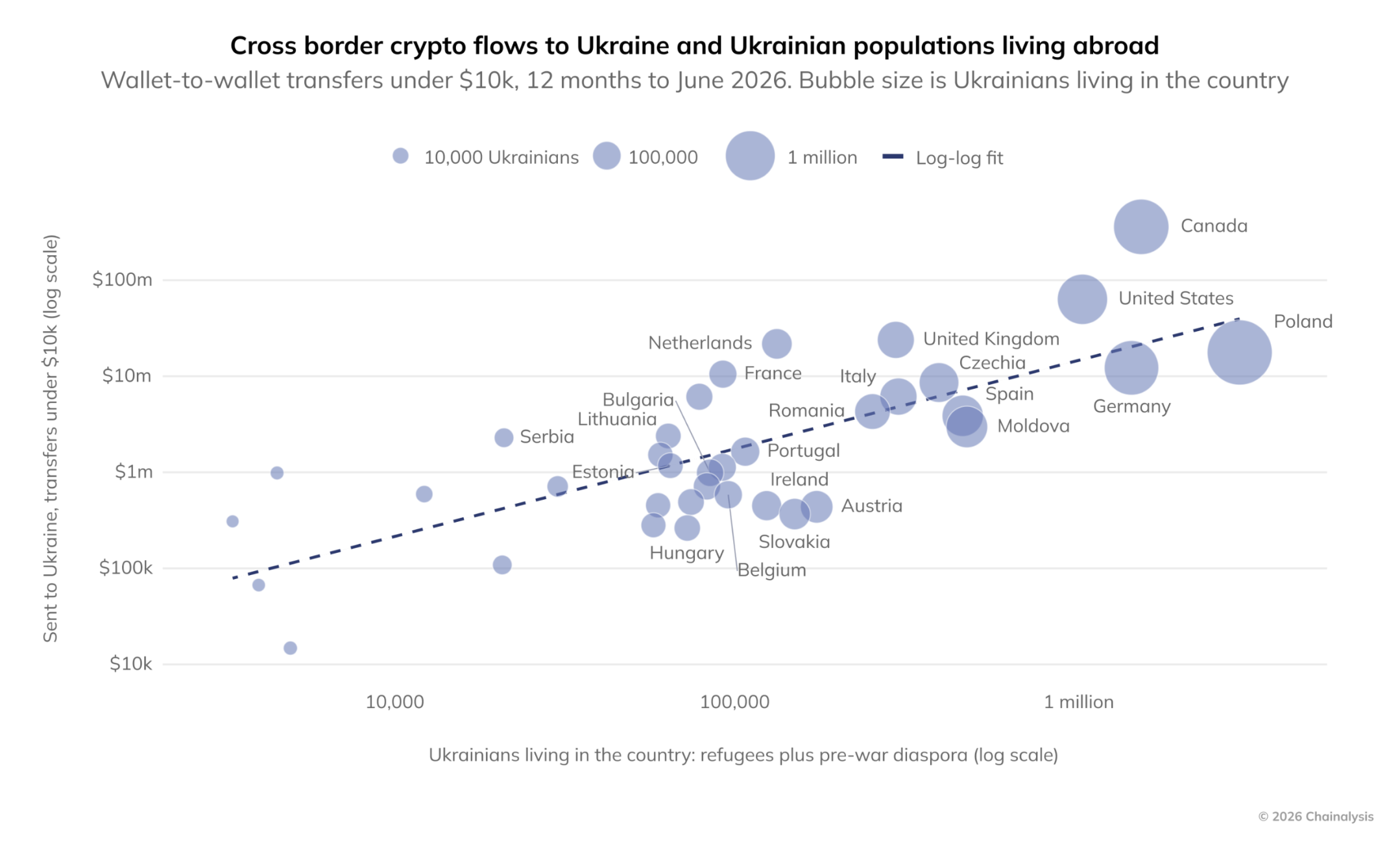
Ukraine received $12 billion in cross-border wallet-to-wallet stablecoin transfers, including $2.41 billion in transfers below $10,000, according to Chainalysis. The firm found that countries with larger Ukrainian populations—including established diaspora communities and refugees who arrived after Russia’s full-scale invasion in February 2022—generally sent more stablecoins to Ukraine. Among 36 countries studied across Europe and North America, Canada was the largest source of retail-sized, remittance-like transfers, at $359 million.
A Chainalysis spokesperson told Cointelegraph that the cross-border flows were largely denominated in US dollar-pegged stablecoins. The firm did not provide a breakdown by token. The relationship with diaspora population is a reported pattern, not proof of the purpose of each transfer.