
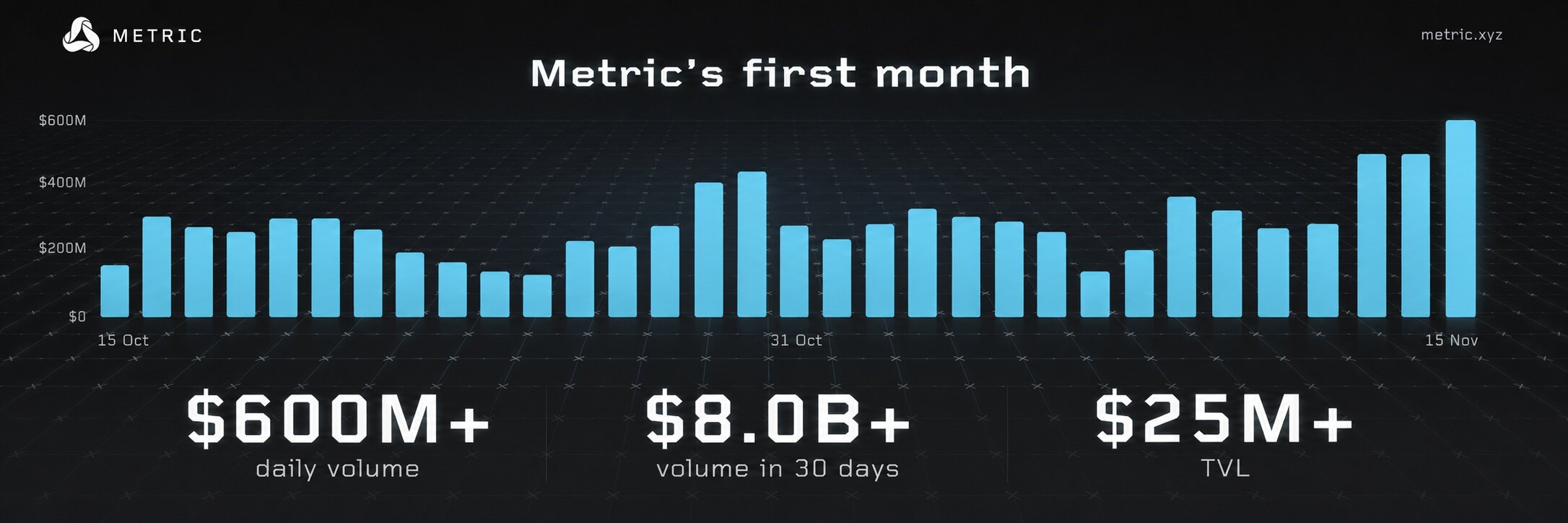
In reporting published on November 17, 2026, Metric said its decentralized spot exchange had processed more than $8 billion in its first month after launch, including more than $600 million in a single day, while holding just over $25 million in total value locked (TVL). Metric disclosed those figures on November 15; the report does not provide an independent volume analysis. The gap between reported trading volume and TVL raises a mechanism question: how can a relatively small pool of capital remain available for repeated trades?
Liquidity that follows a reference price
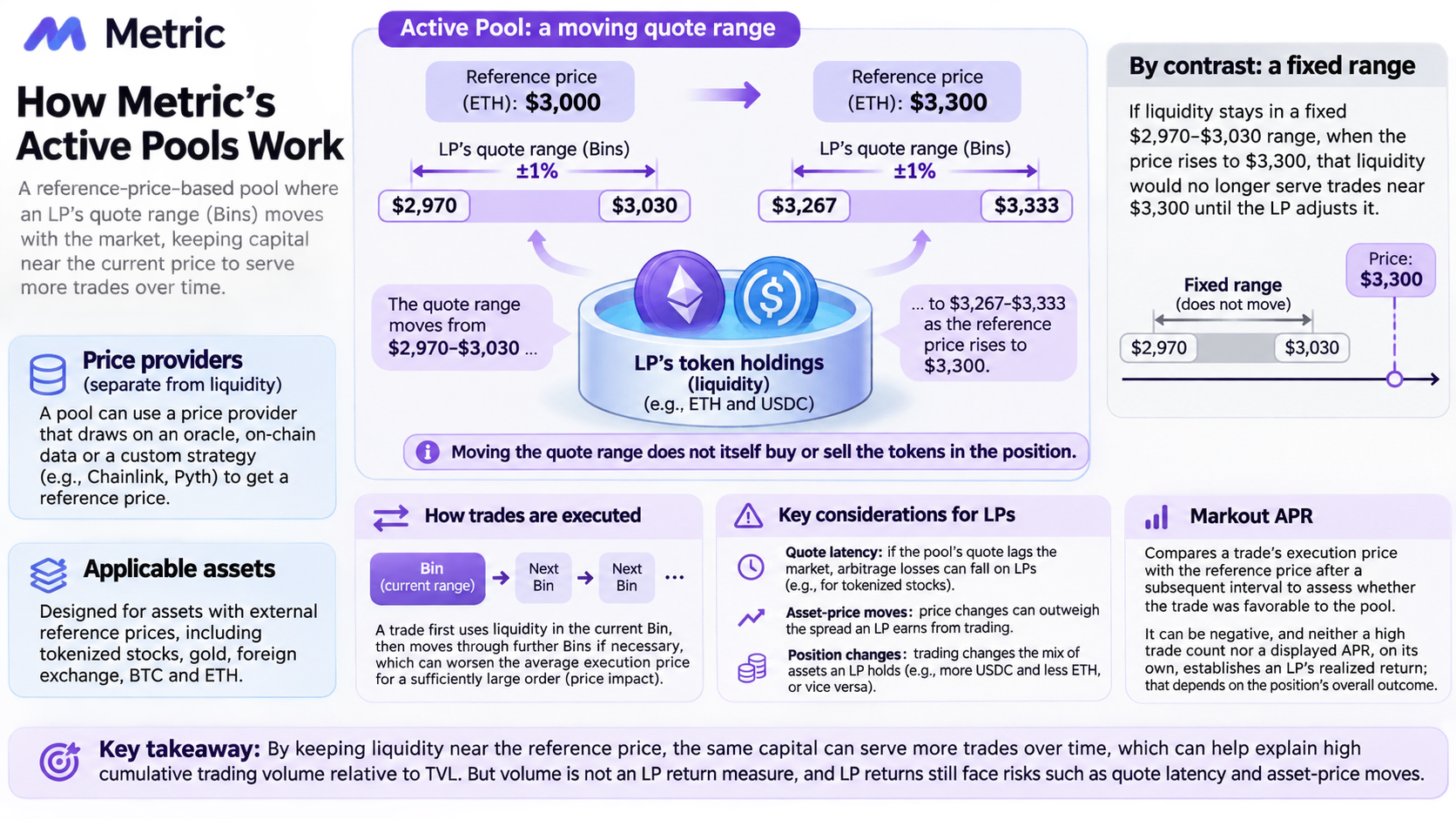
Metric is built around Active Pools. Rather than deriving quotes solely from the assets held in a pool, its design separates pricing from liquidity placement. A pool can use a price provider drawing on an oracle, on-chain data or a custom strategy; Metric’s public code includes integrations for Chainlink and Pyth. The approach is intended for assets with external reference prices, including tokenized stocks, gold, foreign exchange, BTC and ETH.
Liquidity providers (LPs) allocate assets to price ranges called Bins, which move with the reference price. In the report’s example, an LP selects a range 1% above and below an ETH reference price of $3,000: $2,970–$3,030. If that reference rises to $3,300, the range moves to $3,267–$3,333 without the LP withdrawing and redeploying funds. Moving the quote range does not itself buy or sell the tokens in the position. By contrast, liquidity left in a fixed $2,970–$3,030 range would no longer serve trades near $3,300 until the LP adjusted it.
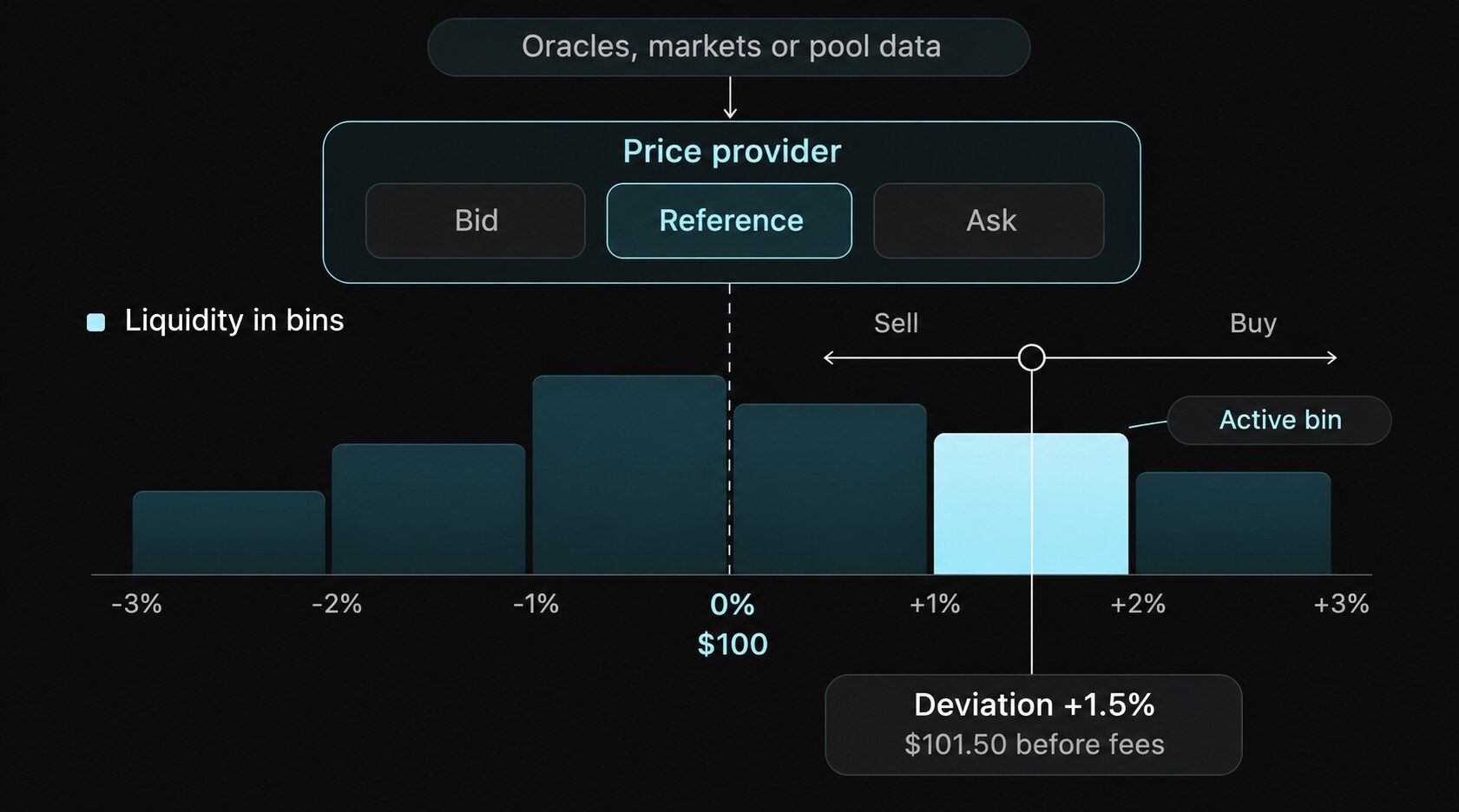
Keeping capital near the reference price could let it serve more trades over time, offering a possible explanation for high cumulative volume relative to TVL. It does not mean every trade receives the same price. A trade first uses liquidity in the current Bin, then moves through further Bins if necessary, worsening the average execution price for a sufficiently large order. Trading also changes the mix of assets an LP holds.
Volume is not an LP return measure
Following an external price introduces its own dependency: if a pool’s quote lags the market, arbitrage losses can fall on LPs. For tokenized stocks, that matters because the price of the underlying share can change in an external market while the on-chain pool still quotes an older price. Asset-price moves can also outweigh the spread an LP earns from trading.
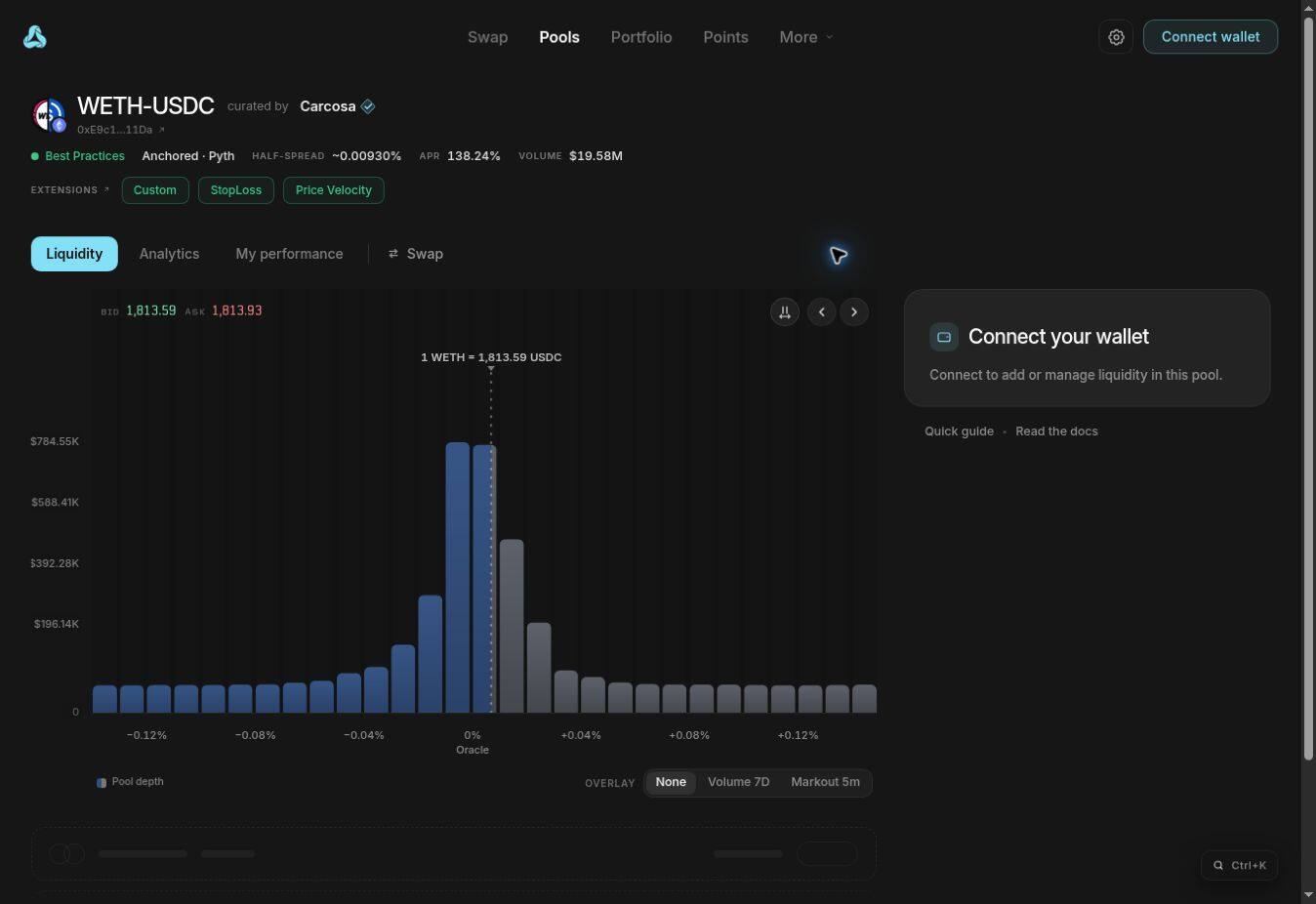
Metric offers a metric called Markout APR, which compares a trade’s execution price with the reference price after a subsequent interval to assess whether the trade was favorable to the pool. It can be negative. Neither a high trade count nor a displayed APR, on its own, establishes an LP’s realized return; that depends on the position’s overall outcome.
Metric supports private pools run with a market maker’s own capital and public pools that accept outside liquidity. Its CTO, Christos Gkolias, previously spent three and a half years at Uniswap Labs as an engineering director and also worked at Google. Those credentials describe the team, not independent verification of the exchange’s reported activity or LP results.
Metric also announced a points program on November 13, allocating one million points per week across trading, liquidity provision, pool management and referrals. It said accrual began on October 15 and included the preceding four weeks of activity. The program is distinct from the trading mechanism and does not resolve the risks to LP returns.