
Bitcoin traded at 60,789.52 USDT at 09:14 Beijing time on November 27, 2026, down 0.02% over 24 hours. Ether was down 0.15% at 1,702.06 USDT. Both moved less than the broader crypto market: at 09:12, total market capitalization was about $2.105 trillion, down 2.32% over 24 hours.
Two other measures of the bitcoin market came from different time windows. US spot bitcoin exchange-traded funds recorded $453 million in net outflows on November 25, the last session before the Thanksgiving closure. Deribit’s monthly BTC and ETH inverse options, with a combined notional value of about $7.31 billion, were due to expire at 16:00 Beijing time on November 27. Neither figure measured buying or selling in the November 27 morning spot market.
What the derivatives figures showed
BTC options accounted for approximately $6.68 billion of the expiring notional value and ETH options for $630 million. Based on positions outstanding that morning, Bitget estimated the “max pain” levels at $70,000 for BTC and $2,100 for ETH. Both were well above spot. The levels describe the distribution of options positions; they are not forecasts of settlement prices.
Bitget also identified the following potential liquidation zones, where a price move could force leveraged positions to close. These were estimates, not recorded liquidations.
| Asset | Short positions above spot | Long positions below spot |
|---|---|---|
| BTC | $61,100–$61,600 | $59,300–$60,100 |
| ETH | $1,713–$1,725 | $1,663–$1,677 |
Both assets were closer to the upper zone. Short covering there could amplify a rise, but a brief move into the zone would not by itself establish that demand had strengthened across the market.
US fund outflows and a Swiss ETF launch
Net outflows from US spot bitcoin ETFs rose from $231.4 million on November 24 to $453 million on November 25. IBIT accounted for $329.7 million, or about 73% of the latter total. There were no new regular creation or redemption figures during the US holiday, so bitcoin’s subsequent hold above 60,000 USDT did not establish whether fund outflows had slowed.
In Switzerland, BBIT began trading on SIX on November 26 as the country’s first spot bitcoin ETF, with US dollar and Swiss franc trading lines. It gave investors access to physically backed bitcoin exposure through securities accounts. The launch established access, not the scale of subscriptions or secondary-market liquidity.
Strategy shares rose 3.11% and Coinbase shares gained 1.34% on November 25 despite the ETF outflows. Strategy had disclosed on November 23 that it held 851,305 BTC as of November 22 at an average cost of about $75,446 per bitcoin, including fees. The November 27 morning price was about 19.51% below that cost. The difference was an unrealized price comparison, not a realized loss or a liquidation threshold.
MARA’s power acquisition awaited closing
MARA Holdings expected to close its acquisition of Long Ridge Energy & Power on November 27 and complete an accompanying $185 million secured note issuance with an 8.75% coupon. The acquisition had a base price of approximately $1.5 billion and remained subject to closing conditions. MARA shares ended the pre-holiday session at $5.42, up 0.18%.
Closing would give MARA more direct control of power assets while adding financing and integration costs. The economic test would be whether the assets generate enough cash to cover interest and investment, and whether MARA can turn that power capacity into sustained computing revenue. Neither outcome followed from the scheduled closing date.
US regulators: a request to the SEC and guidance from CFTC staff
In a letter made public on November 25, US senators Elizabeth Warren and Chris Van Hollen asked the Securities and Exchange Commission to withdraw a proposed crypto-asset rule and rescind exemptive orders covering certain tokenized-securities trading platforms and liquidity providers. The letter did not change the existing arrangements.
Separately, November 23 guidance from Commodity Futures Trading Commission staff explained when certain regulated trading and clearing institutions could use BTC, ETH or payment stablecoins to meet specified financial-resource requirements. Eligibility depends on the institution and the requirement. The assets remain subject to risk-based valuation discounts and liquidity limits; the guidance was not blanket permission to count crypto holdings at face value.

The US reopening: a rebound concentrated in a few stocks?
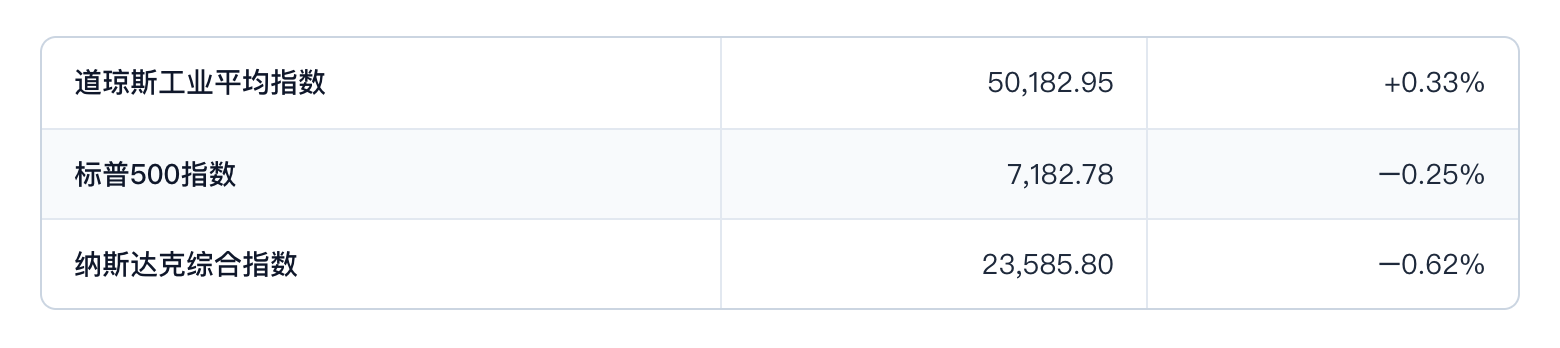
The Black Friday equity session was scheduled to run from 22:30 Beijing time on November 27 to 02:00 on November 28. In the last pre-holiday session, the Nasdaq recovered from an intraday decline of more than 4% but still finished down 0.62%. The S&P 500 fell 0.25%, the Dow rose 0.33% and the VIX rose to 28.29. Among the seven largest technology names tracked in the report, only Meta and Apple closed higher; Nvidia and Amazon lagged.
November 25 trading illustrated the split. Micron fell 4.53%, AMD lost 1.75% and Nebius declined 2.66%, while HP gained 11.49% and Dell rose 0.60% to $297.06. Dell had reported fiscal third-quarter 2027 revenue of $54.9 billion, quarterly AI orders of $60.2 billion and an ending AI backlog of $132.3 billion on November 24. Orders documented demand, but delivery schedules, server margins and customer payments would determine how much cash that demand generated. Customer access to financing, land and power also mattered for delivery.
Nvidia fell 3.91% to $149.30 on November 25, when S&P Global Ratings placed its AA rating on negative watch over management and governance risks. S&P did not downgrade the rating, and its action was not evidence that server orders had declined. In a shortened session, gains across chipmakers, computing companies and the broader market would say more about the breadth of the recovery than a rise in one or two index heavyweights.
Oil supply risk and the interest-rate backdrop
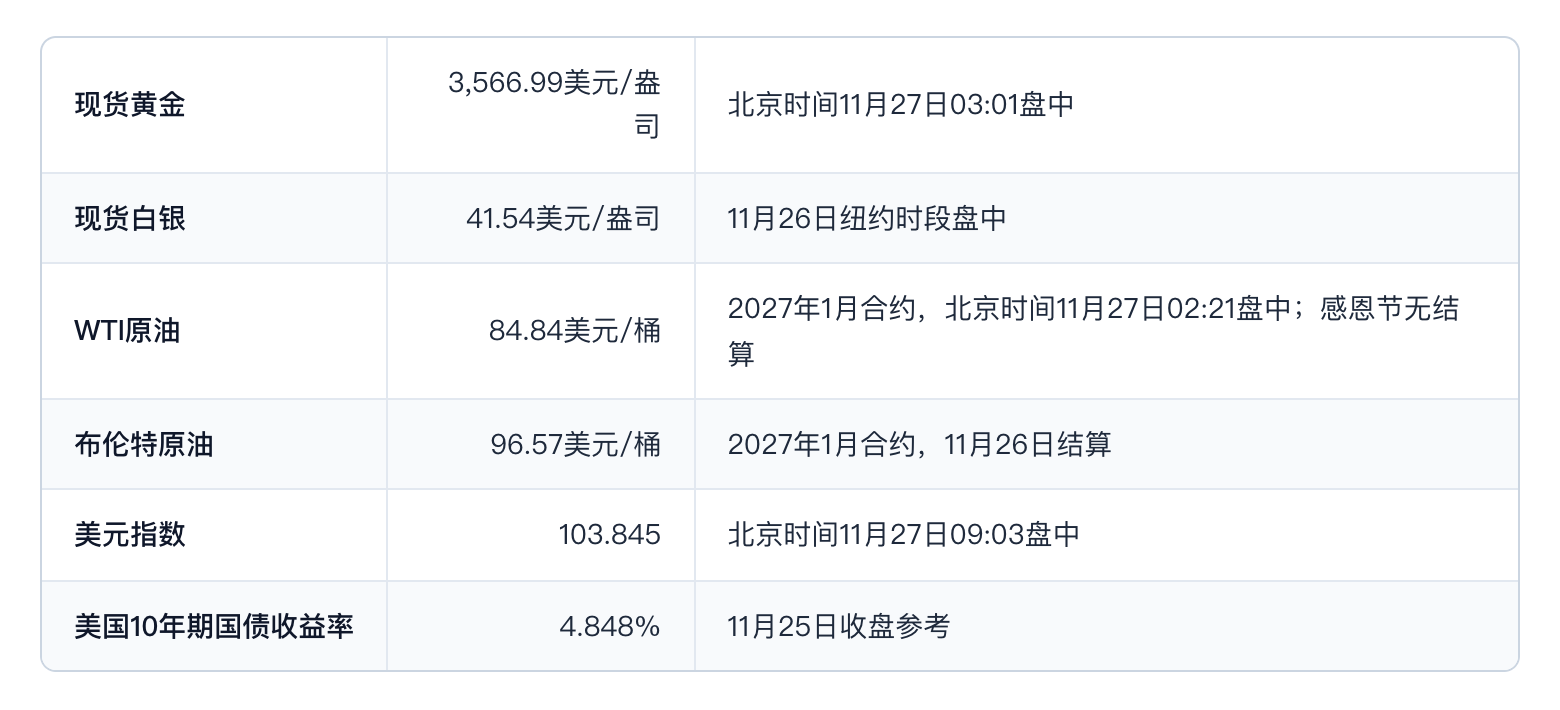
January 2027 Brent settled at $96.57 a barrel on November 26. Iranian authorities said two tankers had struck mines in the Strait of Hormuz, following reports of an attack on a Saudi refinery. The reports raised concerns about supply but did not establish the scale of lost production or disrupted exports. Ahead of the November 29 OPEC+ ministerial meeting, actual loadings and shipping costs mattered alongside production targets: unchanged quotas would not guarantee unchanged deliveries if transport remained disrupted.
The US 10-year Treasury yield had last closed near 4.85%. Spot gold fell about 0.4% in New York trading while silver rose about 0.8%. Oil and gold thus moved in different directions: crude reflected concern about deliverable supply, while higher yields increased the opportunity cost of holding non-interest-bearing gold. TD Securities said on November 26 that it was too early to conclude gold and other precious metals had bottomed.
Tokyo’s November inflation data also showed why the treatment of energy matters. Core consumer prices, which exclude fresh food but include energy, rose 2.9% year over year, up from 2.6% but below the 3.0% consensus. Excluding both fresh food and energy, inflation slowed from 2.6% to 2.5%. The first measure alone therefore did not establish that underlying inflation had accelerated ahead of the Bank of Japan’s December rate decision; subsequent wage and services-price data remained relevant.