
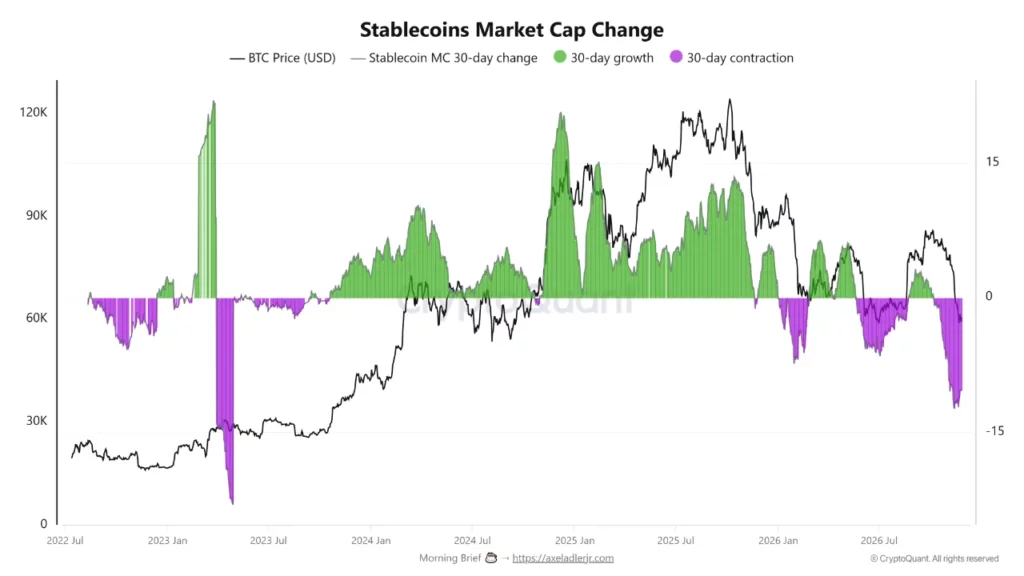
Bitcoin traded near $61,720 on November 27, 2026, up 2% in 24 hours even as total stablecoin market capitalization stood about 12% below its level 30 days earlier. CryptoQuant contributor CryptoZeno saw the contraction as a constraint on a sustained recovery: fewer stablecoins were available to absorb future selling. The figure did not, however, measure demand for Bitcoin during the rebound.
Bitcoin’s daily trading volume reached $23.17 billion, with a market capitalization of $1.24 trillion, according to crypto.news market data. The advance extended beyond Bitcoin: Ethereum rose 2.5% to $1,730.81, BNB gained 1.8% to $560, XRP climbed 2.6% to $0.98 and Solana rose 3.5% to $73.48.
What the stablecoin contraction measures
Stablecoins provide dollar-denominated funds that traders can use across exchanges, trading pairs and decentralized finance applications. Their market capitalization measures the size of that pool, not how much of it holders intend to spend on Bitcoin. On November 27, Tether’s USDT accounted for approximately $173.85 billion and USDC for $69.15 billion, or about $243 billion combined. Their reported combined daily trading volume was $45.35 billion, including $35.79 billion for USDT and $9.55 billion for USDC.
CryptoZeno noted that stablecoin supply often expanded alongside Bitcoin’s price during the 2024–2025 rally, but the timing varied: supply changes sometimes preceded price moves. Unusual fluctuations in early 2023 also illustrated why a single reading makes a poor signal. Temporary contractions have not consistently led to prolonged bear markets. For CryptoZeno, a slowing contraction, followed by a return to positive monthly supply growth and an improvement in Bitcoin’s price trend, would make a sustained reversal more convincing.
Bitcoin held steady despite negative demand readings
In a separate November 27 assessment, CryptoQuant contributor CW_ noted that Bitcoin’s demand indicator had stayed negative at roughly the same level for five consecutive days without a corresponding price decline. CW_ interpreted that divergence as evidence that buyers were absorbing sales. It was not evidence that demand had already turned positive: the analyst said a less negative reading alongside a price recovery would strengthen the case for a rebound.
Asset manager 21Shares examined funding over a different interval. It reported a $10.7 billion decline in stablecoin supply over 18 days, the largest dollar decline over a period of that length since the Terra ecosystem collapsed in 2022. It also reported a 15% drop in stablecoin balances on exchanges. Separately, US spot Bitcoin and Ethereum exchange-traded funds recorded combined net withdrawals of $3.9 billion between October 30 and November 13. The researchers identified sustained inflows into spot Bitcoin ETFs and renewed growth in exchange stablecoin balances as developments that could support a more durable recovery.
With Bitcoin below its 200-week moving average near $68,000, 21Shares said a recovery into the $73,000–$75,500 range would indicate stronger upward momentum. On the downside, it highlighted Bitcoin’s $53,250 realized price. That figure estimates the average on-chain cost basis by valuing each coin at the price when it last moved; it is a reference level, not a forecast of where Bitcoin will trade.