BNB Chain has released a litepaper for a new Layer 1 that would tell applications where a transaction is likely to appear before the full block is sealed. The design targets high-frequency trading, real-time payments, private finance and autonomous AI agents. It would use BNB as its native token rather than introduce a new one. As of November 26, 2026, development was ongoing, with work on a public testnet in progress.
What a 20-millisecond preconfirmation means
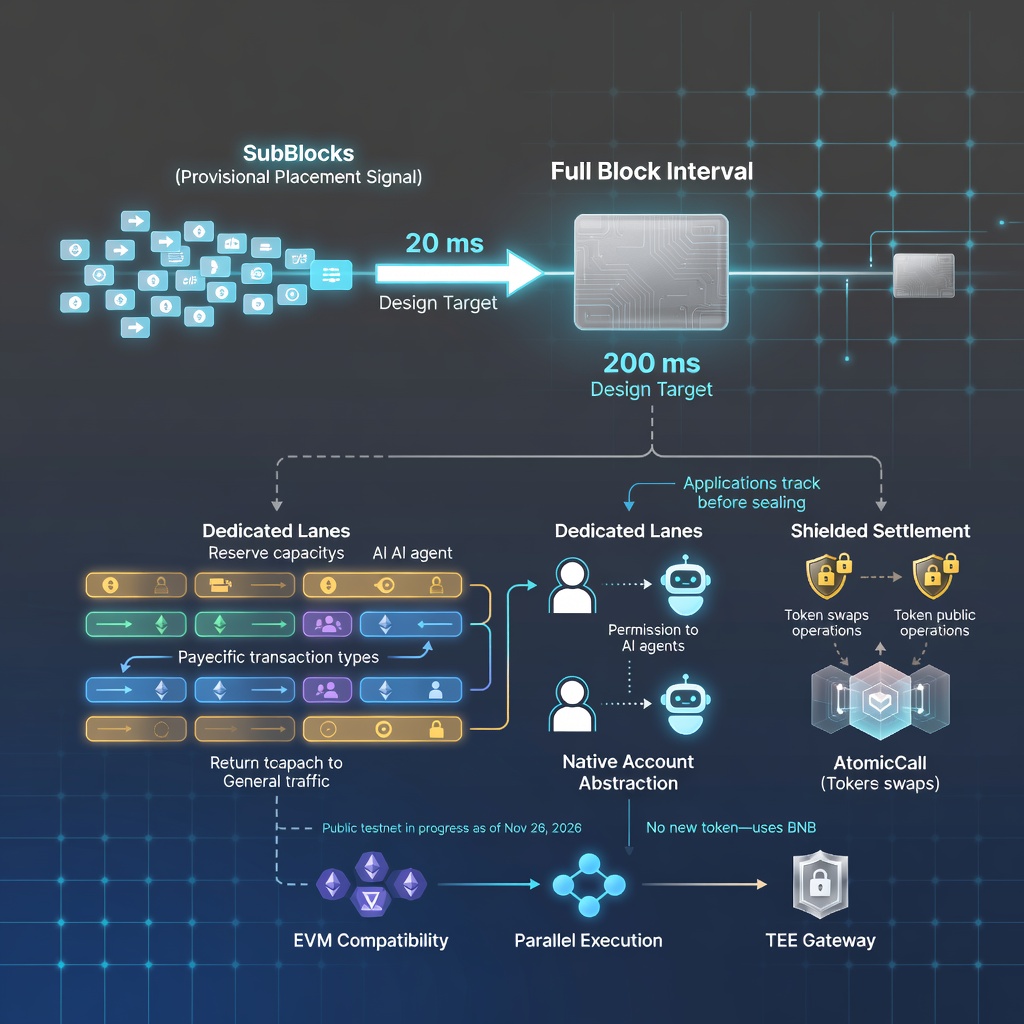
The proposed network would stream small groups of transactions, called SubBlocks, to give applications an early view of transaction ordering. The litepaper specifies preconfirmations in approximately 20 milliseconds and a full block interval of 200 milliseconds. The shorter figure is a design target for provisional feedback on placement, not a time to final confirmation.
Dedicated lanes address a different problem: competition for space within a block. The design would reserve capacity for designated transaction types, such as payments, so a payment would not have to compete with unrelated traffic for every available slot. Any unused reservation would return to general traffic.
Account permissions and shielded settlement
Native account abstraction would let users authorize transactions, batch actions and set limits on permissions delegated to agents. Applications could sponsor transaction fees, so a user would not need to hold BNB to interact with a sponsoring application.
The litepaper proposes shielded settlement for BNB and admitted BEP-20 tokens. A mechanism called AtomicCall would let shielded assets fund selected public operations, including token swaps. The distinction matters: the funding assets can be shielded even when the operation they pay for is public.
What changes for developers
The proposed chain retains Ethereum Virtual Machine (EVM) compatibility, but builders would need to account for differences in transaction formats, fees and execution timing. For state storage, the design replaces the Merkle-Patricia trie with a flat key-value store under a cumulative lattice-hash commitment. Parallel EVM execution and protected transaction ordering through a trusted execution environment (TEE) gateway are planned enhancements.
BNB Smart Chain remains the ecosystem’s primary general-purpose network. BNB Chain has invited builders and researchers to discuss the new Layer 1 design through the BNB Forum.