
Findings reported on November 25, 2026, from the Praxis preprint, cleared for posting on November 23, suggest that researchers could test a Bitcoin bridge design with far less encrypted data and computation than earlier schemes would require. David Tse, Nikhil Vanjani and Psi Vesely calculated those savings for one encryption task, not for a complete bridge withdrawal.
What the proof unlocks and what Bitcoin checks
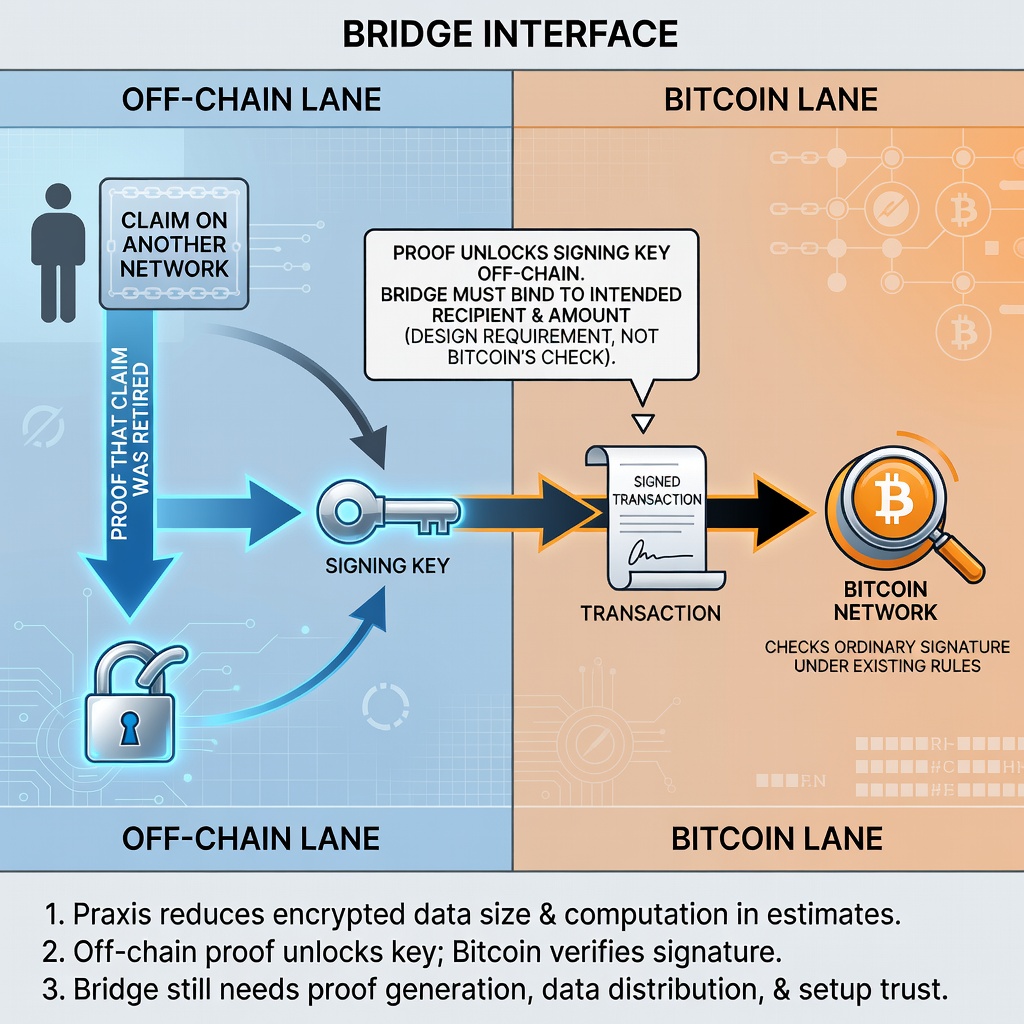
A bridge can lock bitcoin on the mainnet and issue a matching claim on another network. For a withdrawal, the bridge needs to establish that the claim has been retired and authorize the right amount of bitcoin to go to the intended recipient.
The earlier Bitcoin PIPEs v2 proposal illustrates how to divide that work. It uses witness encryption, which makes encrypted information recoverable by anyone who produces or obtains a valid proof for a specified condition. In the bridge example, proof that the claim was retired could unlock a Bitcoin signing key off-chain. Bitcoin would check the resulting transaction signature under its existing rules, without having to verify the more complex proof. The bridge would still need rules binding that signing authority to the intended amount and recipient.
Praxis addresses the encryption step. Where earlier BABE research used witness encryption for one particular mathematical check, Praxis is designed for a wider range of conditions whose solutions can be checked efficiently. The authors identify bridges without a custodian and restrictions on how bitcoin can be spent as possible applications.
What the cost estimate leaves out
In their Groth16 proof-system example, the authors calculated an encrypted package size of 7.88 GiB at their stated 100-bit security level. Holding the condition, key length and stated security level constant, they estimated that both package size and encryption work were less than one ten-billionth of their respective calculated costs for earlier designs by Hair and Sahai. The comparison uses calculated sizes and operation counts across schemes with different security assumptions; it is not a measurement of withdrawal performance.
A bridge would still have to make several gigabytes of encrypted data available for a withdrawal. The authors count the work of opening the package only after a valid proof is available, so that figure excludes the time and computation needed to generate the proof.
The example also depends on an honestly run setup for the proof system. The authors say anyone who retained the setup secret could create proofs that pass verification and open packages tied to that setup. Smaller packages may make the design easier to test, but they do not remove that trust assumption.