
Bitcoin miners supplied more computing power in the week ending November 23, 2026, even as each unit of that power earned less. Luxor put the network’s seven-day average hashrate at 1,033 exahashes per second (EH/s), up from 959 EH/s a week earlier. Over the same week, dollar hashprice fell from $30.27 to $29.36 per petahash per second per day.
Hashprice measures expected gross revenue, before electricity and other costs. The November 23 reading was well below the $55.94 low that Hashrate Index recorded in 2022. The comparison spans a change in how much bitcoin miners earn per block: the April 2024 halving cut the fixed subsidy from 6.25 BTC to 3.125 BTC. Transaction fees supplement the subsidy but accounted for just 0.64% of block rewards in Luxor’s November 23 snapshot. Bitcoin traded near $60,000 on November 24, about 52.5% below its October 2025 price record.

How much mining power remained relative to earlier downturns?
CryptoSlate compared the network 413 days after each cycle’s peak daily price close. For each cycle, it measured the 30-day average hashrate against its highest reading between the price peak and day 413. Averaging matters because blocks can arrive quickly or slowly by chance, moving short-term hashrate estimates. The comparison used Blockchain.com’s daily estimates, Coin Metrics readings for three missing dates in November 2025, and price peaks from Galaxy Research.
| Comparison date | Highest 30-day average in window | 30-day average on comparison date | Share of high |
|---|---|---|---|
| February 2, 2019 | 52.4 EH/s | 41.9 EH/s | 79.9% |
| December 26, 2022 | 265.2 EH/s | 246.8 EH/s | 93.1% |
| November 23, 2026 | About 1,110 EH/s | About 1,013 EH/s | 91.2% |

The matched dates do not show the full depth of each decline. After the December 2017 price peak, hashrate continued climbing until October 2018, then fell to 37.6 EH/s on December 25 before recovering. In the latest cycle, the 30-day average peaked on November 11, 2025, and fell to 896 EH/s on July 28, 2026, about 19.3% below that high. By November 23, the network was closer to its high than at the matched point after the 2018 slump, but slightly farther below it than in 2022.

Power curtailment and the difficulty adjustment
Bitcoin’s mining difficulty fell 9.13% on November 14, 2026. Based on West Texas electricity prices and mining-machine economics, Luxor estimated that miners reducing power use there could account for roughly three-quarters of the 91 EH/s decline in the network’s 14-day average around the adjustment. That is an estimate, not a direct measurement of how much capacity went offline. Riot Platforms has previously earned credits for reducing power consumption.
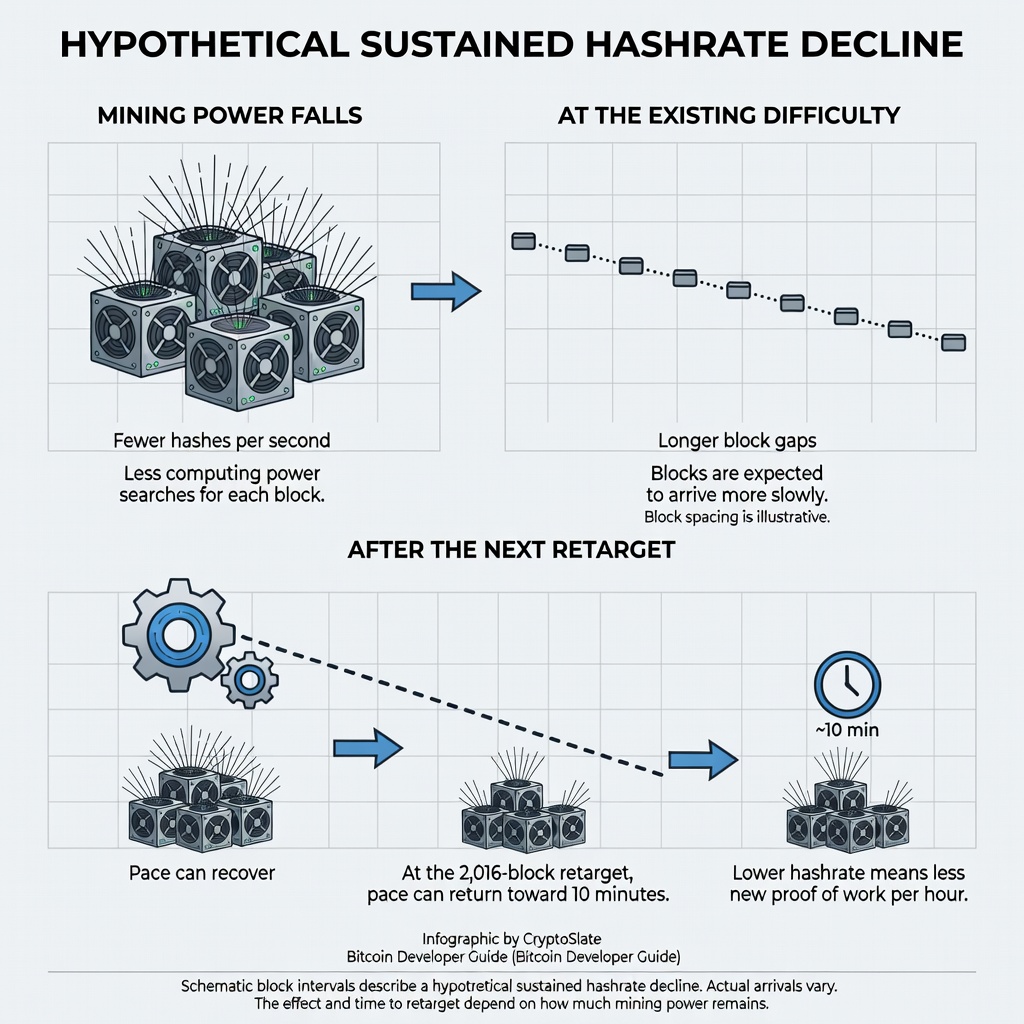
At unchanged difficulty, a sustained loss of hashrate lengthens the expected interval between blocks. Bitcoin recalculates difficulty every 2,016 blocks, allowing the interval to move back toward its 10-minute target. Recovering that pace does not mean the lost computing power has returned: while hashrate remains lower, the network accumulates less new proof of work per hour.
AI tenants compete for powered sites
Company disclosures show another use for some mining infrastructure. Core Scientific reported $215.4 million in third-quarter colocation revenue and was billing for 485 megawatts of capacity as of September 30. IREN said its Horizon 1 facility entered service for Microsoft during the September quarter. Its mining revenue fell to $28 million from $67 million in the preceding quarter.
Riot’s figures distinguish a future commitment from a current change in mining output. The company mined 1,637 BTC in the third quarter, up from 1,406 BTC a year earlier. It separately disclosed a 910-megawatt powered-land lease for AI at Corsicana, with first delivery scheduled for September 2027. That lease documents competition for powered land, not a measured loss of Bitcoin hashrate in November 2026.