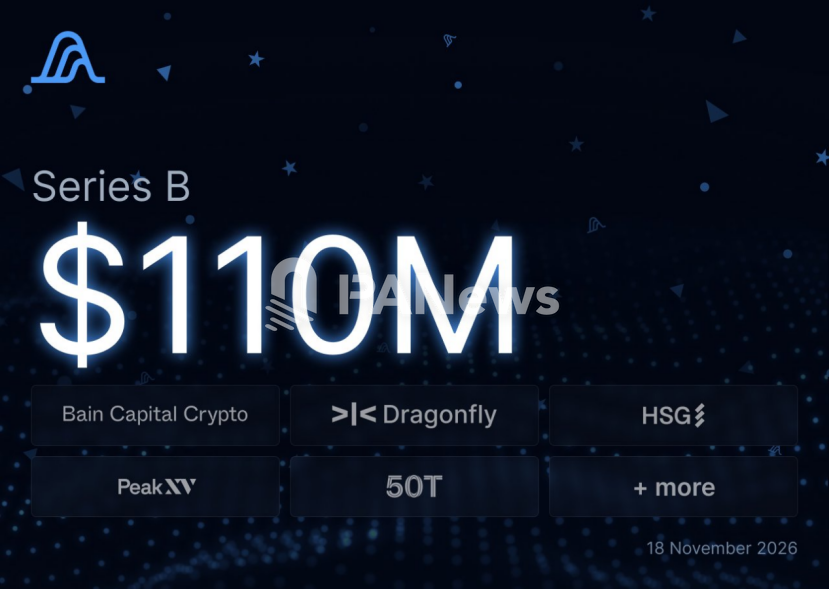
Variational announced a $110 million Series B on November 18, 2026, at a $1.5 billion post-money valuation. Bain Capital Crypto led the round, with Dragonfly, HSG, Peak XV, 50T Funds and Coinbase Ventures participating. As reported by PANews on November 19, the financing brings Variational’s cumulative funding to approximately $171.8 million, including about $61.8 million raised before this round.
The research question is what the new capital enables. Variational’s on-chain derivatives venue does not rely on an exchange-style order book: its built-in Omni Liquidity Provider, or OLP, quotes prices, takes the other side of customer trades and manages the resulting exposure. That design can give traders access to markets beyond crypto, but it concentrates pricing, hedging and operational risk in one provider.
What the reported activity shows
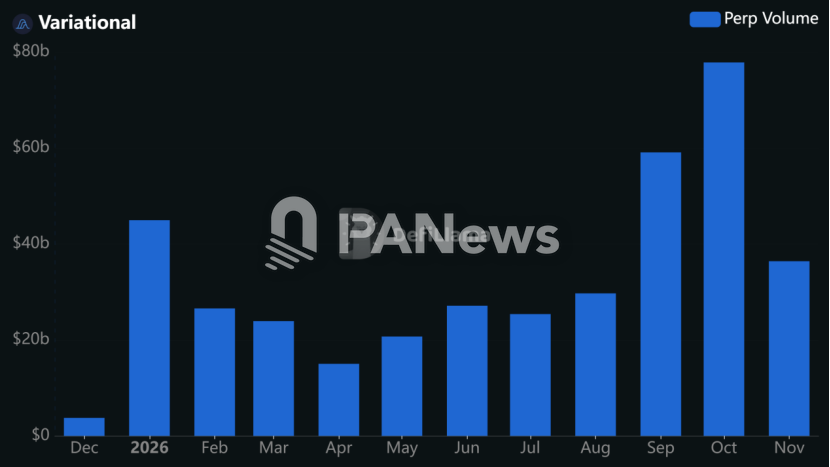
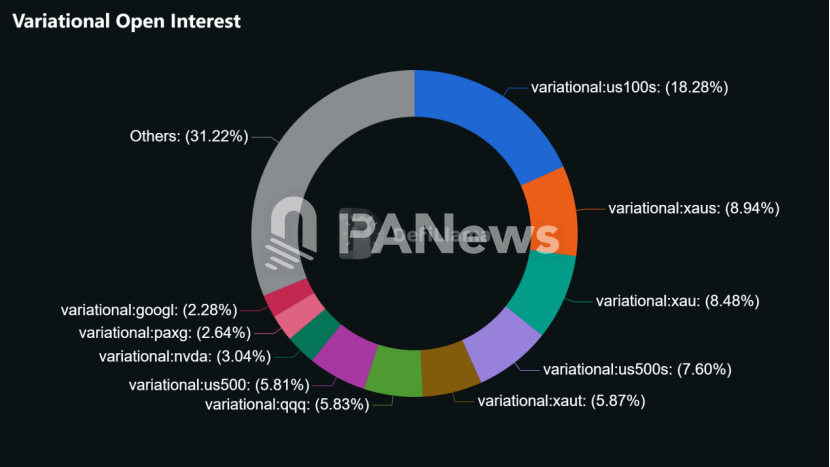
PANews cited DefiLlama derivatives-volume figures of $29.7 billion in August 2026, $59.1 billion in September and $77.8 billion in October—an increase of roughly 162% from August to October. It also reported more than $356 million in open interest across nearly 130 real-world-asset markets, including $165 million in equity-index open interest. The source did not give a separate measurement date for those open-interest figures.
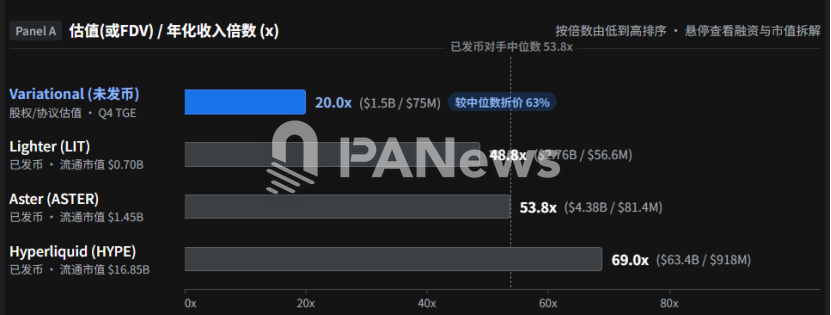
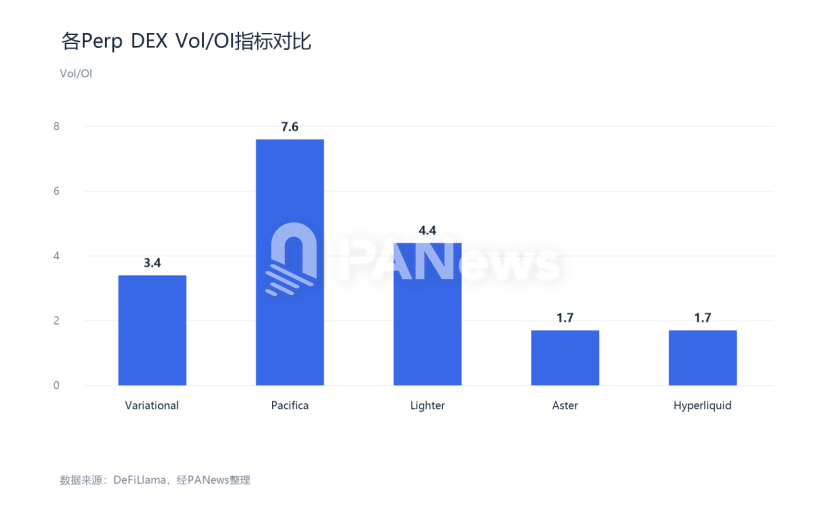
Variational disclosed $75 million in annualized net revenue, according to PANews. Annualization is a run-rate measure, not a full year of realized revenue. PANews also compared a roughly 3.4 daily volume-to-open-interest ratio for Variational with 7.6 for Pacifica, 4.4 for Lighter and 1.7 for each of Hyperliquid and Aster. It raised the possibility that points incentives affected trading activity; the ratios alone cannot establish how much volume reflects durable demand.
Where the OLP earns—and bears risk
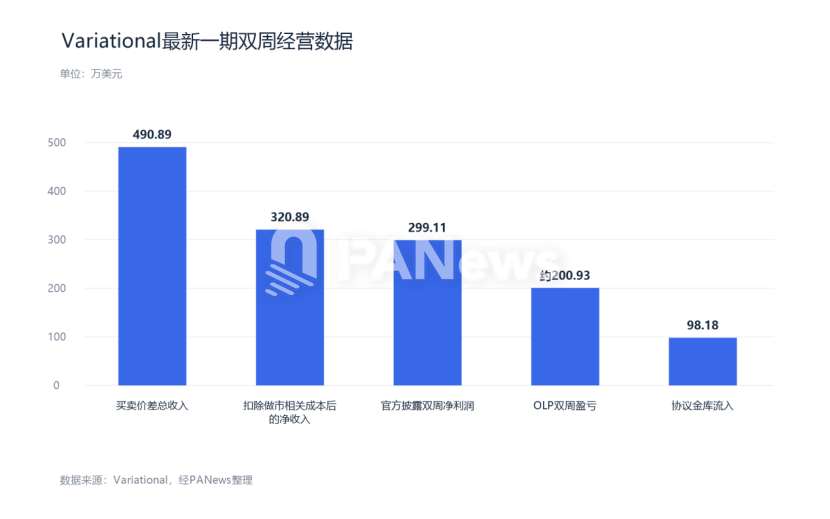
Instead of charging an explicit trading commission at the front end, the OLP quotes a bid and an ask. A trader’s cost can therefore appear in the spread between those prices. After accepting a trade, the OLP can hedge its exposure through centralized or decentralized exchanges or traditional-finance dealers. Its remaining spread, after hedging costs, is the potential profit. PANews said Variational’s November 13 biweekly operating figures put net profit at about 61% of gross bid-ask-spread revenue for that period.
This is not the same as cost-free trading. Nor does an on-chain position, by itself, establish that a dealer’s quote is competitive or that its off-chain hedge will remain available. Under the model described by PANews, users depend on a team-controlled OLP for quotes, risk management and settlement availability, without a replacement market maker in the venue’s order book.
The distinction matters for Variational’s Swap product. Here, “swap” means a USDC-settled derivative providing price exposure without ownership of the underlying asset—not a spot-token exchange. PANews described these contracts as having no fixed expiry and as supporting leveraged exposure to assets such as gold and indices. It said the OLP model aims to draw on traditional dealers’ liquidity and financing terms, unlike an order-book perpetual whose funding rate responds to conditions within that market. That is a description of the intended mechanism, not proof that every customer quote is better.
Why expanding capacity requires capital
Following the raise, co-founder Edward Yu said on X that Variational planned to increase Swap open-interest limits, improve liquidity, add tradable assets and expand into new asset classes. He also described a planned Pro version with a multi-dealer network for peer-to-peer-settled derivatives, including swaps, perpetuals and options. These are plans, not implemented capabilities established by the report.
PANews said Variational had signed more than $1 billion in institutional credit capacity in September 2026, while initially setting an approximately $10 million open-interest ceiling for each Swap market. The stated constraint reflects a central trade-off: an OLP acting as counterparty must support on-chain USDC margin and provide collateral to traditional institutions to obtain credit. Raising market limits therefore depends on more than attracting additional orders; it also depends on capital and functioning hedge and credit arrangements.
The token figures are scenarios, not proceeds
Variational’s token plan, announced in September 2026, allocated 32% of VAR’s total supply to a points-based genesis distribution, fully unlocked at its planned fourth-quarter token-generation event. Another 18% was allocated to an ecosystem reserve and 50% to the team and investors, according to PANews.
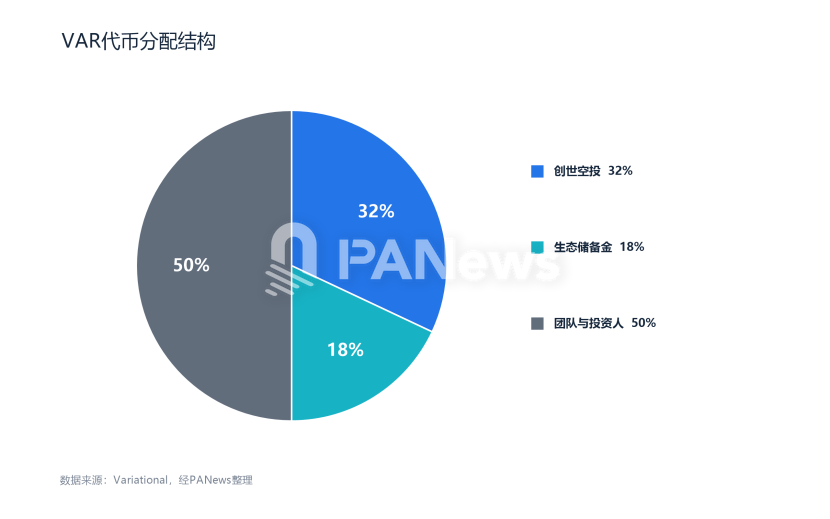
PANews multiplied the 32% genesis allocation by the round’s $1.5 billion valuation to describe a hypothetical $480 million of immediately unlocked tokens. That arithmetic assumes the financing valuation can be used as the token’s fully diluted valuation; an equity financing does not establish a token trading price or the amount holders will sell. The report also cited a $1.43 billion implied median first-day fully diluted valuation on Polymarket and said 26% of funds in that market backed a value above $2 billion. Those are market-implied expectations, not realized prices.
The financing supports Variational’s effort to scale a capital-intensive dealer model. The evidence reported by November 19, 2026 shows rising volume and a broader set of markets, but leaves the decisive questions open: how competitive OLP quotes remain as positions grow, how reliably exposures can be hedged, and whether planned market capacity can be supported in practice.