As reported on November 19, 2026, a U.S. federal judge’s acquittal of Anton and James Peraire-Bueno had implications beyond their disputed Ethereum trades. BlackRock had identified the criminal case in the prospectus for its iShares Staked Ethereum Trust ETF as a risk to its staking program if MEV were ultimately found to violate applicable law. The ruling addressed a narrower question: whether the brothers made a materially false representation that supported the fraud charges.
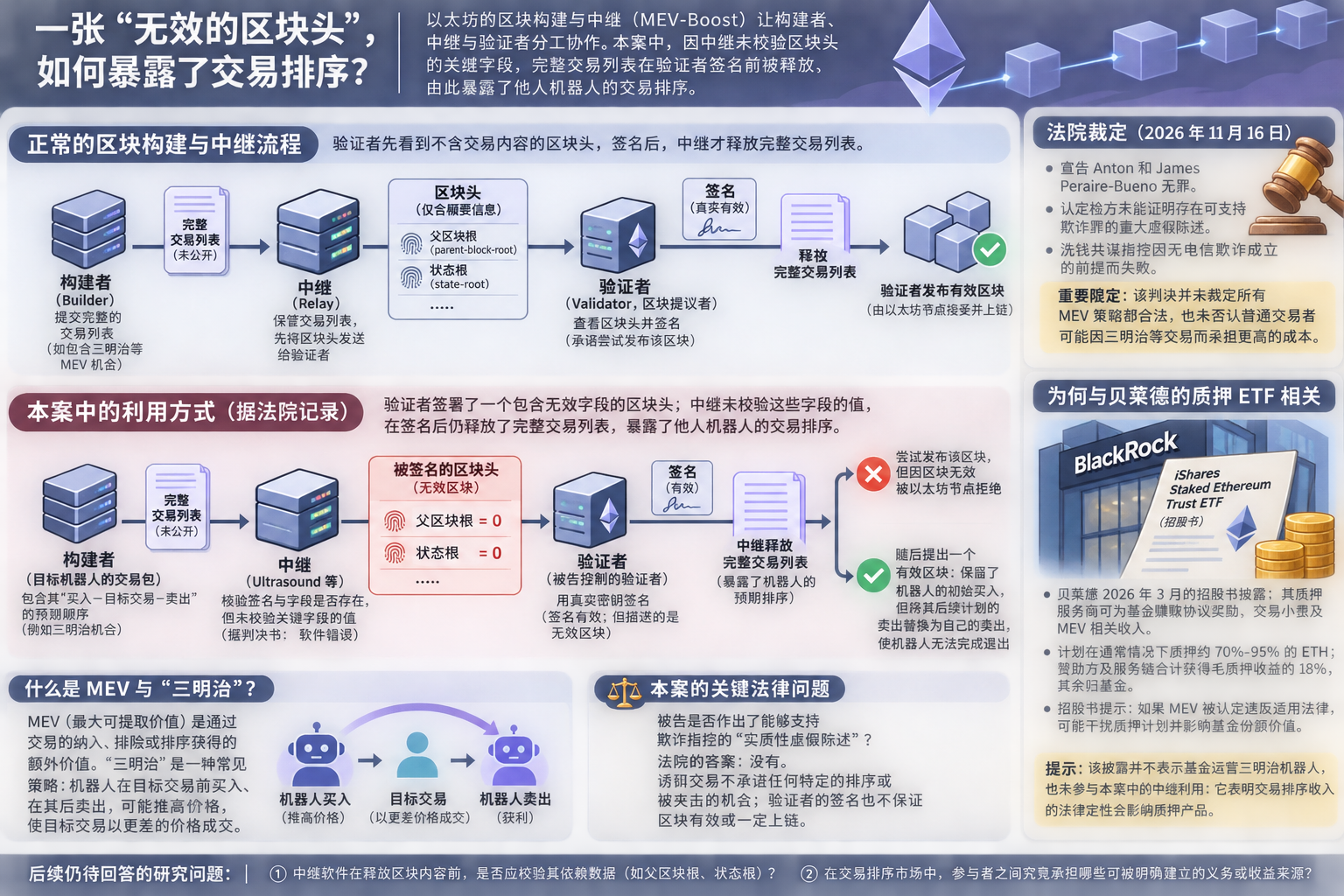
How the relay exposed a block’s contents
MEV, or maximal extractable value, is value obtained through the inclusion, exclusion or ordering of transactions. It encompasses different strategies. In a sandwich, a bot buys before a target trade and sells afterward, potentially leaving the target trader with a worse execution price.
According to the court record, three professional traders operating bots that sought sandwich opportunities submitted transaction bundles through Ethereum’s block-building system. In that system, a relay initially gives the validator proposing a block a header rather than the full transaction list. After the validator signs, the relay releases the contents. The arrangement is intended to let builders compete without revealing their transaction ordering before the validator’s commitment.
The court record says the brothers studied the bots, set up 16 validators and, on April 2, 2023, placed eight bait transactions in the public pending-transaction queue when one of their validators was due to propose a block. The bots submitted bundles built around those transactions.
The brothers then signed a block header whose parent-block root and state root had been set to zero. The signature was genuine, but the header described an invalid block. The Ultrasound relay checked the proposer’s signature and the presence of fields, but did not verify those two field values before releasing the full transaction list, according to the ruling. Ethereum nodes rejected the invalid block. Having seen the bots’ intended ordering, the brothers proposed a valid block that retained a bot’s initial purchase but replaced its planned sequence with their own sale, leaving the bot unable to complete its intended exit.
The original indictment characterized the episode as obtaining roughly $25 million in about 12 seconds. That is the prosecution’s account of the amount, not an independent civil accounting of each loss by the judge. At trial, one bot operator described an instance in which its algorithm was willing to exchange approximately $2.3 million in USDC for SHIB worth about $8.25 at the prevailing price because it expected an immediate, more favorable resale.
What the acquittal did—and did not—decide
Prosecutors charged the brothers in May 2024 with wire fraud, conspiracy to commit wire fraud and conspiracy to commit money laundering. A nearly four-week trial ended in a mistrial in 2025 when the jury could not reach a unanimous verdict. After a bench trial, the judge acquitted them on November 16, 2026.
The prosecution argued that the bait transactions implied they would be executed in the expected bundle, and that signing the header promised publication of the corresponding block. The judge rejected both proposed representations. A transaction in the public queue did not promise anyone an opportunity to sandwich it or guarantee a particular ordering. Nor did the validator’s signature guarantee that the block was valid or would reach the chain. The relay operator acknowledged the missing field validation as a software error, according to the ruling.
The judge also found that concealing a strategy, exploiting that error and subsequently moving funds could not substitute for the material false representation required for wire fraud. In this case, the money-laundering conspiracy charge depended on proceeds from the alleged wire fraud and failed with that predicate. The decision was not a ruling that every MEV strategy is lawful, or that ordinary traders suffer no costs from sandwiches.
Why a staking fund disclosed the risk
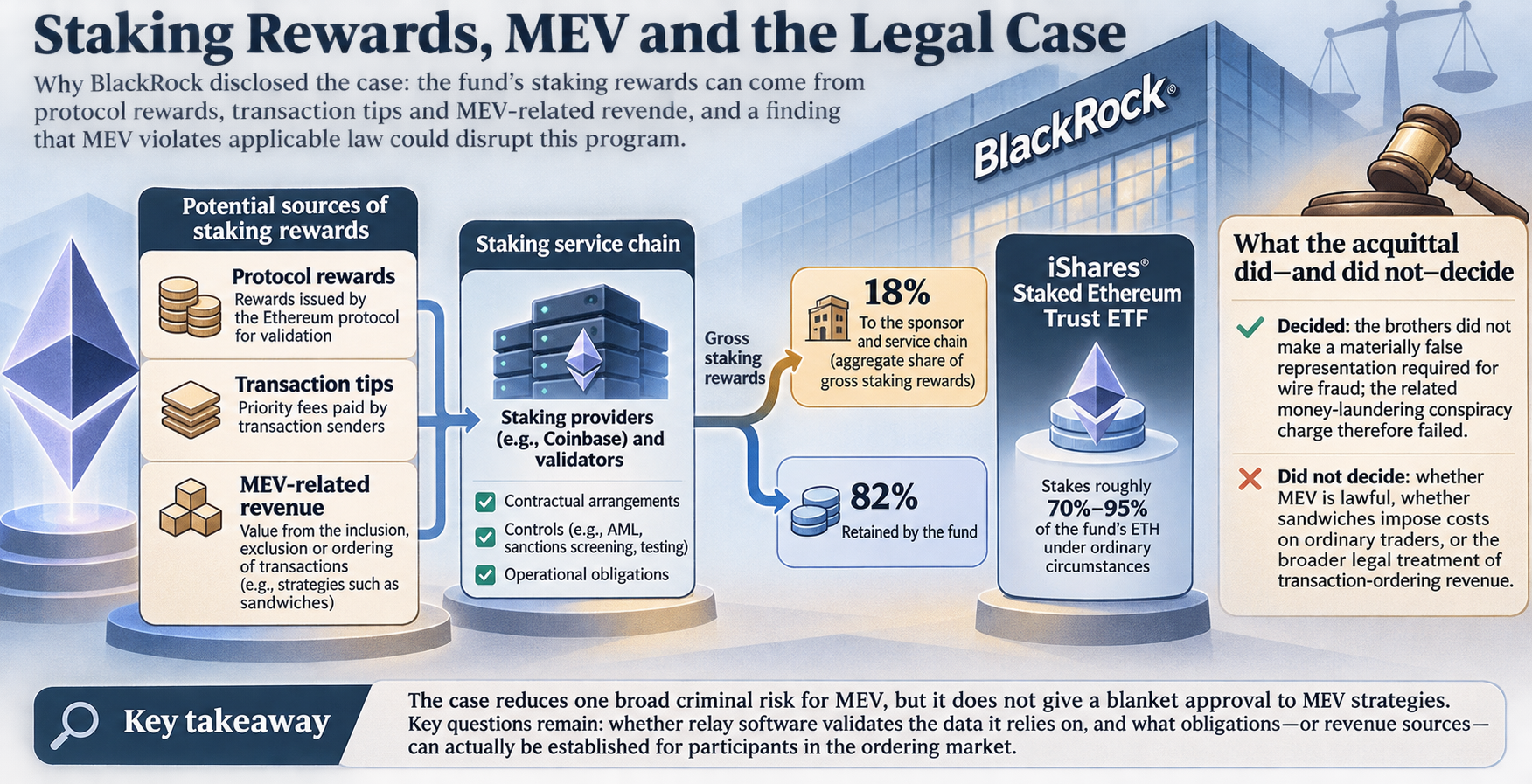
BlackRock’s March 2026 prospectus says its staking providers may earn protocol rewards, transaction tips and MEV-related revenue for the fund. It anticipates staking roughly 70%–95% of the fund’s ETH under ordinary circumstances and says the sponsor and service chain together receive 18% of gross staking rewards, with the remainder retained by the fund. The prospectus warns that a finding that MEV violates applicable law could disrupt staking and affect share value.
That disclosure does not say the fund operates sandwich bots or took part in this relay exploit. It does show why the legal treatment of transaction-ordering revenue matters to a staking product. The prospectus does not establish which strategies generate each portion of its MEV revenue.
There is also a distinction between a protocol signature and a contractual obligation. BlackRock’s staking arrangements call for legally binding commitments between Coinbase and validators, including specified controls concerning anti-money-laundering measures, sanctions-address screening and testing. The prospectus still warns that failures to perform, recovery costs and staking losses may fall on the fund and its holders. In the criminal case, by contrast, prosecutors did not establish that signing the disputed header made the particular promise on which their fraud theory depended.
The case therefore leaves two separate research questions: whether relay software validates the data it relies on before releasing a block’s contents, and what obligations—or revenue sources—can actually be established for participants in the ordering market. The acquittal answered the charged fraud question; it did not resolve either issue for MEV as a whole.