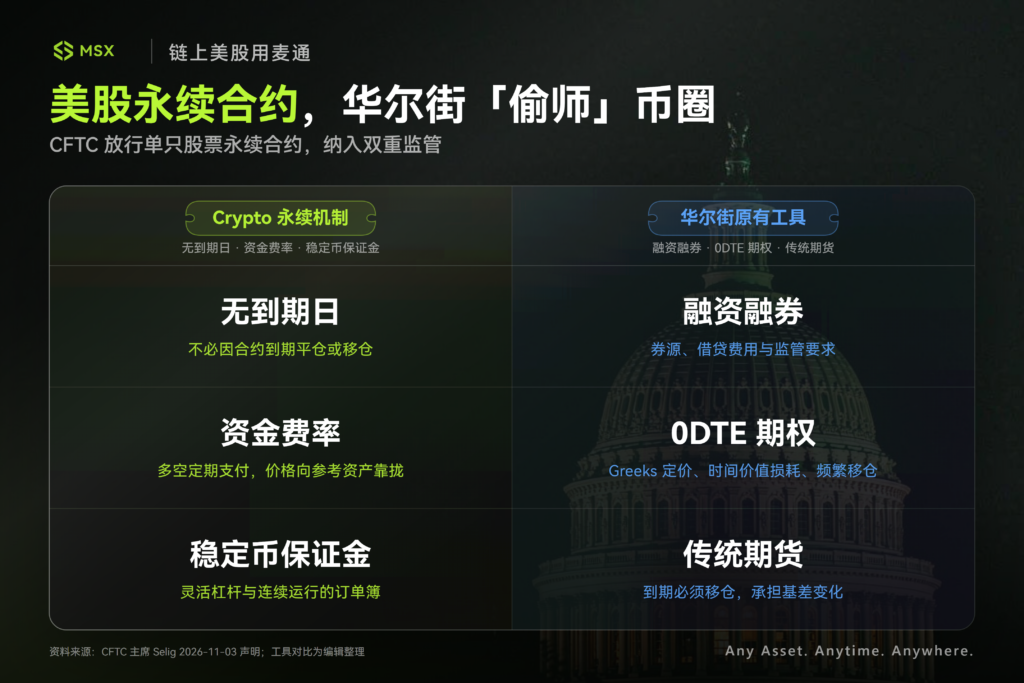
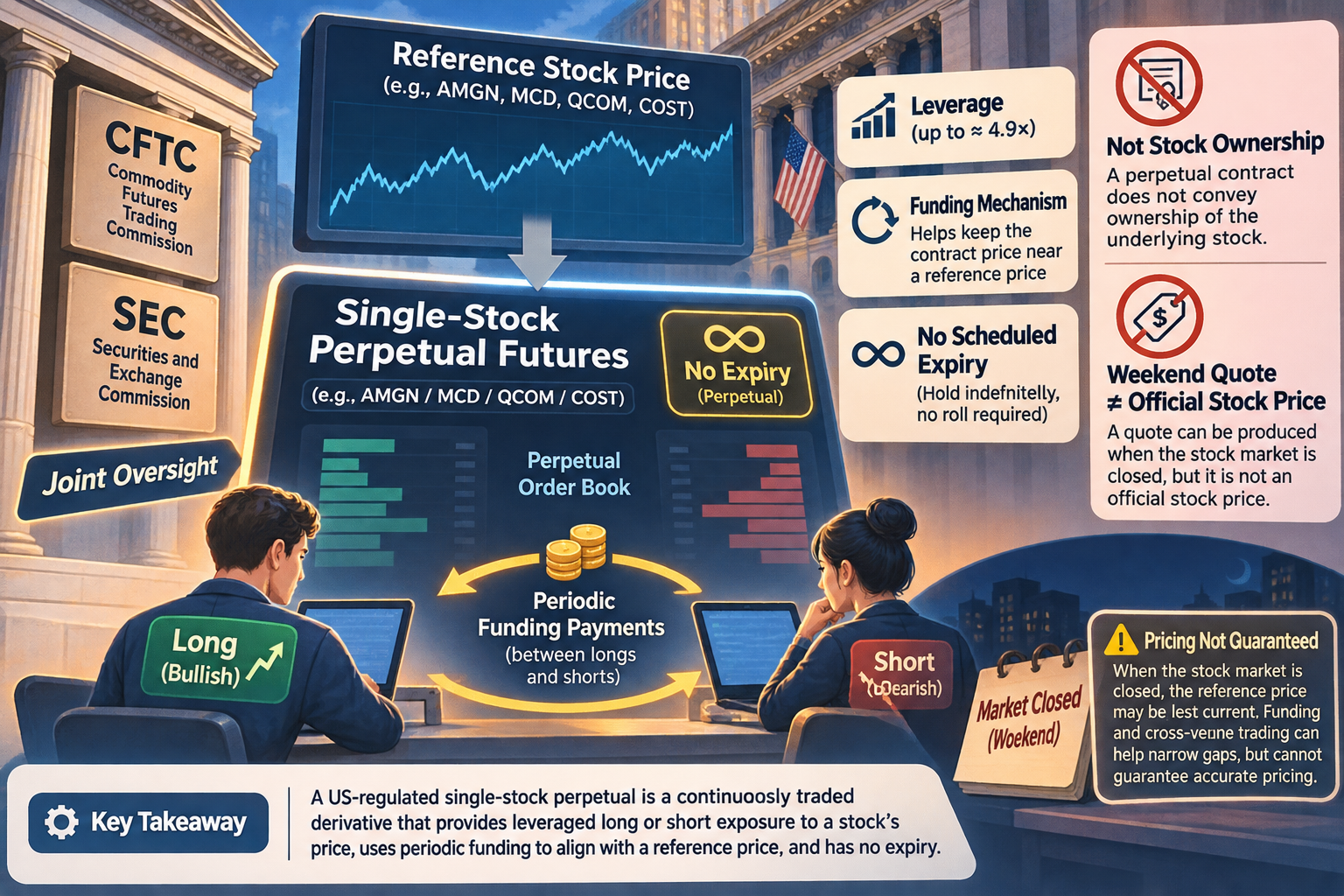
As reported on November 5, 2026, single-stock perpetual futures had begun trading on a US-regulated venue. On November 3, Commodity Futures Trading Commission (CFTC) Chair Mike Selig said the contracts fall under the securities-futures framework and are subject to both CFTC and Securities and Exchange Commission (SEC) oversight. Kalshi began offering perpetual contracts referencing Amgen, McDonald’s, Qualcomm and Costco that day, with maximum leverage of approximately 4.9×.
The development brings a contract structure familiar to crypto traders into a regulated US setting. It does not mean that a perpetual contract conveys ownership of the stock it references, or that a weekend contract quote is an official stock price.
The mechanism and its limits
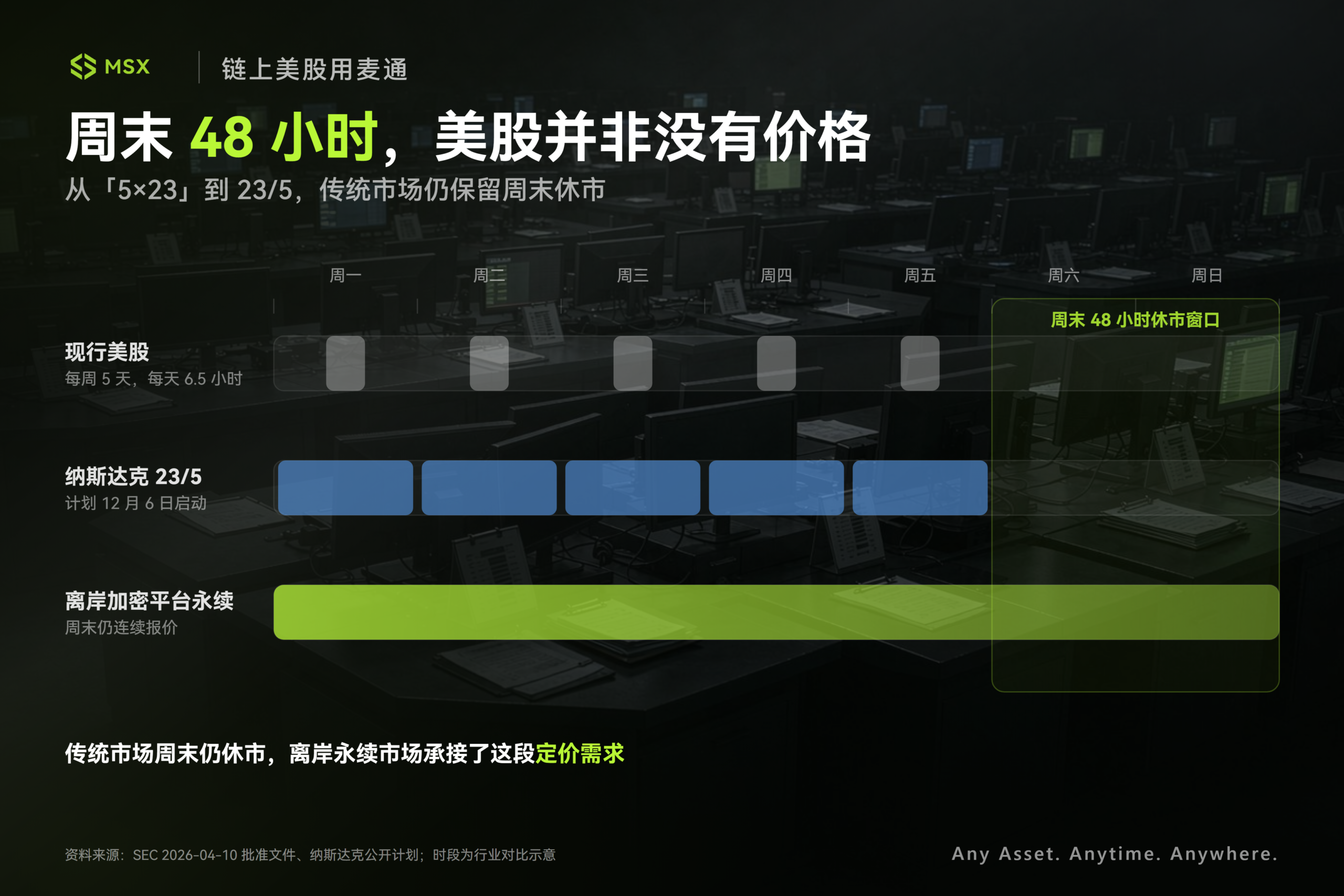
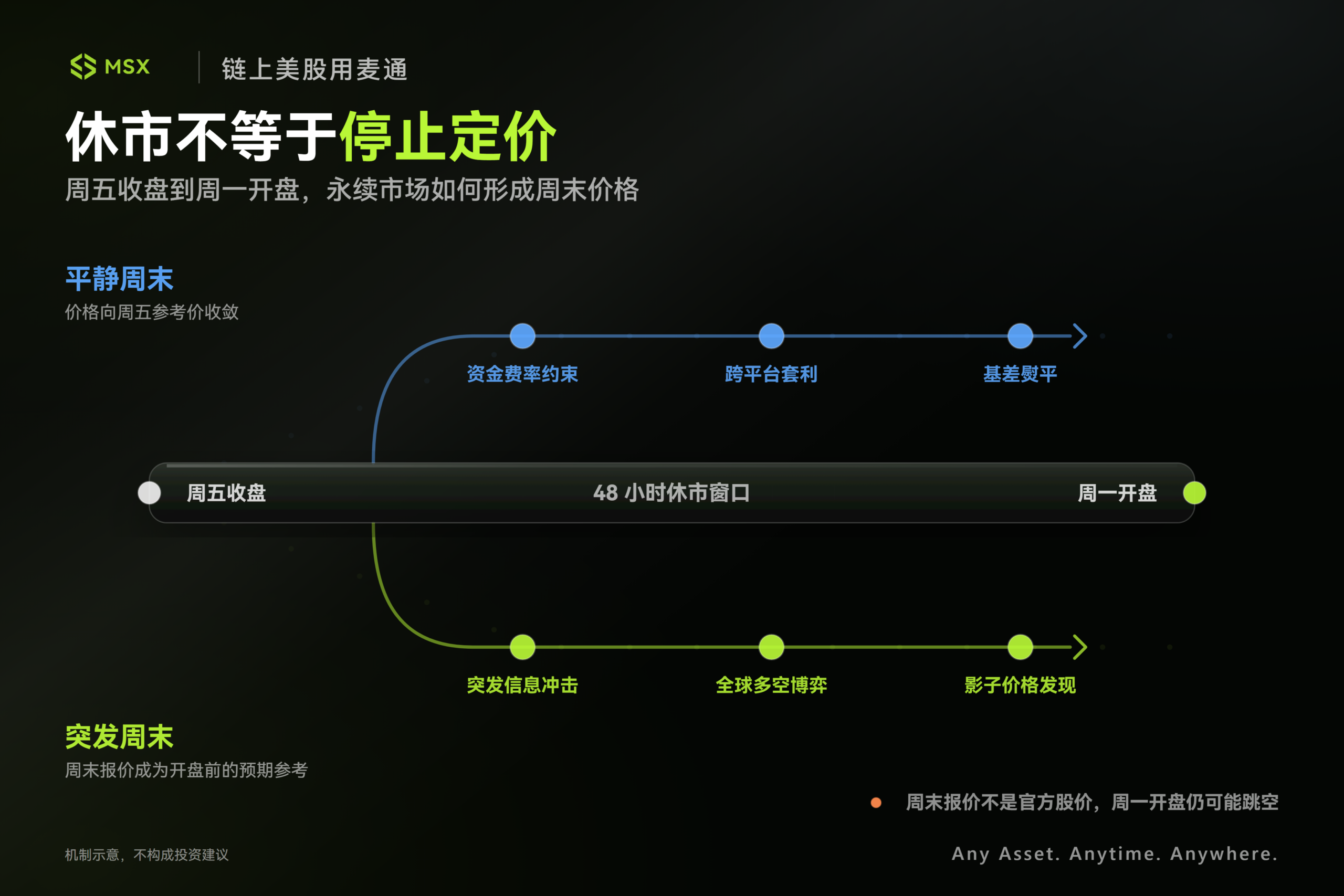
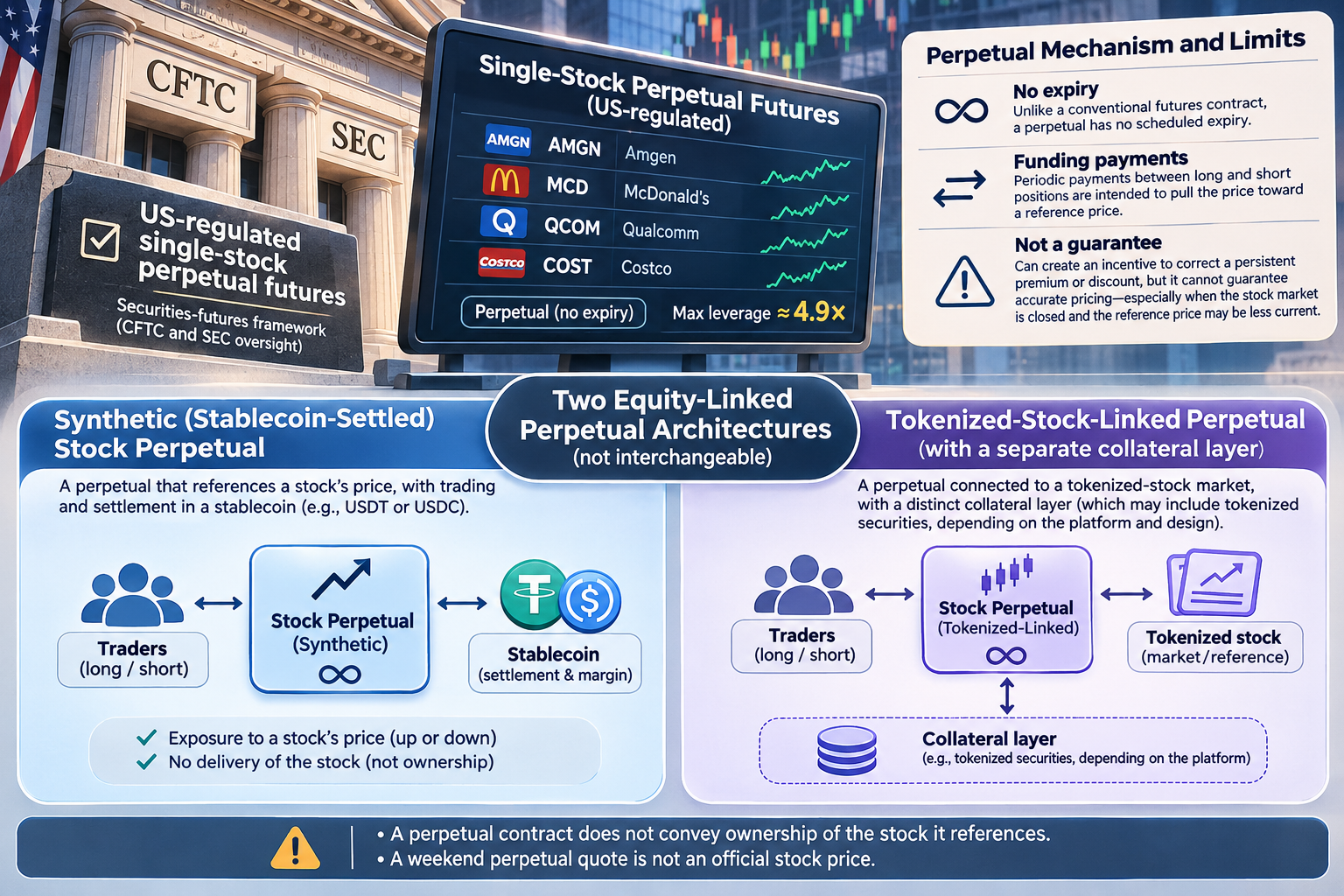
Unlike a conventional futures contract, a perpetual has no scheduled expiry requiring a holder to roll the position. Periodic funding payments between long and short positions are intended to pull its price toward a reference price. That mechanism can create an incentive to correct a persistent premium or discount, but it cannot guarantee accurate pricing—particularly when the underlying stock market is closed and the reference price may be less current.
The distinction matters for equity-linked products. Some platforms offer synthetic stock perpetuals settled in stablecoins: traders take long or short exposure to a stock’s price without delivery of the share. Other product designs connect perpetual trading to tokenized-stock markets or explore tokenized securities as collateral. These are different claims about the trading and collateral architecture, not interchangeable descriptions of stock ownership.
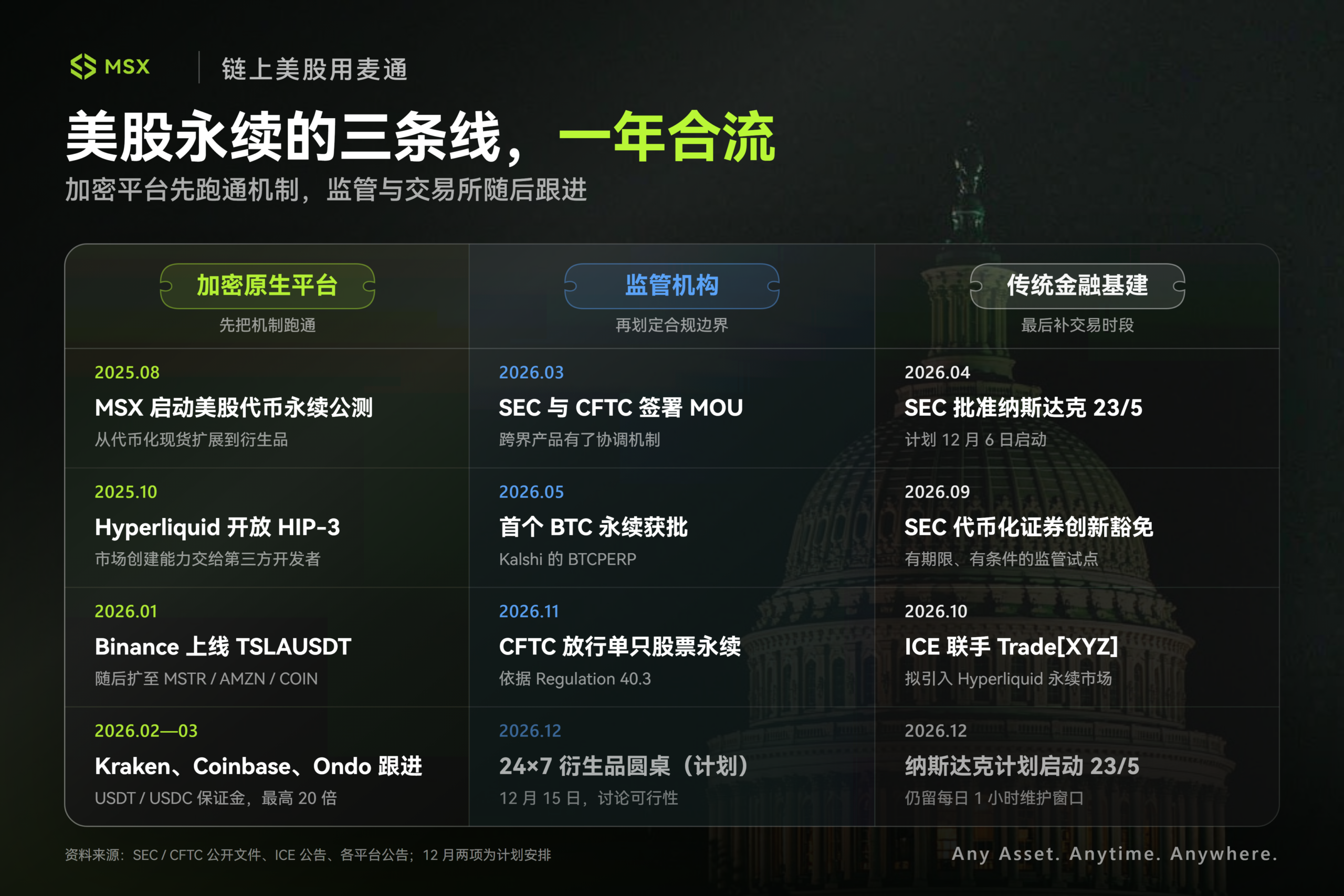
Selig’s November 3 explanation placed US single-stock perpetuals within the securities-futures category under the Commodity Futures Modernization Act of 2000. According to the account, an eligible venue must be a CFTC-registered designated contract market and have the SEC notification registration needed for a national securities exchange to trade securities-futures products. That jurisdictional arrangement follows an SEC–CFTC cooperation memorandum signed on March 11, 2026. It is also distinct from the CFTC’s May 29 approval of KalshiEX’s Bitcoin perpetual, BTCPERP: Bitcoin and single-stock references raise different regulatory questions.
What the reported volumes measure
Crypto venues had already expanded perpetual trading beyond cryptoassets. The reported launches include Binance stock perpetuals using USDT for margin and settlement, Kraken’s xStocks-based contracts for eligible non-US users, and Coinbase stock perpetuals settled in USDC for eligible non-US users. Ondo Finance announced Ondo Perps in February 2026 and launched the platform in July; its stated exploration of tokenized securities as collateral should not be treated as evidence that every proposed collateral arrangement was implemented.
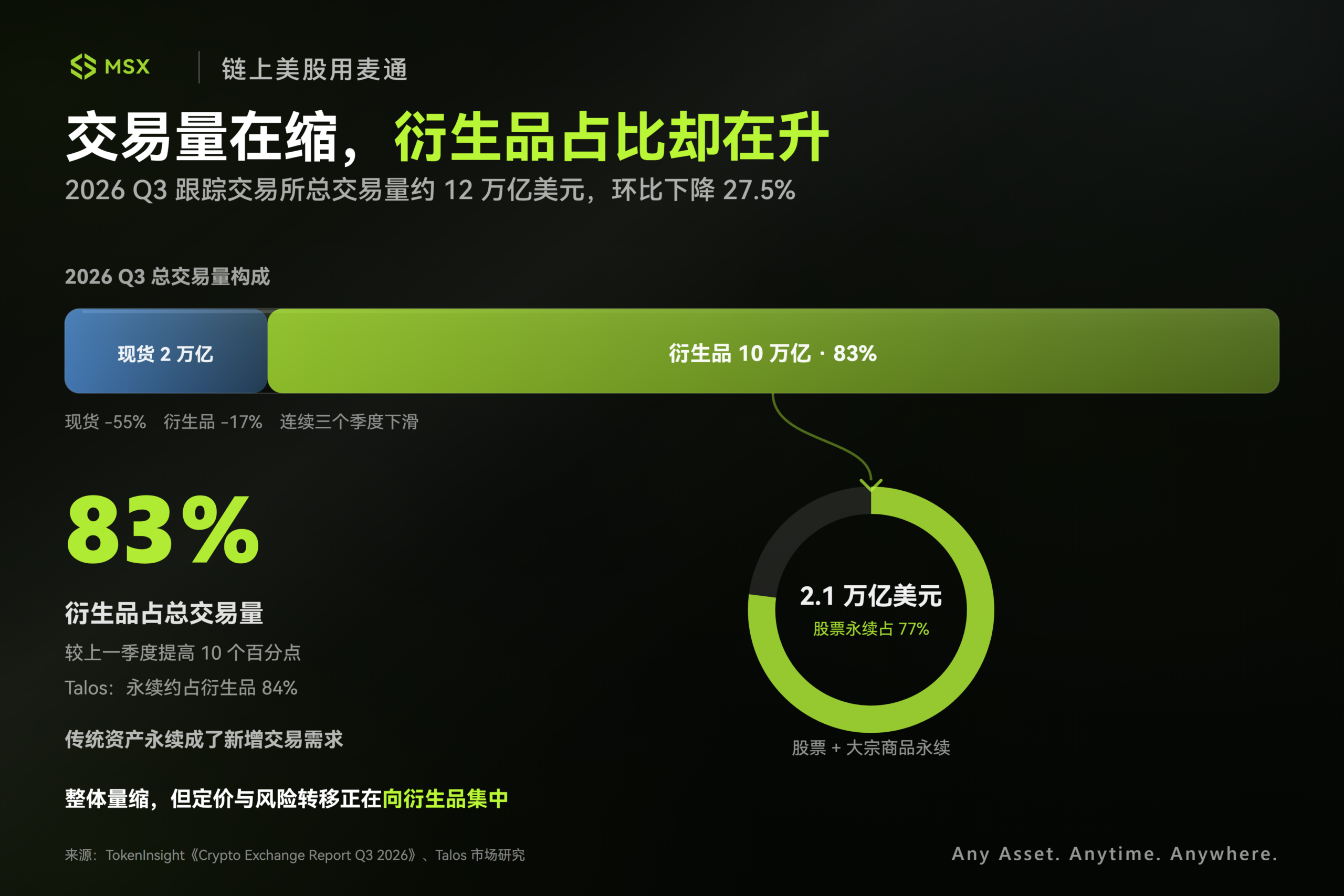
The scale figures require careful separation. Citing The Block, the original report says perpetuals accounted for approximately 75% of centralized crypto-exchange trading volume in 2025, with annual volume approaching $49 trillion. A separate TokenInsight third-quarter 2026 exchange report puts all derivatives, not perpetuals alone, at 83% of volume in its tracked exchange sample. That sample recorded approximately $12 trillion in total quarterly volume, down 27.5% quarter on quarter: spot volume was approximately $2 trillion, down 55%, while derivatives volume was approximately $10 trillion, down 17%.
For nine exchanges covered in TokenInsight’s stock-and-commodity perpetual tally, third-quarter volume totaled approximately $2.1 trillion. Stock perpetuals accounted for approximately $1.61 trillion, or 77% of that subtotal; commodity perpetuals accounted for approximately $491 billion. These are reported trading-volume measures for specified samples and periods, not on-chain holdings or a valuation of the underlying assets. The figures show activity in traditional-asset contracts alongside falling overall sample volume; they do not, by themselves, establish why platforms expanded into those contracts.
The unresolved test: pricing when stocks are closed
A continuously traded stock perpetual can produce a weekend quote, but its connection to the next US stock-market opening is conditional. The report describes Coinbase using external equity-price sources, including Pyth and Blue Ocean ATS, during normal hours, then an internal index incorporating a moving average of perpetual mark prices and available tokenized-stock quotes during some closed periods. Funding and trading across venues may help narrow discrepancies. Neither provides a continuously available spot-stock hedge on weekends; liquidity, margin, funding costs and an opening price gap remain risks.
Traditional-market participation is also still partly prospective. On October 29, Intercontinental Exchange (ICE) announced a planned collaboration with Trade[XYZ] to bring markets based on Hyperliquid perpetual infrastructure to the US. The proposed regulated trading and clearing arrangements still require regulatory approval. Separately, the report says Nasdaq’s approved five-day, 23-hour trading schedule was expected to start on December 6, while a CFTC roundtable on around-the-clock derivatives trading was scheduled for December 15. As of the original November 5 reporting date, neither was an operating 24/7 US stock market.
The research question is therefore narrower than whether traditional finance has adopted crypto’s entire market structure: regulated single-stock perpetuals were available, while broader market-hour changes and the ICE collaboration remained pending. Whether perpetual quotes become reliable price references outside stock-market hours depends on the quality of the reference prices, liquidity and the ability to hedge—not merely on keeping a contract order book open.