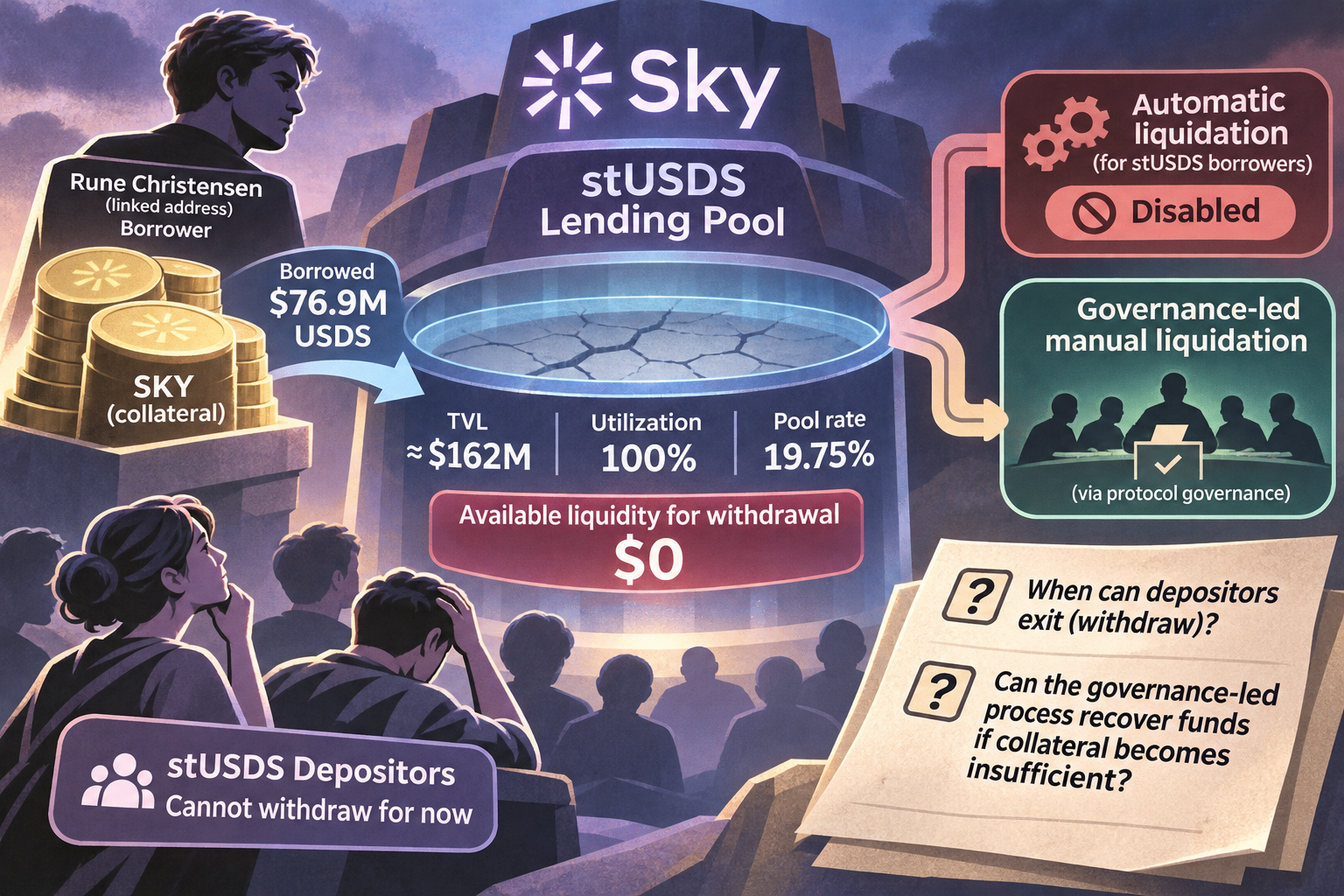
As reported on November 19, 2026, Sky’s stUSDS lending pool had no liquidity available for immediate withdrawals. A loan attributed to an address linked to Sky co-founder Rune Christensen accounted for a substantial share of the pool’s outstanding borrowing. The case raises two distinct questions: when depositors can exit, and how the protocol handles collateral risk while automatic liquidations are disabled.
What the pool data showed
Community user @punkquidity said an address linked to Christensen had borrowed $76.9 million in USDS against SKY collateral, with no principal repaid over the preceding six months. According to that account, the debt represented nearly 48% of all funds borrowed from the stUSDS pool. The loan has no maturity date, so the absence of principal repayments does not, by itself, breach the protocol’s rules.
@punkquidity also reported that the pool had lacked withdrawable funds for several days: the last freely withdrawable funds were taken on the evening of November 10. The user described a similar period of near-zero available liquidity on October 31, before withdrawals became available again that evening.
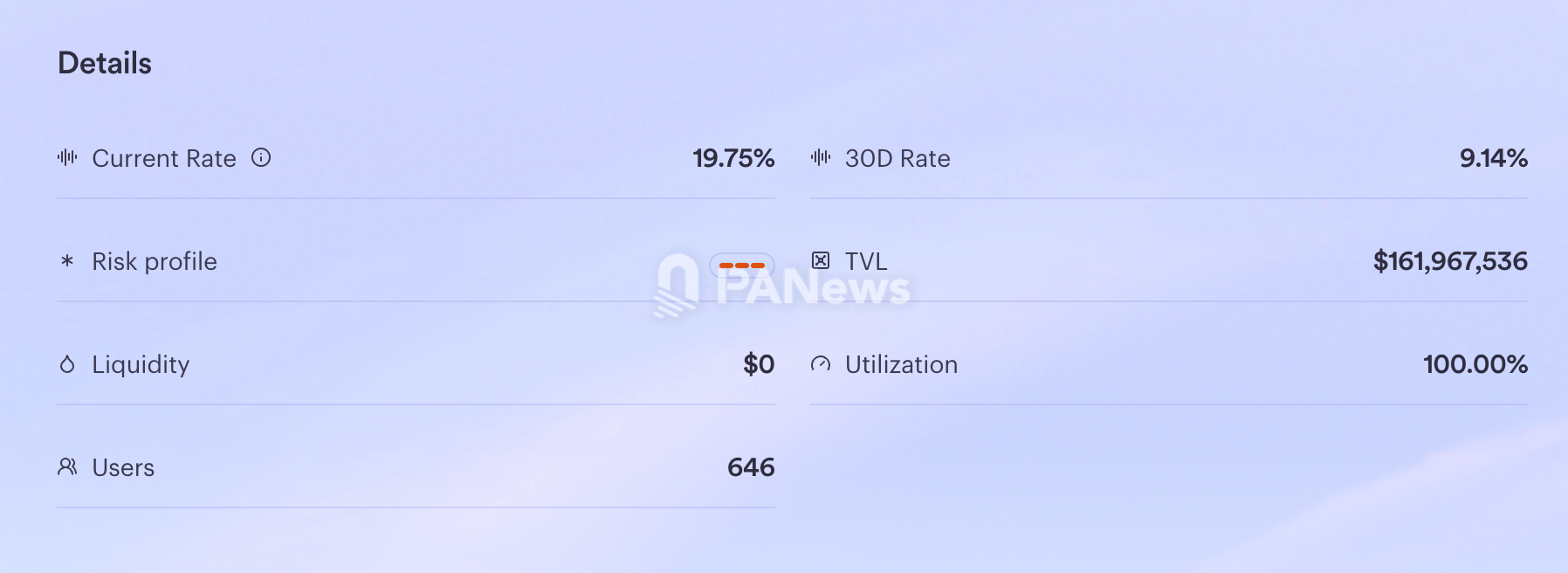
Sky’s website showed approximately $162 million in total value locked, 100% utilization, zero liquidity available for immediate withdrawal and a pool rate of 19.75% as of November 19. Depositors seeking to redeem would therefore have to wait for loan repayments or new funds to enter the pool. A higher rate might encourage either response, but it does not itself supply funds for withdrawals.

Collateral risk without automatic liquidation
The report initially described the SKY pledged against the loan as worth roughly $185 million. It separately estimated the collateral’s value at about $172 million using the then-current market price—approximately 2.2 times the debt. Those market-value figures should not be confused with the valuation used to assess the loan’s liquidation thresholds.
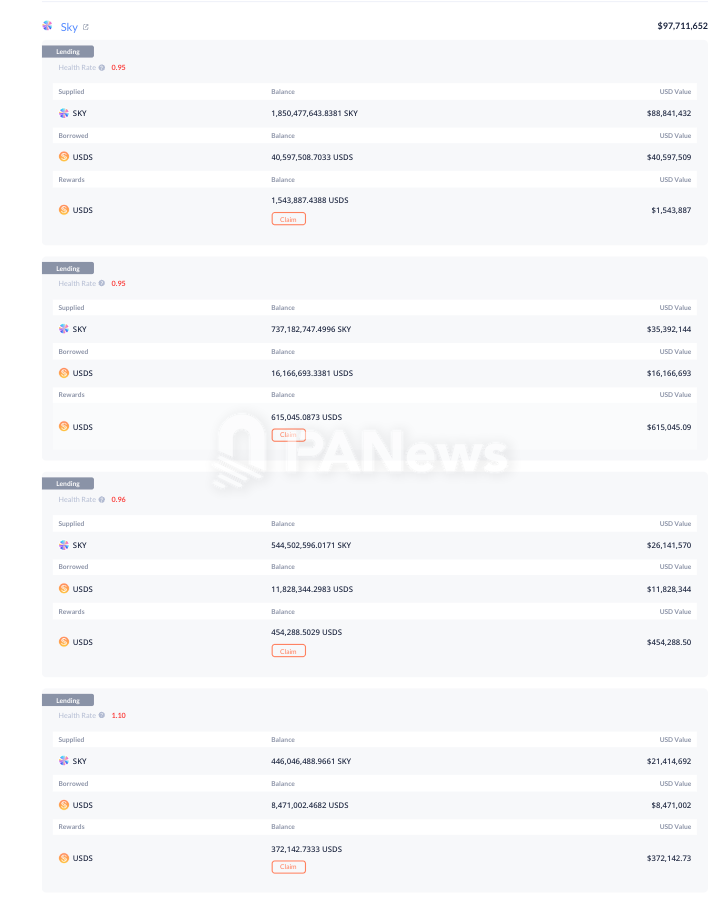
According to DeBank data cited in the report, three of the linked wallet’s four collateral positions had health factors below 1 when assessed using Sky’s valuation of no more than $0.025 per SKY for this loan. Sky had disabled automatic liquidations for stUSDS borrowers, so those positions would not be forcibly liquidated through that mechanism.
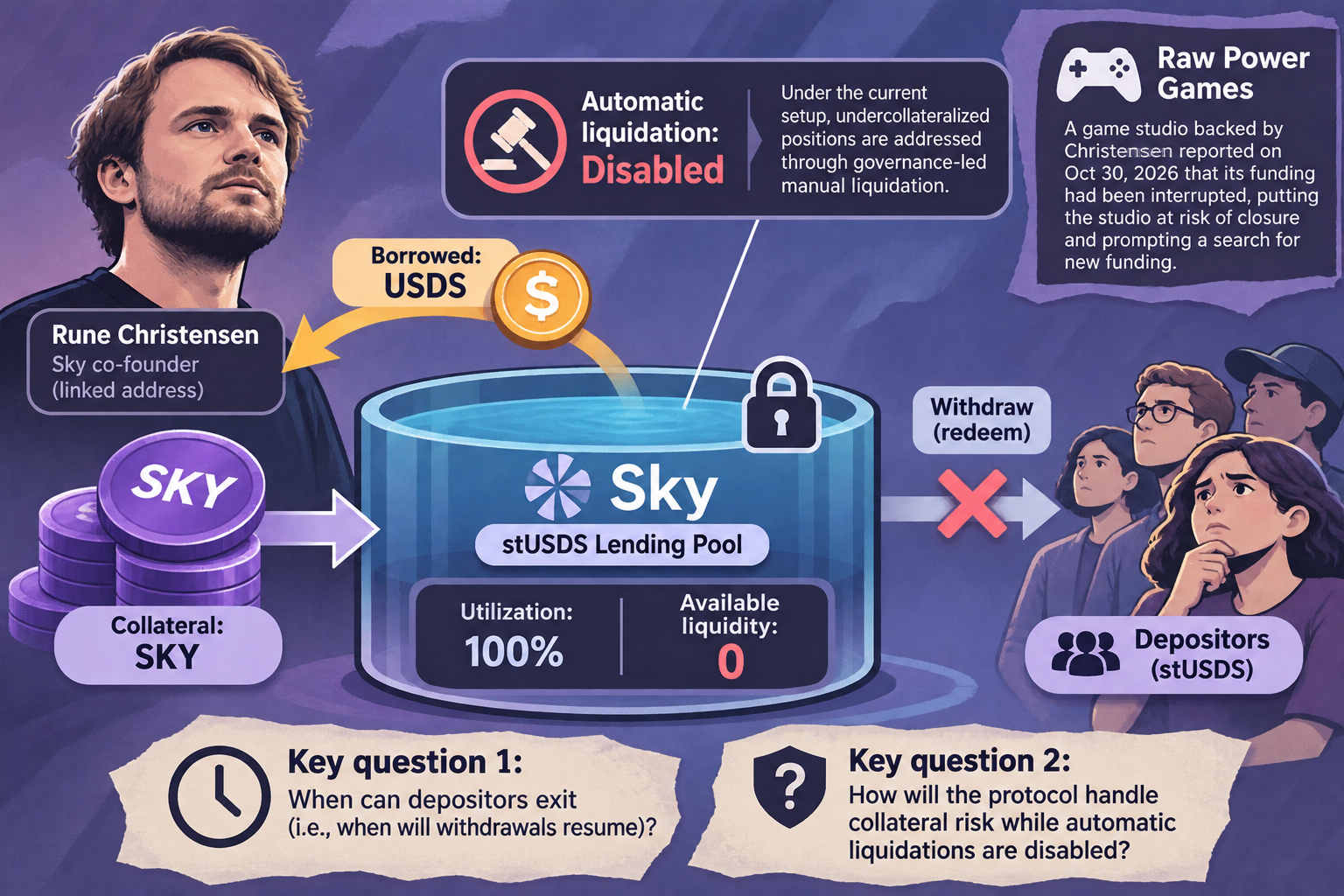
This was not described as a recent change. In September 2025, while preparing to launch stUSDS, Sky said liquidation for LSEV2-SKY-A had not been enabled because most MKR had yet to migrate to SKY and market liquidity was insufficient. Its stated approach was to avoid market disruption and liquidation-system failure, leaving undercollateralized positions to be addressed through governance-led manual liquidation. The unresolved risk is whether that process can recover funds if collateral becomes insufficient; the reported health factors alone do not establish an eventual loss.
Claims about the borrower’s motives
Some market participants characterized borrowing against SKY rather than selling it as a form of indirect cash-out: it provides USDS liquidity while the borrower retains ownership of the pledged tokens. That describes the transaction’s possible economic effect, not evidence of how the borrowed USDS was used.
Speculation intensified amid financial difficulties at Raw Power Games, a game studio backed by Christensen. On October 30, 2026, the studio said funding needed for its project had been interrupted, putting the studio at risk of closure and potentially preventing further development of Chronicles: Medieval. It said it was seeking new funding; it did not announce a confirmed bankruptcy in the statement described by the report. The report also said Coffee Stain had recently announced an approximately $5.42 million purchase of Raw Power Games’ intellectual property and would take over development of related projects. It found no evidence that USDS borrowed from Sky had funded the studio.
For stUSDS depositors, the observable constraint on November 19 was narrower than the speculation about motive: all available pool liquidity was in use, while a large loan remained outstanding and automatic liquidation was unavailable. Whether withdrawals resume depends on funds returning to the pool; the borrower’s intentions and any eventual credit loss remain unproven.