
Circle’s third-quarter 2026 results present two different pictures of its business. Reported profit rose sharply, helped by Arc token presales. Meanwhile, average USDC circulation fell, and the company’s growing payment volume had not yet translated into separately disclosed, recurring payment revenue. This analysis reflects figures and estimates reported on November 17, 2026; it is not an update on subsequent results.
What drove the reported increase?
Circle reported $865 million in total revenue and reserve income for Q3, up about 23% from Q2. Reserve income declined from $668 million to $658 million, while other revenue rose from $34 million to $207 million. About $182 million of Q3 other revenue came from Arc token presales. Circle recognized roughly three-quarters of the presale revenue after the public mainnet launched and tokens were minted and delivered.
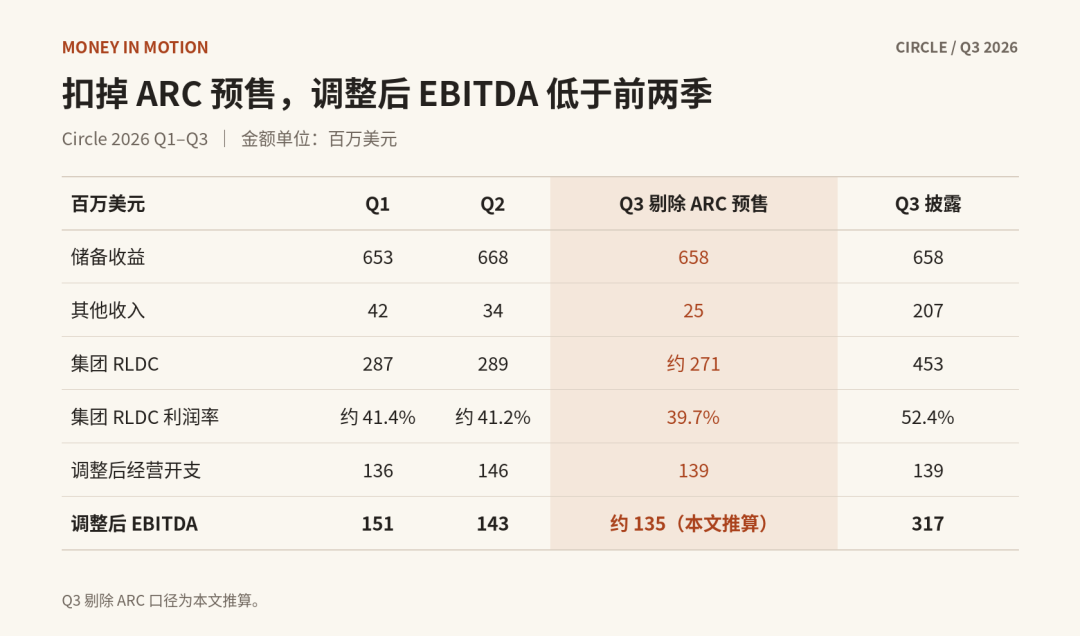
Adjusted EBITDA increased from $143 million in Q2 to $317 million in Q3. The source’s rough calculation subtracts the $182 million Arc presale amount directly from Q3 adjusted EBITDA, yielding about $135 million, below Q2’s $143 million and Q1’s $151 million. That subtraction is a way to test how much the presale affected the headline figure—not a company-reported, fully adjusted EBITDA measure. Excluding Arc presales, Q3 total revenue and reserve income were approximately $683 million.
The reserve business retained less income
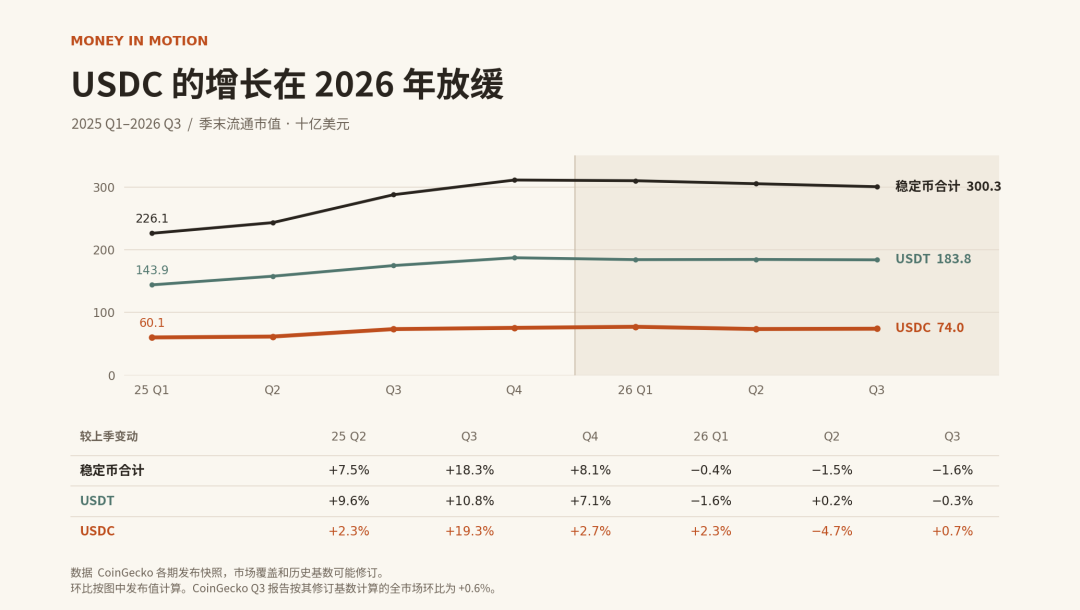
Circle’s Q3 average USDC circulation was $73.3 billion, down 4% quarter over quarter. A slightly higher reserve yield of 3.54% did not offset the smaller average balance. The relevant measure for quarterly reserve income is the quarterly average balance, not circulation at quarter-end.
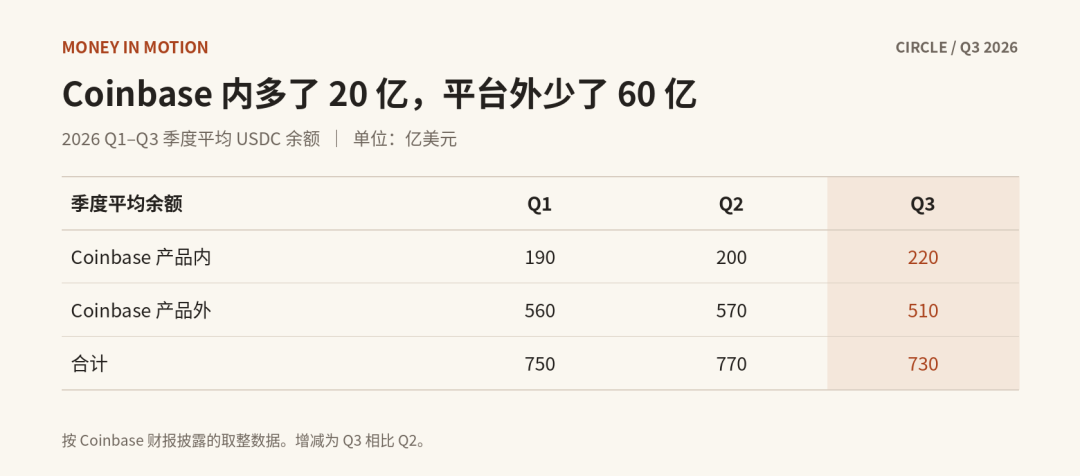
After related distribution and transaction costs, the source calculates that Circle retained $37.80 per $100 of reserve income, versus $38.60 in Q2. Circle’s CFO attributed much of the decline to a full quarter of the Hyperliquid partnership, with associated USDC balances held at Coinbase. Citing Coinbase’s rounded figures, the source says network-wide average USDC balances fell by $4 billion: balances in Coinbase products rose $2 billion, while balances outside the platform fell $6 billion. Those figures do not yet establish whether channel incentives will increase balances outside Coinbase over time. The renewed Binance distribution agreement was expected to affect a full quarter only in Q4.
Payment throughput is not yet a disclosed fee stream
Circle Payments Network (CPN) connects financial institutions for stablecoin-based cross-border settlement. Its annualized payment volume at quarter-end rose from $8.3 billion in Q1 to $14.7 billion in Q2 and $41.3 billion in Q3. The Q3 figure extrapolates roughly $3.4 billion processed in the preceding 30 days; it is not a full year of observed payments.
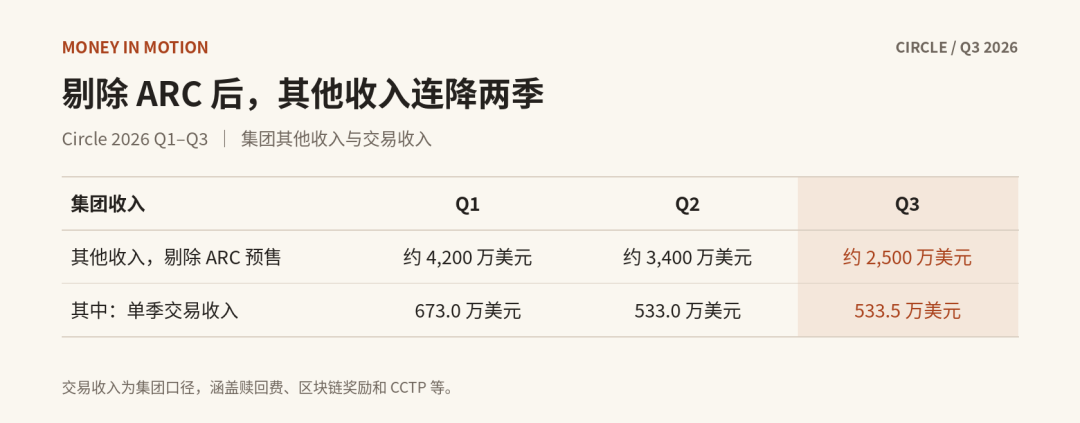
At an assumed 5 basis-point fee—0.05%—the Q3 exit rate would imply about $20.65 million in annual revenue. Circle did not disclose CPN fees separately. Its reported transaction revenue also includes redemption fees, blockchain rewards and digital-asset transaction infrastructure, including CCTP. The calculation therefore cannot establish what CPN actually charged or collected.
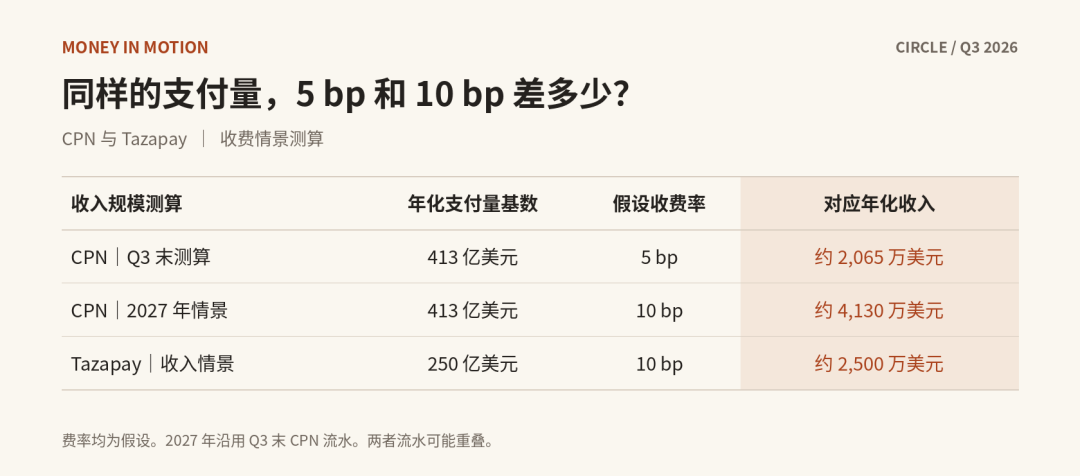
Circle also proposed acquiring the Tazapay shares it did not already own for approximately $400 million in stock, subject to closing adjustments. Tazapay, already a CPN design partner, reported annualized payment volume above $25 billion, about 60% involving stablecoins. Its customer relationships and local payout network could expand Circle’s payment capabilities, but the acquisition was not yet completed. Applying an assumed 10 basis-point fee to CPN’s Q3 exit-rate volume gives about $41.3 million in annualized revenue. This is a scenario, not a forecast or a measurement of Tazapay revenue; CPN and Tazapay volumes overlap and must not be added together.
What the valuation range assumes
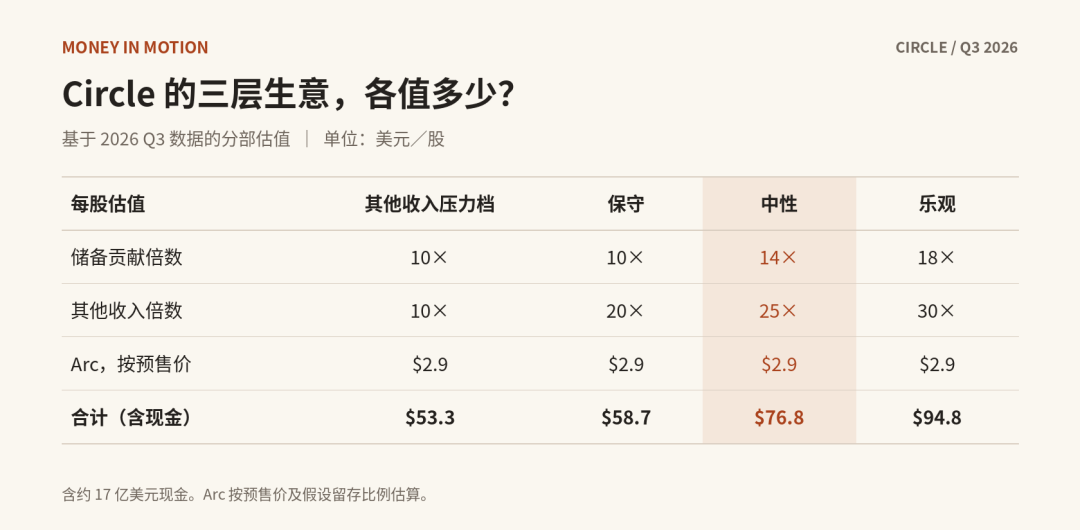
The source separates Circle into reserve operations, other revenue and an Arc token stake. Using approximately $984 million of annualized Q3 reserve contribution, a $138 million midpoint for adjusted full-year other-revenue guidance, about $1.7 billion in cash and roughly 256 million shares, it estimates a range of $59–$95 per share, with a midpoint near $77.
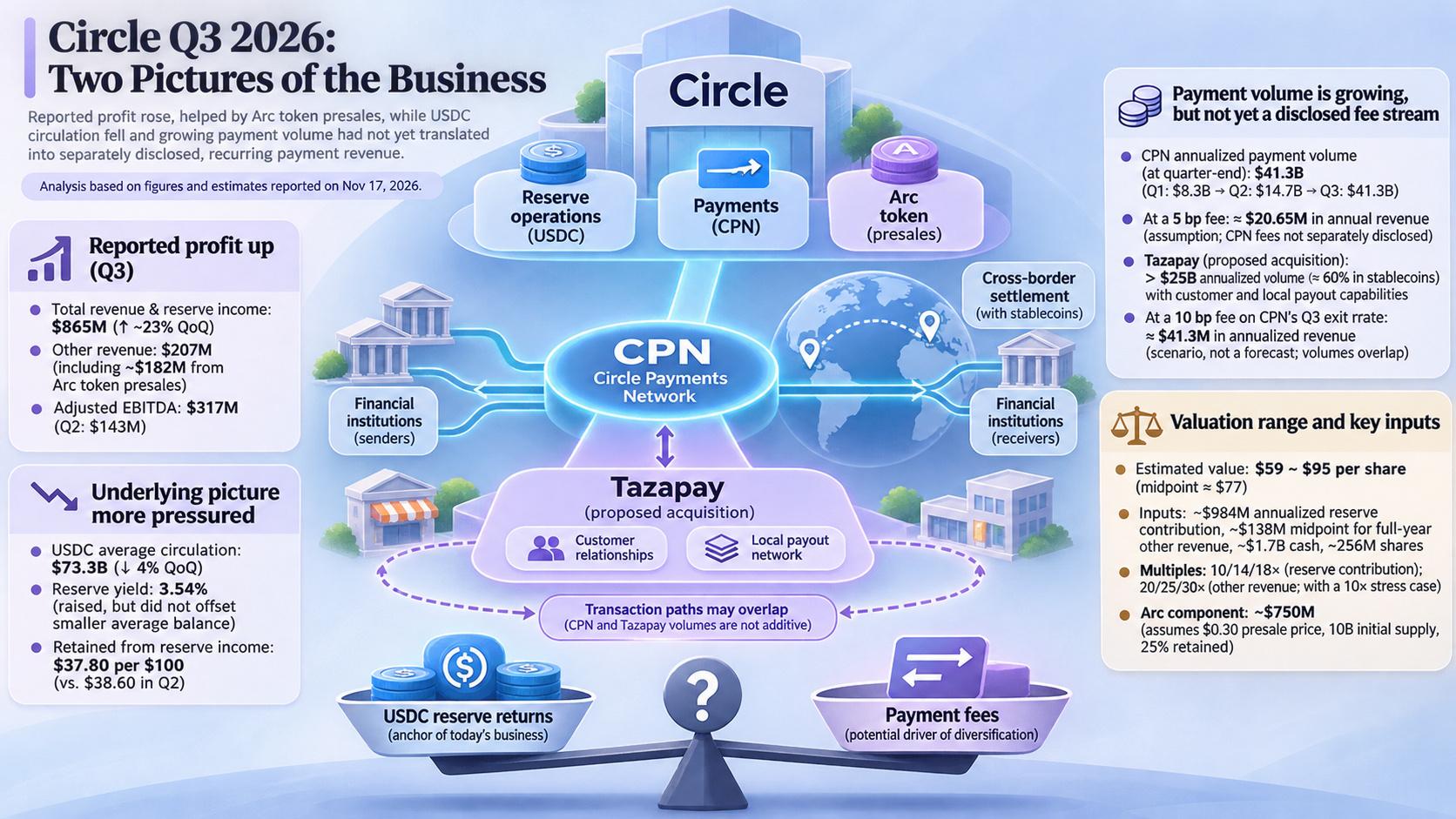
That range depends heavily on chosen multiples: 10, 14 or 18 times reserve contribution and 20, 25 or 30 times other revenue, with a separate 10-times stress case for other revenue. The reserve contribution used in the calculation is before corporate operating expenses and tax. The Arc component—approximately $750 million—assumes a $0.30 presale price, 10 billion tokens of initial supply and 25% retained after the sale. These are valuation inputs, not an independently established market value. The model excludes Tazapay’s potential earnings and newly issued acquisition shares; the proposed transaction was expected to close in 2027.
The central unresolved question is whether payment throughput becomes sustained, measurable fee income sufficient to diversify Circle beyond reserve returns. Q3 demonstrated volume growth, but its disclosures did not isolate the fees and costs needed to answer that question.